
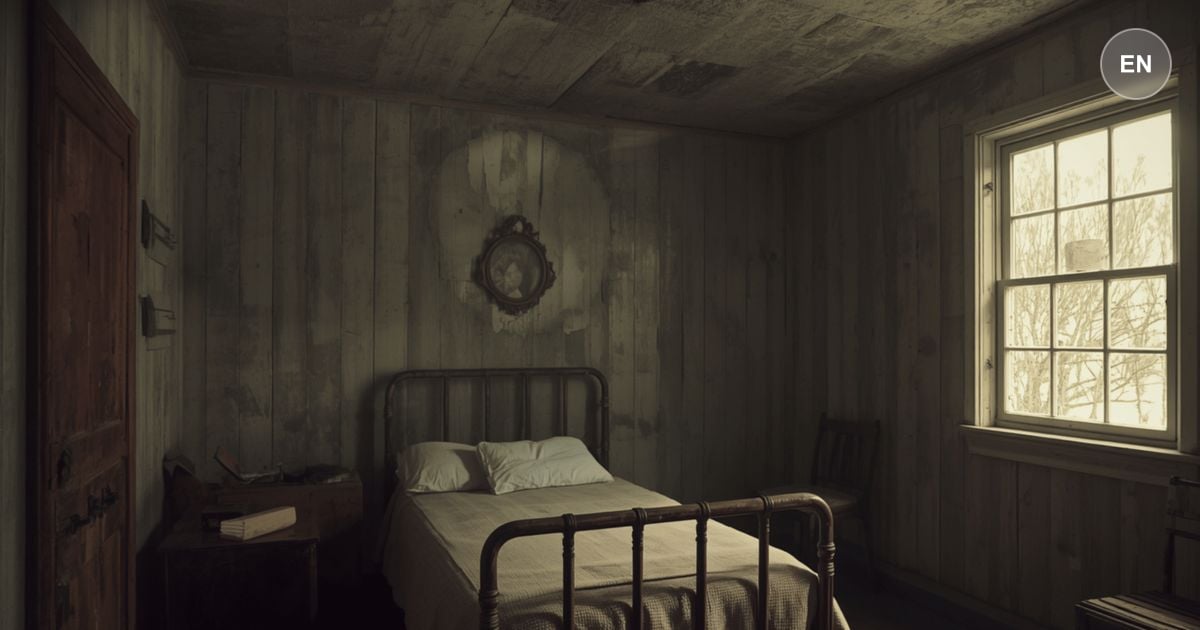
Offred walks back into a house that belongs to everyone but her. Rita takes the groceries without warmth. Cora asks a question that might be friendly or might be a test. Offred answers the way she has learned to answer: safely, blandly, with nothing real attached. The kitchen smells like bread and like a cage.
Atwood maps this household the way a prisoner maps a cell block. The sitting room is Serena Joy's territory, all blue upholstery and dried flowers. The Commander's study is forbidden unless Offred is summoned. Her own small room has been stripped of hooks, because hooks are what people use when they have nothing left. Even the architecture is a message about who matters and who does not.
Serena Joy is one of the novel's most painful portraits. She was once a television personality who preached traditional womanhood, a true believer who helped build the world now closing around her. She cannot have children. The state's solution was to give her a Handmaid, which is less an answer than an insult. Now she tends her garden and snips at flower stems with scissors, and Offred notices the way her hands move. The Wife wanted a family. She got Offred instead.
Nick, the young Guardian who lives above the garage, watches everything from a distance. At night, Offred can see the orange glow of his cigarette from her window, a small light in the dark. She does not know yet whether he is a spy, a rebel, or just a lonely person trying to survive. In Gilead, those three things are not always easy to tell apart.
The chapter's emotional center is memory. Offred replays the day her family tried to run: a car stopped, a child carried into the woods, and then nothing. She does not know what happened next. That not-knowing is its own kind of punishment, one the regime does not have to administer because she does it herself every night.
She ends the chapter whispering the Latin scratched into her closet floor by the woman who lived there before her. She does not understand the words yet. But she understands what they mean: someone was here, someone refused to disappear quietly, and that refusal is still alive in the room.
There is a moment in this chapter when Offred catalogs the household not as a home but as a system of territories. The sitting room belongs to Serena Joy. The study belongs to the Commander. The kitchen belongs to Rita. And Offred's room belongs to the regime's idea of what she should need, which is very little. Atwood is doing something precise here. She is showing us that control does not always announce itself with locked doors and guards. Sometimes it announces itself with blue upholstery and dried flowers and a room where the hooks have been removed from the walls. The removal of hooks sounds almost kind. No sharp edges. No hazards. It is only when you understand why the hooks were removed that the kindness curdles into something else entirely. The message is: we know what you might do with freedom, and we have already accounted for it.
This kind of spatial control has deep historical roots. Enslaved people in antebellum America were forbidden from learning to read not because literacy was dangerous in the abstract, but because literacy is territory. It is interior space that cannot be searched or seized. The same logic applied to laws in some states that prohibited enslaved people from gathering in groups, from owning property, from moving between counties without written permission. The goal was not just physical containment. It was psychological containment. Make the world small enough, and a person will eventually stop imagining a larger one.
What makes Atwood's portrait of Serena Joy so painful is that she helped design the cage and then walked into it herself. She preached traditional womanhood on television, a true believer, and the world she helped build handed her a Handmaid instead of a child and told her to be grateful. She sits in her territory, snipping flower stems with scissors, and the scissors feel like the only sharp thing she is still allowed to hold.
For readers navigating their own lives, the question Atwood leaves open is this: which restrictions in your daily life have you stopped noticing because you adjusted to them so long ago that the adjustment started to feel like your own preference?
Explore this chapter with AI to uncover deeper meaning and practical takeaways.
AI Discussion