
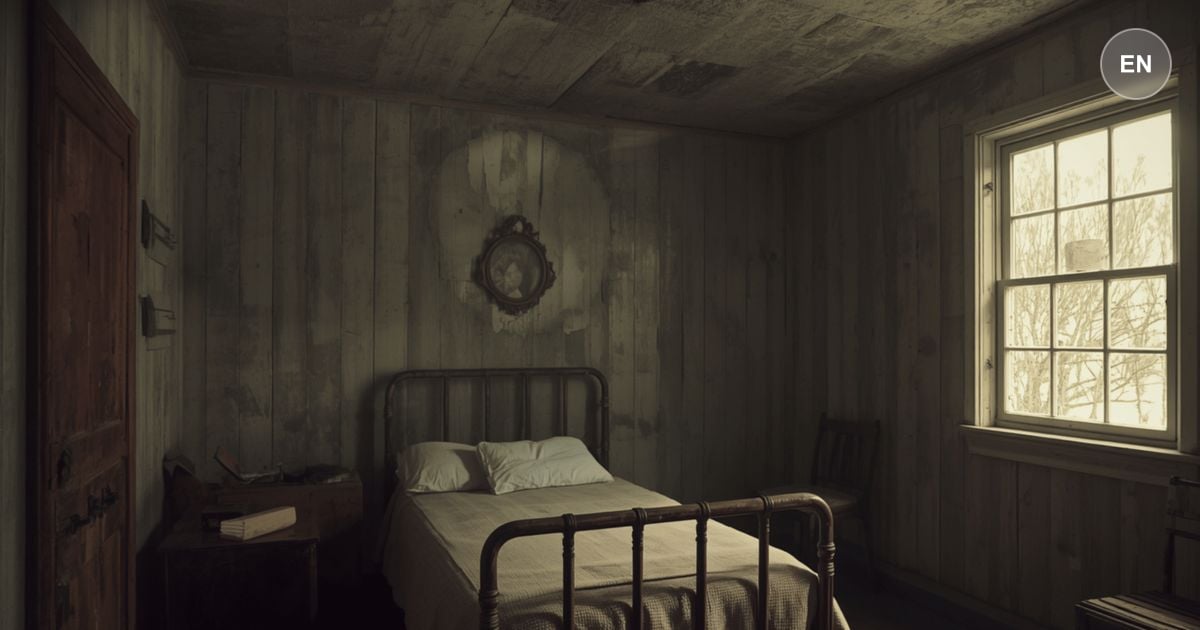
Offred climbs the stairs to Nick's room above the garage, heart loud in her chest. The space is spare: a bed, a chair, the faint smell of tobacco. Nick is younger than the Commander, quieter, and unknown in ways that feel both dangerous and like relief. They stand there awkwardly at first, and then the distance between instruction and desire collapses into touch. What begins is not a romance. It is something more urgent and more honest than that.
The affair gives Offred something Gilead has been systematically removing: a choice. Not a large one, not a safe one, but hers. Nick says little. He strokes her hair. She lies awake in his arms and feels, for a few minutes, like a person who exists. The guilt toward Luke comes too, and she cannot afford to push it away or lean into it. She holds both feelings the way you hold two heavy bags on a long walk.
The next day, Serena Joy delivers the photograph. Offred's daughter, older now, wearing white, alive. Offred takes the image to the closet and sobs quietly, memorizing every detail of the face. The relief is enormous. So is the trap buried inside it. Serena can take this hope back anytime she wants. That is the point.
The visits to Nick become a pattern, a rhythm that reorganizes Offred's nights. Cora hears the floorboards and says nothing. The Commander summons Offred to the study less often. Life quietly reshuffles itself around two secrets: the attempt at pregnancy and something that might be love, though neither of them names it. Every night she climbs back down those stairs before the household wakes, red dress pulled over her night clothes, the sky going pink at the edges.
Atwood is precise about what survival costs. Offred does not get to feel only one thing. She gets guilt and gratitude braided together. She gets hope that someone else controls. She gets a few minutes of being real in a system designed to make her invisible. That is what she bets on. That is what she carries back down the stairs each morning.
There is a specific kind of exhaustion that comes not from being denied everything but from being given just enough. Atwood understood this in 1985, and she built it into the architecture of Gilead with surgical precision. The regime does not need to be brutal every single day. It only needs to remind you, at carefully chosen moments, that it holds what you love most. Serena Joy handing Offred a photograph of her daughter is not an act of mercy. It is a calibration. It says: I know what keeps you going. I know how to turn that on and off. Now you know I know.
This mechanism shows up far outside dystopian fiction. Think about the workplace where a supervisor never formally recognizes good work but occasionally pulls someone aside to say 'I see you, you're doing great.' That worker stops asking for a raise and starts performing for the next private moment of approval. Think about the family member who runs cold for weeks and then shows up with warmth and a home-cooked meal, and suddenly everyone at the table feels relieved instead of asking why the cold came in the first place. Think about the healthcare system that delivers genuinely attentive care once in a while, inside a structure that is chronically understaffed, and the patient who walks out grateful for basic decency instead of expecting it as a floor, not a ceiling.
The psychological research on this is striking. Unpredictable rewards create stronger attachment than consistent ones. Slot machines pay out randomly on purpose. When you cannot predict when the good thing is coming, you stay focused on the source of it. You organize your behavior around earning the next good moment. The system, or the person, does not have to give you much. They just have to control the timing.
The question worth sitting with is not whether the relief you felt was real. It was real. Offred loves her daughter. The photograph matters. But real relief and real leverage can exist in the same moment. Knowing that does not make the relief smaller. It makes you harder to steer.
Explore this chapter with AI to uncover deeper meaning and practical takeaways.
AI Discussion