
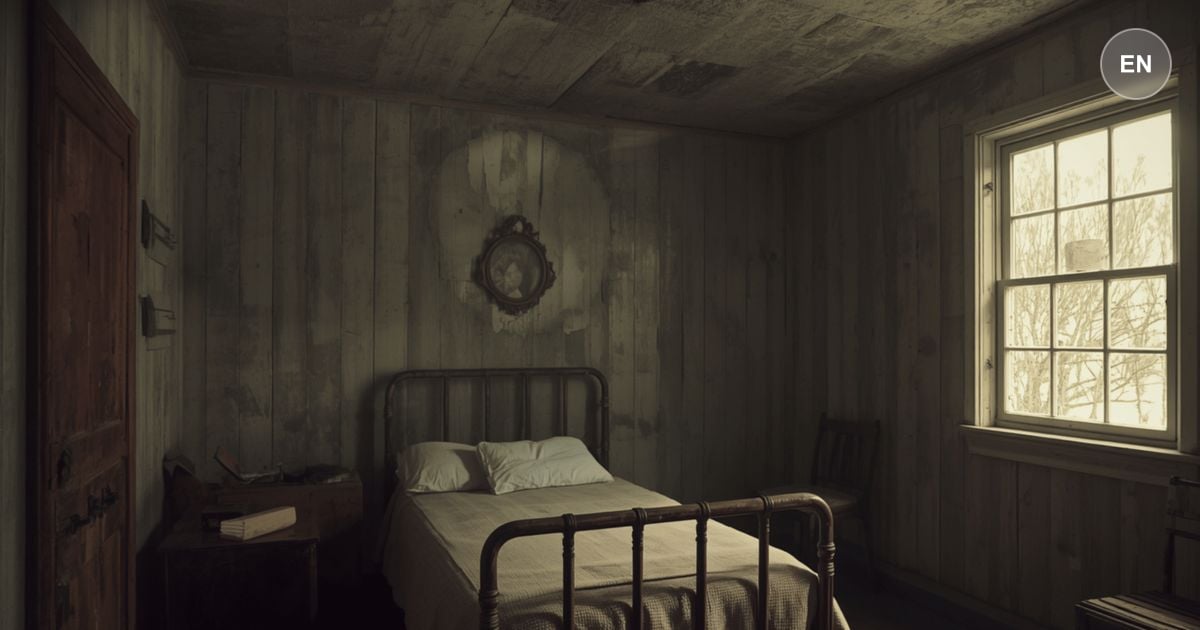
Fred does not want what Offred expected. He wants company. He wants to play Scrabble. So there she sits across from the Commander in his forbidden study, spelling words she is not supposed to know, holding letters like contraband in her hands. Each turn of the game is a small electric thrill. Each word she spells is proof she still exists.
Fred offers lotion for her dry hands. He pours whiskey. He talks about the pressures of running a regime as if she is a colleague, an equal, someone who chose to be in this room. Offred performs interest, because performance is survival. But underneath the performance, something real leaks through: grief for the life she lost, for games and books and choosing what to read on a Tuesday night.
He shows her a fashion magazine from before Gilead. Women laughing in sunlight. Offred nearly comes apart looking at it. Then she asks about the Latin phrase scratched into her closet wall, the one she has been turning over in her mind. Fred laughs and translates it loosely: don't let the bastards grind you down. He learned it as a school joke. He taught it to the previous Handmaid, the woman who occupied this room before Offred. That detail lands hard. There was a woman before her. That woman sat in this same chair. The chain of women linked through this man's casual cruelty and casual warmth is almost too much to hold.
These visits become routine. Scrabble, whiskey, conversation. Offred hates Fred. She also uses him, and she hates herself for that too. The study is the only room in Gilead where she speaks as a full person, and that is exactly what makes it dangerous. Fred may genuinely believe he is being kind. But kindness that does not free you is just a prettier cage.
Serena Joy would have her killed if she knew about these nights. Nick might report Offred or might protect her; she cannot read him clearly enough to know. Every time she walks back to her room, she carries the scent of lotion and the weight of guilt in equal measure.
She lies awake afterward understanding the shape of her situation: Fred wants her mind, Gilead wants her body, and she is split between those two demands with no room left that belongs entirely to her.
There is a version of power that announces itself with cruelty, and most of us have been taught to recognize that version. We know what it looks like when someone yells, threatens, or punishes. What we are much less prepared for is the version that shows up with a soda and a compliment and a genuine smile. Atwood understood something that psychology has since confirmed: unpredictable warmth from a person who controls your circumstances is one of the most effective forms of behavioral conditioning that exists. It is the same mechanism that makes certain jobs, relationships, and living arrangements so hard to leave even when the overall conditions are clearly harmful. The good moments do not cancel the bad ones. But they make the bad ones feel like exceptions rather than the pattern.
This is not a conspiracy. The people running this pattern on us are usually not sitting in a back room calculating how much warmth to dispense. Reginald probably does enjoy June's company. Fred probably did enjoy Offred's. That is what makes the pattern so durable. It does not require bad intentions to produce bad outcomes. It only requires that one person controls what the other has access to, then becomes the source of the thing being controlled. When your supervisor is the only one who can approve your schedule change, their occasional flexibility feels like generosity rather than basic workplace function. When a family member withholds approval for years and then offers rare praise, that praise lands with a weight it should never have to carry.
The tool this chapter offers is not cynicism. It is not a reason to reject every kindness or to treat warmth as automatically suspicious. The tool is a single diagnostic question, asked honestly: does this warmth give me more room to move, or does it make the current room feel large enough that I stop looking for the door? Offred could not leave Gilead. Most of us can leave the situation running this pattern on us. The question worth sitting with is whether the comfort has made us forget that we still have legs.
Explore this chapter with AI to uncover deeper meaning and practical takeaways.
AI Discussion