
The landlord gives her the suite a Grand Duchess had last week, and enters her as Princesse de Tarassevitcheva, though she has never been a princess. She has the bed stripped to the feather, finds no bugs, and says the place is too large. She tells Alexei to come when he is not teaching. He says that after tomorrow he will not be in the General's service, because he spoke German to a Baron and his wife from Berlin without the Berlin accent, and the Baron held it an insult. The General dismissed him yesterday. He does not mention Polina, or the hat, or Ja wohl. When she asks if he threatened the man, he says the Baron was the aggressor, and raised his stick. She turns on the General and calls him a blockhead for treating his tutor so. All men are crowing cocks, she says, and that is why they quarrel. He is to point the Baron out to her as they go, and to take her where the roulette is played.
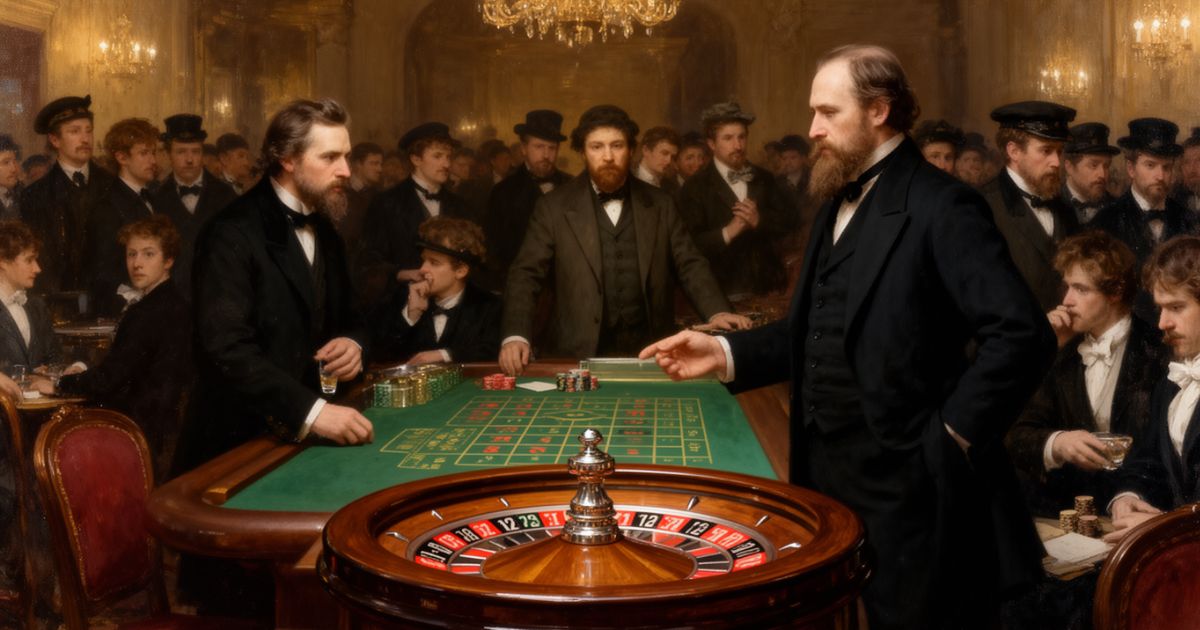
She will not rest. She has been sitting still for five days. The General is nervous of the Casino, and the party follows all the same, because they had offered to escort her. De Griers murmurs that she has fallen into her second childhood and will do something foolish if left alone, and he seems to feel his hopes return. She has already said she will give them none of her money, and the General knows his mother. At the table a space is cleared for her chair, beside the chief croupier. A young man has forty thousand francs in a heap, and his hands shake as he rakes it in. Go and tell him to stop, she says, and take the money home, or presently he will lose it all. Shouting is forbidden. She turns sharply away. The young man is done for. A Frenchwoman with a dwarf plays for one hour, writes the figures down, and is not losing. The grandmother asks how a person ought to stake.
Zero, he tells her, belongs to the bank. Hit it and the stake is paid thirty-five times, and there are thirty-six chances against. Rubbish, she says. Who fears the wolf should never enter the forest. Three ten-gulden pieces are lost, and she strikes the table when the croupier calls thirty-six. Stake, she says. It is not your money. Zero comes. She clutches his hand, and says it was the Lord God who suggested the two coins. She stakes the most the rules allow, and zero comes again. They pay her four thousand two hundred gulden. Stake four thousand florins on the red. Red. Again. Twelve thousand. His hands and knees are shaking, and the blood is beating in his brain. He knows that he is a gambler. Enough, she says. Let us go home. Wheel my chair away. The gold is to go into her purse. His hands have not stopped.
The Grandmother's casino triumph reveals something uncomfortable about human psychology: we desperately want to believe we're special. When good things happen to us, especially early on, our brains work overtime to find patterns and assign credit to our choices rather than chance. This isn't stupidity, it's how we're wired. The problem comes when this natural bias meets systems designed to exploit it. Casinos know that early wins hook players harder than any marketing campaign. Workplaces often promote people based on short-term results that may be more about timing than talent. Social media algorithms show us our most successful posts first, making us think we understand what works. The Grandmother's story from 1867 Russia could happen today in any American workplace, investment app, or side hustle. The technology changes, but the psychological trap remains identical. We want to believe we've figured out the system, that we're the exception to the rules that govern everyone else. The most dangerous moment isn't when we're losing, it's when we're winning and starting to think we know why. Recognition of this pattern isn't pessimism; it's protection. When we can separate genuine skill from lucky timing, we make better decisions about when to double down and when to walk away.
Explore this chapter with AI to uncover deeper meaning and practical takeaways.
AI Discussion