
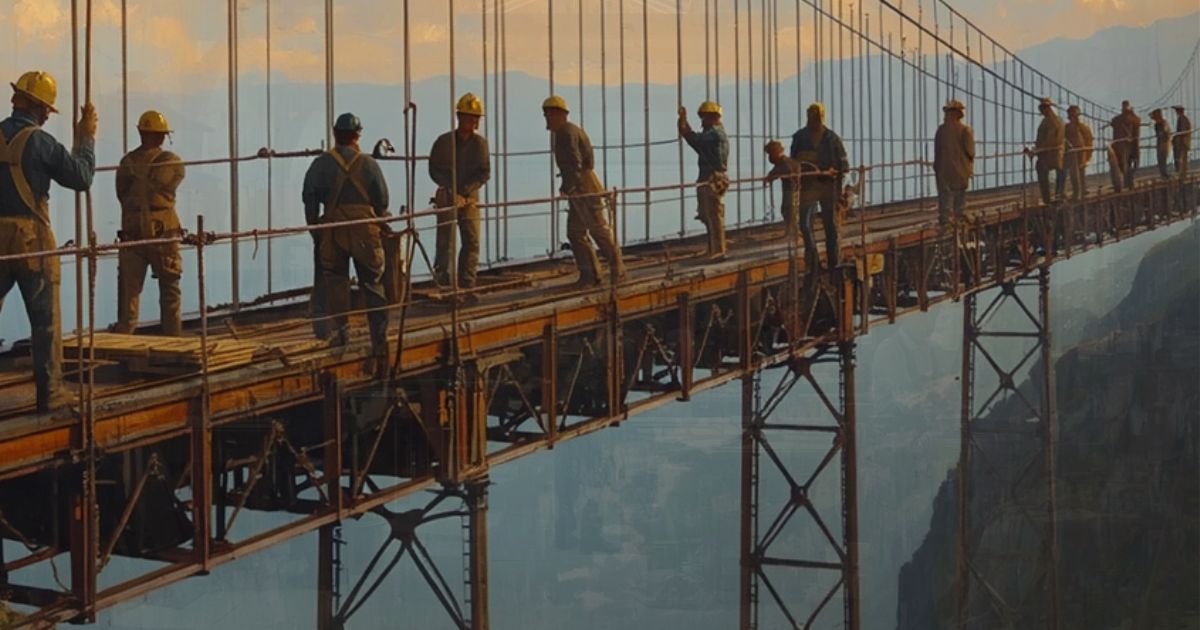
Miss Frazier stands on the clean decks of the new steamer Dimbula, proud of the paint, brass, patent winches, and straight bow where she cracked the champagne bottle. She asks the captain if the vessel is a real ship at last. He answers cautiously that it takes more than christening: she is irons, rivets, and plates in the form of a ship, and she has to find herself yet. The Dimbula leaves Liverpool with four thousand tons of cargo, saluted by friendly boats that see she is new to the High and Narrow Seas.
At first each component speaks alone. Rivets complain about scandalous thickness; frames and stringers argue over push and pull; decks repeat orders; the funnel refuses experiments. When the Atlantic gale hits, fear turns into blame. Waves thunder along the hull; the ship rolls until every inch of iron feels sick. The Steam, who has been to sea many times, counsels the younger parts to yield a little and work together, because no rivet forged can stand endless strain if the whole does not share it.
Through sixteen brutal days the Dimbula pitches, repairs, and learns. Plates flex where they must; rivets hold where they should; engines, screws, and steering discover rhythm. She arrives at New York covered in salt and rust, proud enough to tell the passing liners who she is. They answer with grunts and indifference. That does not matter. When a ship finds herself, the separate voices cease and become one soul. The Dimbula can finally say she is the Dimbula, nothing else except perhaps a fool, and mean it.
Kipling's industrial fairy tale treats the vessel as a workplace of quarrelling specialists who only become a crew when survival demands it. Miss Frazier stands for owners who confuse launch-day glamour with readiness. The captain stands for veterans who know every new system must be baptized in weather. The grand liners ignoring the Dimbula are tenured staffs who forgot their first disastrous shift. The moral is not that suffering is noble, but that coordination is earned when each part stops protecting only itself and learns how its stress becomes everyone else's. Kipling keeps the focus on craft under pressure: who coordinates, who improvises, and who learns after the first scare. That lesson travels beyond the book's setting into any workplace where competence is tested in public rather than in slides. Kipling keeps the focus on craft under pressure: who coordinates, who improvises, and who learns after the first scare. That lesson travels beyond the book's setting into any workplace where competence is tested in public rather than in slides. Kipling keeps the focus on craft under pressure: who coordinates, who improvises, and who learns after the first scare. That lesson travels beyond the book's setting into any workplace where competence is tested in public rather than in slides.
Kipling wrote this story during the height of industrial expansion, when new technologies required workers to coordinate in ways never before attempted. The Dimbula represents something revolutionary: a machine so complex that its parts must actively cooperate, not just function. This was the dawn of truly collaborative work. Today, we face the same pattern everywhere, from hospital emergency rooms to restaurant kitchens during the dinner rush. The comfortable team-building exercises and trust falls miss the point entirely. Real unity doesn't come from artificial challenges or motivational speeches. It comes from the moment when individual survival depends on collective success. Think about your own experience: when did you feel most connected to coworkers? Probably not during the company picnic, but during the impossible deadline, the system crash, or the day when everything went wrong and you had to figure it out together. The pattern reveals something profound about human nature: we don't trust each other because we like each other. We like each other because we've learned to trust each other under pressure. This is why the most cohesive work teams often come from high-stakes environments, emergency services, military units, surgical teams. They've been through the storm phase and emerged knowing they can count on each other. The question becomes: how do we create opportunities for this kind of authentic team formation without waiting for crisis to force it?
Explore this chapter with AI to uncover deeper meaning and practical takeaways.
AI Discussion