
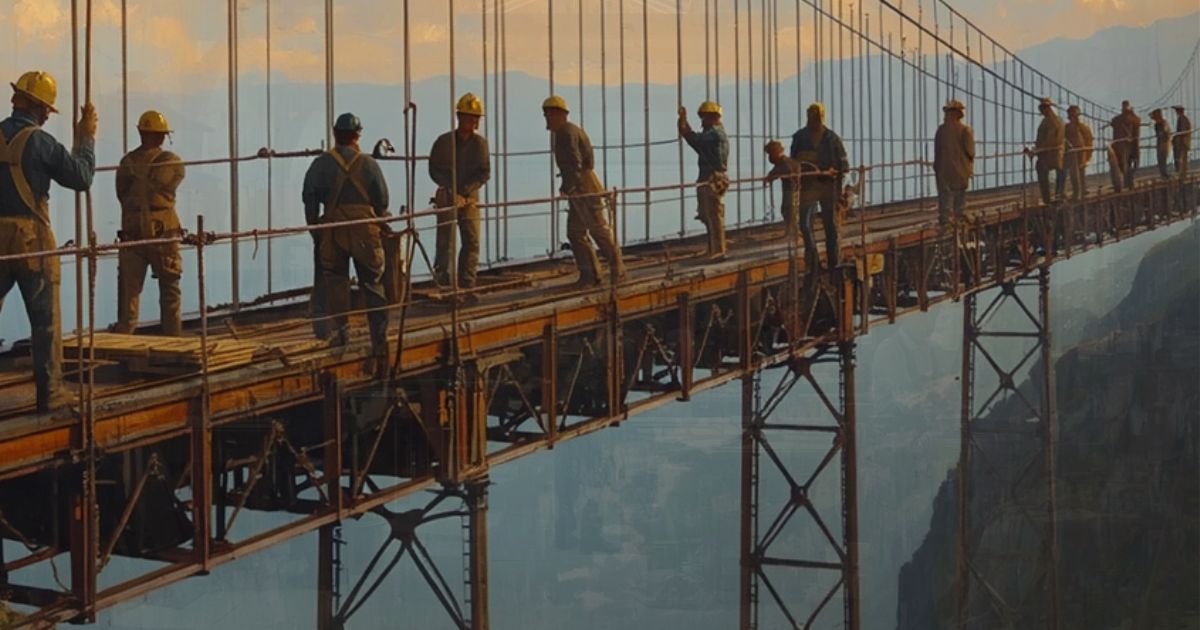
Chief Engineer Findlayson and his assistant Hitchcock have spent three brutal years driving the Kashi Bridge across the Ganges. The opening scene is industrial grandeur at furnace heat: tiny asses haul earth from the borrow-pit, riveters hang like swarms under girders, cranes snort along spile-piers, and construction trains dump thousands of tons of stone to hold the river in place. Piers twenty-four feet across sit capped with red Agra stone eighty feet below shifting sand; above them run rail, cart-road, footpaths, and guard-towers loopholed for musketry.
Findlayson turns on his trolley and looks over seven miles of country he has remade. Practically, the thing is done, though a few weeks of riveting remain on the three centre spans. Hitchcock, once a raw Cooper's Hill cub who wept when Government widened the bridge and ruined half an acre of calculations, has become the partner Findlayson plans to pull up the service with him. Their joke, all but, carries the engineer's habit of naming the last gap honestly.
The bridge's numbers were worth memorizing: twenty-four-foot piers capped with red Agra stone, every base sunk eighty feet through shifting sand to find stable ground, three centre spans still needing weeks of riveting before the whole could carry the weight of a train. Seven miles of country Findlayson had remade from scratch, rerouting ox-cart roads and digging borrow-pits that left raw wounds in the field long after the embankment settled. Guard-towers at each end were loopholed for musketry because the bridge ran through country where railway property invited destruction. The opening ceremony had been settled for months, with officials invited who had not once ridden a construction trolley at dawn.
What the ceremony would not show was the dry-season work: laying courses of dressed stone in dust that turned the skin yellow, driving the first test locomotive over a completed span at walking pace while Hitchcock stood below watching the deflection, or the cold nights when fog off the river made the rivet gangs impossible to count and Findlayson walked the decking alone checking torque marks with a lantern. The bridge was finished in his mind before the last bolt turned.
Kipling then recounts what the panorama omits: contractors who could not be trusted in crisis, correspondence wars over doubtful consignments, Hitchcock's wild leave to London to terrify a supplier across a dinner table, cholera and smallpox in the village where Hitchcock served as magistrate, fever always present, weddings and riots among twenty warring castes, and the black frame of the bridge rising plate by plate in Findlayson's mind. Peroo, ex-serang of the British India boats, controls tackle and gangs with a honour tied to the structure. He saved Number Seven girder when wire rope jammed, directed through Hitchcock's broken arm, and speaks to Findlayson about Mother Gunga with respect learned in ports from Rockhampton to London. He rows the spurs, mocks officials who arrive only for the opening, and warns that penning the river between stone sills may invite a reply.
Peroo had spent twenty years reading weather from ship decks before he came ashore to work tackle for Findlayson, and the shift showed in everything he did. He could judge a wire rope's remaining strength by the sound it made under load, and when the rope jammed at Number Seven girder he directed the recovery through Hitchcock's shouted instructions from above, working by feel in a space where no lamp survived the wind. The girder swung true. Hitchcock's arm broke that same day from a falling shackle, and Peroo ran the gang until a replacement could reach site. He spoke to no one about it afterward.
His authority over the twenty warring castes on the job came partly from the ports he had worked: Rockhampton, Colombo, London's West India Docks, Aden. Gangs that would not take orders from each other would take them from a man who had handled cargo in every ocean. He kept a private respect for the river, calling it Mother Gunga without irony, and warned Findlayson more than once that penning moving water between fixed stone invited a response the engineers had not budgeted for.
Evening brings telegrams two months before any sane forecast: floods on the Ramgunga, heavy rains on the canal. Findlayson calculates hours to Melipur Ghaut and orders the night-gong struck. Conches, drums, McCartney's bugle, and locomotive whistles answer; gangs pour into the river-bed by flare-light, lifting track, shifting tools, dropping concrete blocks from stone-boats, and racing rivets into the centre girders before the cribs wash out. Peroo's pipe shrills over wire-rope and shouting; Hitchcock spends extra trucks of stone on the east bank. Then the squall darkens the moonless night, and Peroo says Mother Gunga is awake six hours early. A second gong clears the bed; men hear water crawl over sand. Findlayson meets Hitchcock on the temporary walkway between piers and tells him to call the roll, count stores, sit on his hunkers, and pray for the bridge.
What follows is flood as spectacle and ordeal: a wall of chocolate water, spans settling on whirled-out cribs, stone-boats grinding in the eddy, dead men and oxen hurrying past, the embankment marked inch by inch. Findlayson cannot eat, remembers colleagues whose failures ended careers and lives, and recalculates the Findlayson truss while Peroo crouches at his feet. The Lascar drags out his priest, then offers Malwa opium against the creeping fever. Findlayson swallows; Peroo watches the boats. A hawser snaps; Findlayson, dreaming ropes of white fire, is burned off the bank and spun downstream. On a flooded indigo island he and Peroo shelter under a peepul while opium turns the night into a divine council: Mother Gunga as crocodile pleads for vengeance; plague, drought, and famine accuse; Ganesh counts profit; Shiva hears schoolmen; Krishna speaks for villagers who will ride the fire-carriage and begin to think of bridges more than gods. Brahm still dreams; the bridge may stand.
The telegrams arrived two months before any cautious forecast allowed for flood risk, first from the Ramgunga gauge stations and then from closer tributaries that had been running clear the previous week. Findlayson read them twice and sent Hitchcock to the gangs on the center spans with orders to pull temporary timber and get loose materials above the high-water line before dark. The river color changed by evening, the normal tawny brown going to a heavy grey-green that the boatmen recognised before any instrument confirmed it. Flotsam came first: broken bamboo, melon rinds, a dead cow, then whole trees still bearing leaves stripped from the bank upstream.
The gong that served as the flood alarm was a salvaged boiler plate hung on a crane post, and Peroo struck it himself at the moment the current stiffened against the finished piers and the first wave climbed the cutwater. Men came off the center spans along the rivet scaffold, hand over hand in the dark, while Findlayson and Peroo crossed to the island that the rising water would soon isolate. Reaching it by flat-bottomed boat, they found the shore shrinking by the hour.
Morning light restores the practical world. Findlayson wakes sick and ashamed; Peroo remembers the saying that when Brahm ceases to dream the gods die. Hitchcock comes up-river in the Rao Sahib's gilt launch, hair on end, demanding first word of the bridge. All serene: not a stone shifted. They are seven koss downstream, soaked, half-starved, and alive because Peroo knew boats and Findlayson, for all his formulas, finally depended on him. The chapter ends with engineering pride humbled by water, faith, and friendship forged in mud: a monument meant to outlast memory, tested before the ribbon is cut.
Throughout, Kipling balances imperial confidence with unease. The bridge is raw and ugly as original sin yet pukka permanent; it will survive the builder's name. Findlayson trusts mathematics but fears Mother Gunga's arithmetic. Peroo trusts gods he has seen in engine-rooms and on fo'c'sles. Hitchcock trusts Findlayson enough to wake a Rao at midnight. The flood does not destroy the work, but it exposes who actually holds the project together when telegrams fail and the gong is only prayer with a hammer. That is the chapter's lasting lesson for anyone building under another person's deadline.
On the island the two men sheltered under a temple awning while a boatman's package of bhang dissolved into the tea they drank against the cold, and what followed was neither sleep nor delirium but something between. Findlayson understood later that he had taken the drug without knowing it. While it lasted, the flood around him became a council chamber: divine shapes that the river had accumulated over centuries, fish-god, cattle-god, bear, the elephant and the horse, debating whether the stone barrier men had built across the goddess's channel deserved to stand or should be taken down in a single night. The voices agreed on very little except that the new thing had changed the rules.
Morning came before the bhang fully lifted. Findlayson and Peroo crossed back at first light to find the bridge intact, the piers holding, the center spans scarred but unbroken. The flood had come with everything it had, and the structure had answered. Peroo thanked Mother Gunga with the particular formality of a man who had been expecting either this outcome or its opposite, then reported to Hitchcock that the north abutment needed inspection and the rivet gang could return to work.
Kipling wrote this during the height of British engineering confidence, when men believed technology could conquer nature. Findlayson represents that era's faith in human control, three years of precise calculations, quality materials, skilled labour. Yet the Ganges doesn't care about engineering degrees. The flood threatens everything because some forces simply don't negotiate. Wage workers everywhere still face the same collision between personal effort and systemic forces. The nurse who works double shifts during understaffing, the factory worker whose plant closes despite record productivity, the teacher whose students struggle despite innovative lessons. We're taught that hard work guarantees results, but Findlayson's crisis reveals a deeper truth: excellence means doing your best work while accepting that outcomes depend on forces beyond your control. His opium visions aren't escape, they're his mind processing what every dedicated worker eventually faces. The gods debating the bridge's fate represent all the variables we can't control: economic cycles, corporate decisions, natural disasters, political changes. Findlayson survives because he learns to separate his identity from his project's fate. He remains responsible for the bridge without being destroyed by forces beyond his influence. This distinction, between responsibility and control, might be the most crucial skill for navigating modern working life.
Explore this chapter with AI to uncover deeper meaning and practical takeaways.
AI Discussion