
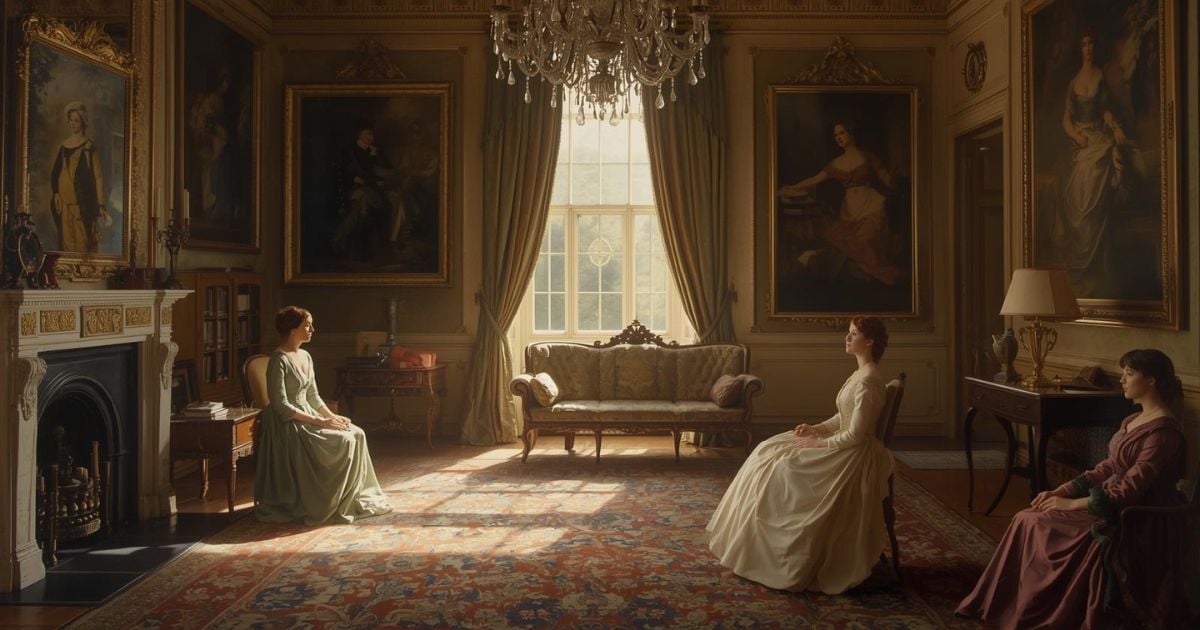
Within four days of her mother's arrival, Marianne is well enough to be moved into Mrs Palmer's dressing-room, and she asks that Colonel Brandon be invited, so she may thank him for fetching her mother. His emotion, as Elinor reads it, is more than affection, and more than the knowledge that others know it. The hollow eye, the sickly skin, and the warm acknowledgment of a peculiar obligation bring Eliza back to him. Mrs Dashwood, watching just as closely and to a different effect, sees only simple feeling in him, and persuades herself that something more than gratitude is already dawning in Marianne. His carriage takes them home, and he will visit the cottage in a few weeks. Marianne's leave of Mrs Jennings is long and grateful, as if owed for past inattention. He wants her to have at least half the carriage, and then he goes alone to Delaford.
Near Barton every field is a recollection. She turns her face to the window, and when Elinor helps her down she has been crying. The tears are unobtrusive, and Elinor will not blame them. In the sitting-room Marianne looks around with a resolute firmness, as if to accustom herself at once to every object that can be connected with Willoughby. After dinner she tries the pianoforte. The first music her eye rests on is an opera he procured, favourite duets, her own name in his handwriting on the outer leaf. That will not do. She puts it aside, runs over the keys, complains that her fingers are feeble, and says, with firmness, that she will practise much in future. The next morning she is stronger. They will walk to the farm, to Sir John's new plantations, to the ruins of the Priory. She will never rise later than six, and she will read six hours a day. Elinor honours a plan that begins so nobly, and smiles at the same eager fancy now pouring excess into self-control. The smile becomes a sigh. The account she still owes is delayed only until the delay breaks.
A soft morning lets them into the lane, as far as a full view of the hill. There, exactly there, on that projecting mound, Marianne says: she fell, and she first saw Willoughby. She is thankful she can look at the spot with so little pain. If she could be sure he was not always acting a part, and not so wicked as her fears have fancied since the story of that unfortunate girl, her mind might be easy. She would gladly suppose him only fickle. She does not compare her conduct with his. She compares it with what it ought to have been, and with Elinor's. Had she died, it would have been self-destruction. Mrs Jennings was repaid with contempt. Elinor, above all, was left to be miserable for her sake. The future must be her proof. She will not claim that she can forget him. If she could but know his heart, everything would become easy. Elinor tells the chief points of his apology, does justice to the repentance, and softens only the protestations of present regard. Marianne says nothing. At the cottage door, through tears, she manages two words. Tell mama. Will the page she put aside stay closed, once those two words have been carried into the parlour?
Marianne's devastation reveals something uncomfortable: sometimes we fall in love with our own interpretation of someone rather than who they actually are. She created an elaborate narrative about her and Willoughby's 'special connection' based on limited evidence, walks, conversations, shared interests. But she never had confirmation that he shared her interpretation of these moments. This isn't stupidity; it's human nature. We're pattern-seeking creatures who fill in gaps with hope. The problem comes when we mistake our internal narrative for external reality. Today's dating culture makes this worse. We analyze texts, read meaning into emoji choices, build entire relationship theories around someone's online networks activity. We convince ourselves that someone liking our posts means they're thinking about us, that inside jokes mean intimacy, that attention means affection. But just like Willoughby, people can enjoy interaction without deeper investment. The solution isn't cynicism, it's calibration. We need to match our emotional investment to actual evidence of reciprocity. This means having uncomfortable conversations, asking direct questions, and accepting that not every connection is mutual. It means building our sense of self on multiple foundations, not just one person's attention. The goal isn't to protect ourselves from all disappointment, but to avoid Marianne's mistake: confusing the story in our head with the reality in front of us.
Explore this chapter with AI to uncover deeper meaning and practical takeaways.
AI Discussion