
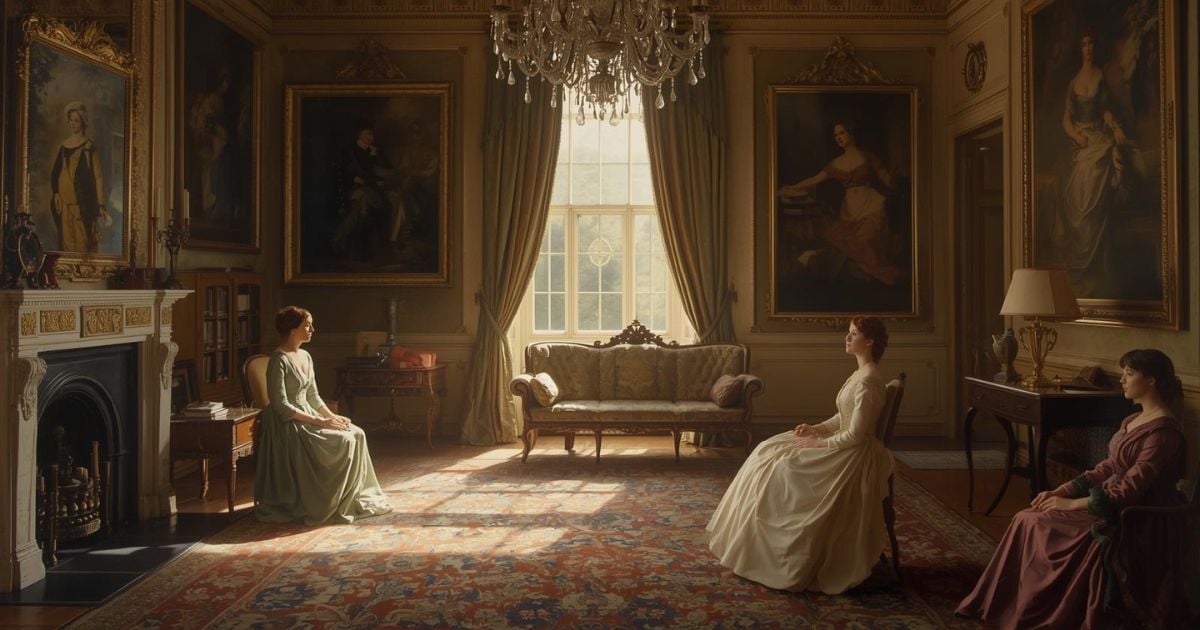
The Miss Steeles come from Exeter, and Lady Middleton is won before they have been an hour at the Park. They are in raptures with the furniture, and so fond of the children that her good opinion is engaged at once. A pocket handkerchief thrown from a window is monkey tricks. A hard pinch is how playful William is. When a pin in her head dress scratches little Annamaria, the child is covered with kisses, her scratch bathed with lavender water, her mouth stuffed with sugar plums, and apricot marmalade is fetched because it soothed a bruise last week. With such a reward for her tears, she is too wise to cease crying. Sir John goes to the cottage to announce the sweetest girls in the world. Elinor knows the phrase. Under that commendation, the sweetest girls in the world are to be met with in every part of England.
Marianne cannot say what she does not feel, so the whole task of telling lies, when politeness requires it, falls on Elinor. Anne Steele wants to know about smart beaux, and about Mr Rose at Exeter, prodigious smart, and not fit to be seen of a morning. Was their brother quite a beau before he married, being so rich? Elinor does not perfectly comprehend the word. If he ever was a beau before he married, he is one still, for there is not the smallest alteration in him. Lucy turns the talk to the house and the furniture. This specimen is enough. Elinor leaves without any wish of knowing them better. Sir John thinks sitting an hour or two in the same room is intimacy, and he promotes their unreserve by telling whatever he knows of his cousins, in the most delicate particulars.
The name he gives, in a very audible whisper, is Ferrars, and they are not to tell it, for it is a great secret. Anne repeats it. Mr Ferrars is the happy man, Elinor's sister-in-law's brother, a very agreeable young man, and she knows him very well. Lucy amends her sister at once. They have seen him once or twice at her uncle's, and it is rather too much to pretend to know him very well. Elinor hears this with attention and surprise. Who was this uncle? Where did he live? How came they acquainted? She wishes the subject continued, and she does not choose to join it. For the first time, Mrs Jennings does not take up a petty fact. Anne's manner seems ill-natured, and it suggests that she knows, or fancies she knows, something to his disadvantage. Then no further notice is taken of the name, not when Sir John alludes to it, and not when he mentions it openly. Will anyone ask who the uncle is, or will the smaller claim be the one that stands?
Edward's strange behavior reveals something crucial about relationships: sometimes the biggest barriers aren't between two people, but inside one person's head. He's not pulling away because he doesn't care about Elinor, he's pulling away because he cares too much and knows something she doesn't. Maybe his family has expectations, maybe there are financial constraints, maybe he's made promises he can't break. The tragedy is that his attempt to protect her (and himself) from disappointment actually creates the very pain he's trying to avoid. This dynamic is everywhere in life on a wage. The single parent who won't date because they can't afford evening childcare. The adult child who becomes distant before admitting they can't help with family expenses anymore. The friend who stops calling because they're embarrassed about losing their job. The coworker who becomes formal after being formally warned, knowing they can't risk any workplace relationships now. We often interpret withdrawal as rejection when it's actually someone trying to manage impossible circumstances. Austen shows us that the kindest interpretation is usually the correct one: people pull away to protect, not to hurt. The question becomes: how do we create space for people to share their real obstacles instead of forcing them to perform distance? How do we signal that we can handle their truth, whatever it is?
Explore this chapter with AI to uncover deeper meaning and practical takeaways.
AI Discussion