
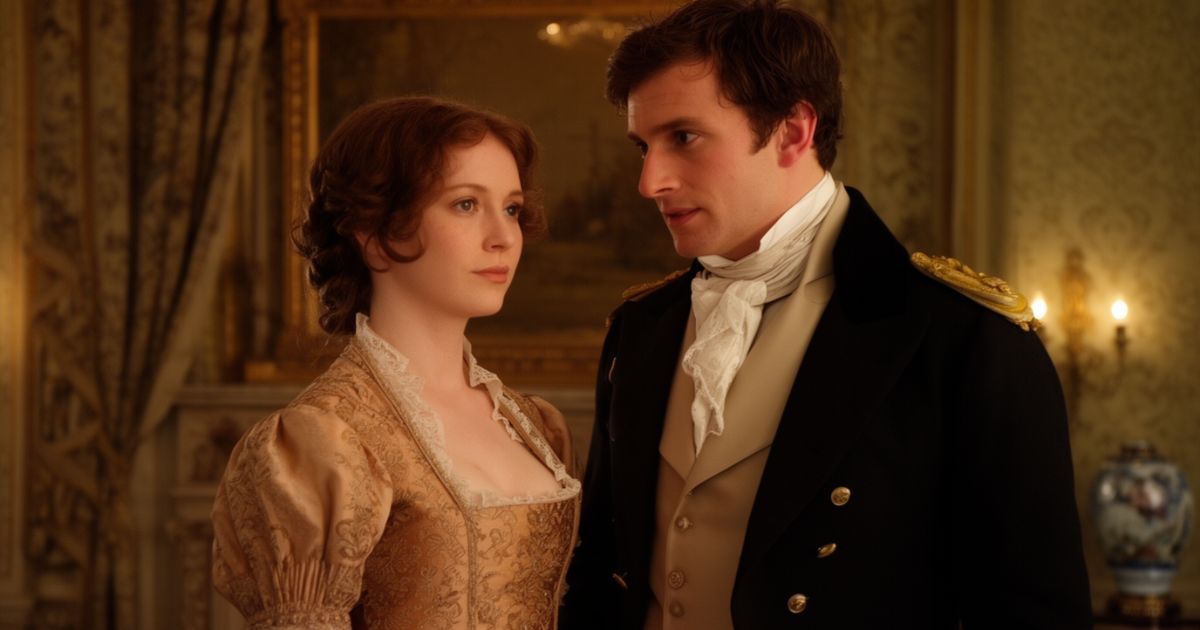
He was not the curate. Captain Frederick Wentworth, brother of Mr Wentworth of Monkford, had been made commander after the action off St Domingo, and in the summer of 1806, not yet employed again, he came into Somersetshire with no parent living and a home for half a year at his brother's. He was a remarkably fine young man, full of intelligence, spirit, and brilliancy. Anne was extremely pretty, gentle, and modest. He had nothing to do. She had hardly anybody to love. They became acquainted by degrees, and then, once acquainted, rapidly and deeply in love. A short stretch of happiness followed, and only a short one. Sir Walter, when applied to, did not withhold consent and did not say it should never be. He gave astonishment, coldness, silence, and a resolution to do nothing for his daughter. He thought the alliance degrading. Lady Russell, with a pride more tempered than his, grieved over it as most unfortunate. Anne at nineteen, with birth, beauty, and mind, engaging herself to a stranger who had nothing but himself, looked to her like a throwing away, or worse, a sinking into a wearing, anxious dependence. She had almost a mother's love, and she meant to prevent it.
Wentworth had no fortune. What had come freely he had spent freely, and he had laid nothing by. He was sure he would soon be rich, soon have a ship, and soon be placed where that ship would lead to everything he wanted. He had always been lucky. That confidence would have been enough for Anne. Lady Russell saw in it only a dangerous character added to the evil. He was brilliant and headstrong. She had little taste for wit, and a horror of anything like imprudence. Anne might have withstood her father's ill-will. Her sister offered not one kind look. She could not withstand Lady Russell, whose opinion was steady and whose manner was tender. She was persuaded the engagement was a wrong thing: indiscreet, improper, hardly capable of success, and not deserving it. She could hardly have given him up if she had not believed she was consulting his good even more than her own. That belief was her chief consolation. He was not convinced. He felt himself ill-used, and he left the country. A few months had seen the beginning and the end. Anne's suffering did not end with them. The attachment clouded her youth, and an early loss of bloom and spirits lasted.
More than seven years have gone. No one inside the Kellynch circle has borne comparison with him, and no second attachment has been possible. At about twenty-two, Charles Musgrove, eldest son of a man whose land stood second in that country only to Sir Walter's, asked her to change her name, and soon afterwards found a more willing mind in her younger sister. Lady Russell lamented the refusal. Anne had left nothing for advice to do, and the subject has never been spoken of since. At twenty-seven she thinks very differently from what she was made to think at nineteen. She does not blame Lady Russell, and she does not blame herself for having been guided. She would not give any young person that certain immediate wretchedness in exchange for an uncertain good. She believes she would have been happier keeping the engagement, even if every fear they could reasonably have expected had come true, and without counting the result, which arrived sooner than calculation allowed. Soon after the break he got employ. All he had told her would follow took place. He distinguished himself, gained the other step in rank, and by successive captures must now have made a handsome fortune. She has only navy lists and newspapers for this. She cannot doubt that he is rich, and she has no reason to believe him married.
She had been forced into prudence in her youth. She learned romance as she grew older, the natural sequel of an unnatural beginning. She cannot hear that his sister is likely to live at Kellynch without the old pain returning. The only three of her own friends who know wear a perfect indifference, and Mrs Croft was out of England when it happened, and Mary, then at school, was never told. She hopes the acquaintance, which must come, need not involve any particular awkwardness. The idea has already cost her many a stroll and many a sigh.
Chapter 4 is the novel's emotional ledger. Austen balances felicity and rupture with accountant precision: a short happiness, a long aftermath. What makes the chapter devastating is Anne's fairness. She does not demonize Lady Russell; she absorbs the lesson into her own ethics. That maturity is admirable and painful because it leaves her nowhere to put the anger. Readers see what Anne sees: Wentworth's confidence was not folly; it was accurate self-knowledge. The chapter therefore reframes persuasion not as melodrama but as a daily practice of living inside someone else's risk model.
Explore this chapter with AI to uncover deeper meaning and practical takeaways.
AI Discussion