
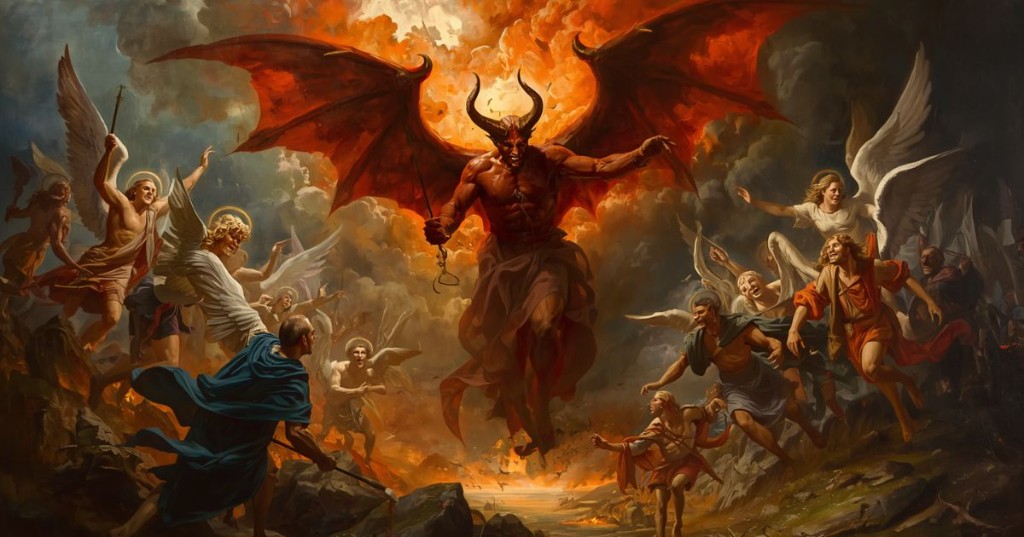
Milton opens by asking the Heavenly Muse to guide his ambitious song about Man's first disobedience and the forbidden fruit that brought death into the world. He will trace how the infernal Serpent, cast out after warring against God, seduced our first parents, and he promises to justify God's ways to human readers. After nine days stunned on a burning lake, Satan lies vanquished with his rebel host in darkness visible, a prison lit only by flames that reveal woe without offering hope. He wakes beside Beelzebub and refuses repentance, framing defeat as permanent rebellion: better to reign in Hell than serve in Heaven. He insists the mind can make a Heaven of Hell, vows to pervert whatever good God draws from evil, then rises from the lake like a sea monster chained until Heaven permits his next move. Flames part as he strides to the burning shore to call the legions.
Standing on the brimstone shore, Satan shames the legions scattered thick as autumn leaves with one cry: awake, arise, or be forever fallen. They spring up numberless, hover under Hell's vault, and fill the plain while Milton catalogs the chief fallen gods who will later tempt nations, from child-burning Moloch and lustful Chemos through Astoreth, Thammuz, Dagon, Rimmon, Osiris, and slothful Belial, who needs no temple because corruption finds him anywhere. Trumpets sound; Azazel unfurls Satan's standard streaming like a meteor, and the legions advance in grim parade to Dorian flutes while Satan reviews ranks whose visages still resemble gods, though names once bright in Heaven are now blotted from the Book of Life.
Satan weeps three times before he can speak, then pivots from open war toward fraud, guile, and rumor of a new world God may intend to create. The army brandishes flaming swords toward Heaven while Mammon, whose love of gold preceded his fall, leads spirits to mine a sulfurous hill and raise Pandemonium, a capital outshining Babylon and Cairo, built in an hour by hands that once served Heaven. Milton notes Mulciber fell with this rout long before Greek fable placed him on Lemnos, and that riches grow in Hell as readily as pride.
Heralds summon the worthiest to council at Pandemonium's high capital. The vast angels shrink to fit the hall like spring bees crowding a hive, yet inside a hidden recess the great Seraphic lords keep their full stature and sit a thousand strong in secret conclave on golden seats. After short silence the summons is read and the great consult begins, with Satan still charismatic, still self-deceived, and still turning catastrophe into a story his followers can march behind as Book I closes on the threshold of open deliberation.
Milton's Satan embodies a pattern we encounter constantly: the leader who transforms failure into martyrdom. What makes this dangerous isn't the obvious manipulation—it's how genuinely wounded these leaders often are. Satan's pain at seeing his followers suffer feels real because it is real. This authentic emotion becomes the vehicle for avoiding responsibility. In our workplaces, families, and communities, we meet people who combine genuine conviction with an inability to admit fault. The manager who cuts benefits while talking about 'tough love' and 'preparing the team for challenges.' The family member who creates chaos but positions themselves as the truth-teller everyone's trying to silence. The friend who burns bridges but explains they're 'setting boundaries' against people who 'can't handle their authenticity.' These aren't cartoon villains—they're often people who started with legitimate grievances and real care for others. But somewhere along the way, being right became more important than being effective. The seduction works both ways: followers get to feel part of something noble and principled, while the leader gets to maintain their self-image as misunderstood rather than mistaken. Milton's genius is showing us this pattern without telling us what to think about it. He lets us see both Satan's genuine leadership qualities and his fundamental self-deception. The question becomes: how do we maintain our principles while staying open to the possibility that we might be wrong?
Explore this chapter with AI to uncover deeper meaning and practical takeaways.
AI Discussion