
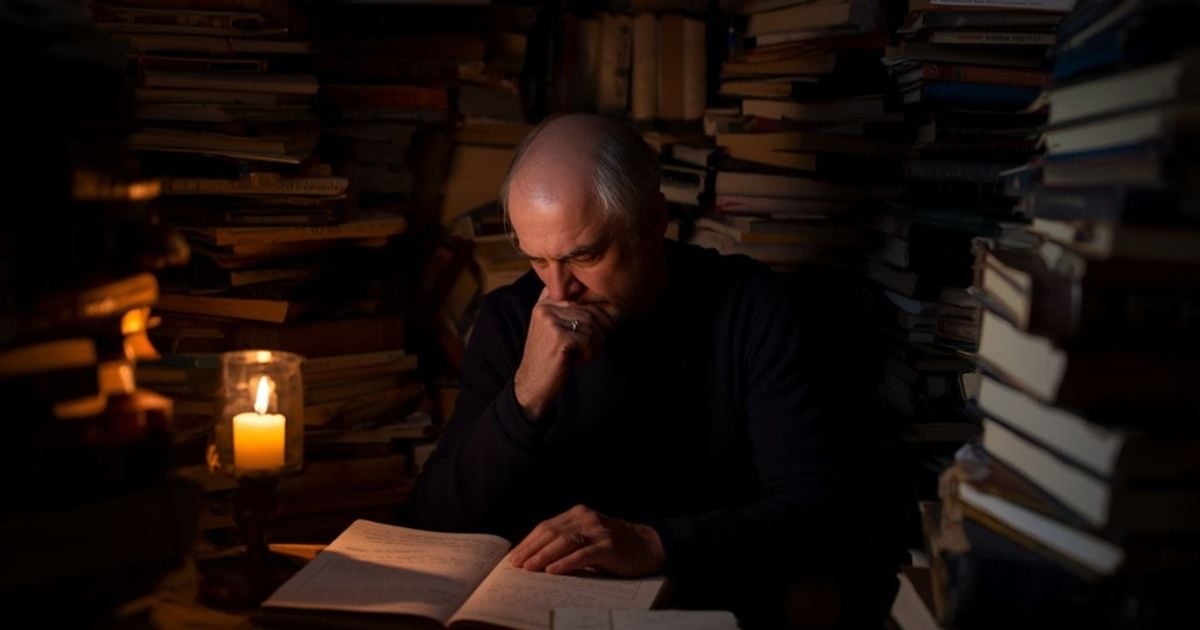
The Underground Man dismisses his sluggard fantasy as "golden dreams" and pivots to his most sustained philosophical attack. The target: the rationalist premise that man does nasty things only because he doesn't understand his own interests, that once enlightened, he would inevitably choose good. "Oh, the babe! Oh, the pure, innocent child!" he scoffs. History offers millions of facts to the contrary: men who fully understood their real interests and deliberately acted against them, rushing headlong into danger simply because they disliked the beaten track.
He introduces a friend. Everyone has one. This gentleman explains, with elegance and passion, exactly how reason and truth demand he must act, and then, within a quarter of an hour, without any outside provocation, acts in direct opposition to everything he just said, driven by "something inside him which is stronger than all his interests." The friend is a compound personality, so it is difficult to blame him as an individual. But the pattern is universal.
The rationalists have assembled a list of human advantages, prosperity, wealth, freedom, peace, and built their entire case on it. But they have left one advantage off the list entirely: independent choice. The caprice, the whim, the wild fancy worked up at times to frenzy. This advantage cannot be classified. It shatters every system built for mankind's benefit, because sometimes a man will act against reason, honour, and peace combined, simply to exercise it. And sometimes, the Underground Man insists, one positively ought to choose contrary to one's own interests.
He pivots to civilisation. Buckle argued that it makes men softer and less bloodthirsty. The Underground Man points to the nineteenth century and disagrees: the most civilised gentlemen have been the subtlest slaughterers, compared to whom Attila and Stenka Razin could not hold a candle. Civilisation's only real gain has been a greater capacity for variety of sensations, which includes finding enjoyment in bloodshed. In old days, men exterminated with a clear conscience. Now we know it's abominable and do it anyway, with more energy than ever.
Then comes the piano-key argument. Science, the rationalists predict, will eventually tabulate all human actions mathematically, prove that man has no real will, that he is "something of the nature of a piano-key," acting not by choice but by the laws of nature. Everything will be calculated, entered in indexes, explained in encyclopaedic lexicons. The Palace of Crystal will be built. There will be no more incidents or adventures in the world. And it will be, the Underground Man notes, frightfully dull, though boredom, he adds, may lead you to anything.
His prediction: in the midst of this general rational prosperity, a gentleman with an ignoble, reactionary, ironical countenance will arise and say: "Hadn't we better kick over the whole show and scatter rationalism to the winds, simply to send these logarithms to the devil?" And he will find followers. Because what man wants is not a rational choice or a virtuous choice. What man wants is simply independent choice, "whatever that independence may cost and wherever it may lead. And choice, of course, the devil only knows what choice."
Dostoevsky wrote this in 1864, but he predicted something we see everywhere today: the harder you push people toward what's obviously good for them, the more they resist. The Underground Man isn't stupid - he knows the rational choice. But he values something more than optimization: his freedom to be wrong. This pattern shows up in modern workplaces where wellness programs fail, in healthcare where patients skip medications, in families where teenagers rebel against parents' wisdom. The more logical and inevitable the advice sounds, the stronger the pushback. It's not about the content - it's about control. When someone says 'this is obviously the right choice,' they're accidentally threatening the other person's autonomy. The Underground Man would rather suffer in his basement than live in someone else's paradise, because at least the suffering is his choice. Today's version might reject workplace efficiency programs, resist helpful apps, or vote against their economic interests - not from ignorance, but from a deep need to maintain agency. The solution isn't to make better arguments or provide more evidence. It's to restore choice. Instead of 'you should do this,' try 'here are some options.' Instead of 'this is best for you,' try 'what do you think would work?' The goal isn't manipulation - it's honoring the human need for self-determination while still achieving positive outcomes.
Explore this chapter with AI to uncover deeper meaning and practical takeaways.
AI Discussion