
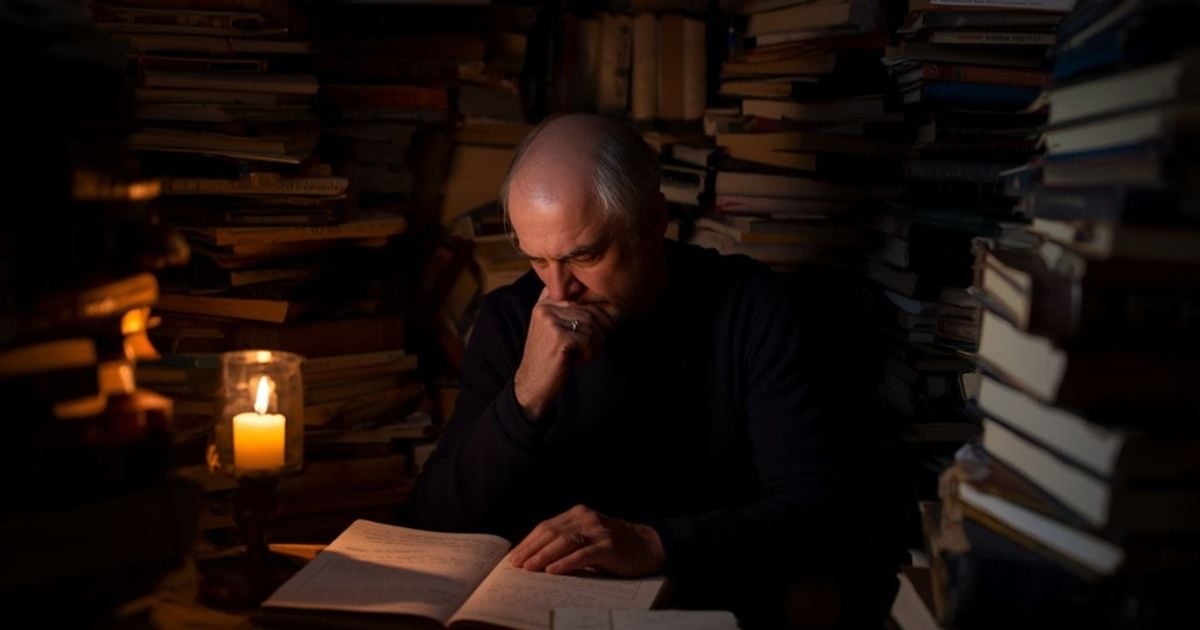
The chapter opens by picking up directly from Chapter 4's closing question about self-respect. He clarifies he isn't being remorseful, he couldn't stand saying "Forgive me, Papa, I won't do it again," not because he's incapable but because he has been far too capable of it. He would get into trouble specifically when he was not to blame, shed genuine tears of penitence, feel real emotion, and then, a minute later, realize with contempt that the whole performance was "a revolting lie." He wasn't acting in the moment, he insists. The sick feeling in his heart was real. But the lie was also real. Both at once.
Why did he do this? Sheer boredom. "It was very dull to sit with one's hands folded." He invented adventures, manufactured offences, took offence on purpose over nothing, and pushed himself until the manufactured feeling became genuine. He tried twice to fall in love. He suffered, he says, in the "real, orthodox way", jealous, beside himself. But in the depth of his heart there was never any faith in his own suffering. All of it came from ennui, all from inertia.
Here he restates the chapter's central diagnosis: the direct, legitimate fruit of consciousness is inertia, "conscious sitting-with-the-hands-folded." Men of action can act because they are stupid and limited: they take secondary causes for primary ones and thereby find a stable foundation for action. Their minds are at ease, and ease of mind is what action requires. The Underground Man cannot do this. Every primary cause immediately draws after it another, still more primary, on to infinity. He can find no foundation.
Even spite, which might serve as a substitute for a primary cause, fails him. Anger in him undergoes what he calls "chemical disintegration." He looks into it, the object flies off into air, his reasons evaporate, the wrong becomes a phantom with no one to blame. He could try letting feelings carry him without reflection, but the day after tomorrow he would despise himself for having deceived himself. Result: a soap-bubble, and then inertia.
He ends on a confession that doubles as a joke: he may only consider himself an intelligent man because all his life he has been able neither to begin nor to finish anything. Perhaps, he suggests, the direct and sole vocation of every intelligent man is babble, "the intentional pouring of water through a sieve."
Dostoevsky identified something that feels painfully modern: how intelligence can become its own prison. The Underground Man's confession that 'direct persons and men of action are active because they are stupid and limited' stings because it contains uncomfortable truth. In our information age, this trap has only gotten worse. We can research every decision to death, read every review, consider every angle until we're frozen. The nurse who can't choose a career path because she sees downsides in every option. The parent who researches parenting methods so obsessively they never actually parent. The employee who rewrites emails so many times they miss deadlines. Social media amplifies this - we have access to infinite perspectives on every choice. But the Underground Man reveals the cruel irony: the more aware you become, the less capable you are of authentic action. His manufactured emotions and fake love affairs show what happens when self-consciousness destroys spontaneity. Sometimes the 'stupid' person who acts on instinct gets better results than the 'smart' person who analyzes everything. The question becomes: how do we use our intelligence without letting it paralyze us? How do we think deeply while still preserving our ability to feel and act authentically? Maybe wisdom isn't about seeing every angle - maybe it's about knowing when to stop looking.
Explore this chapter with AI to uncover deeper meaning and practical takeaways.
AI Discussion