
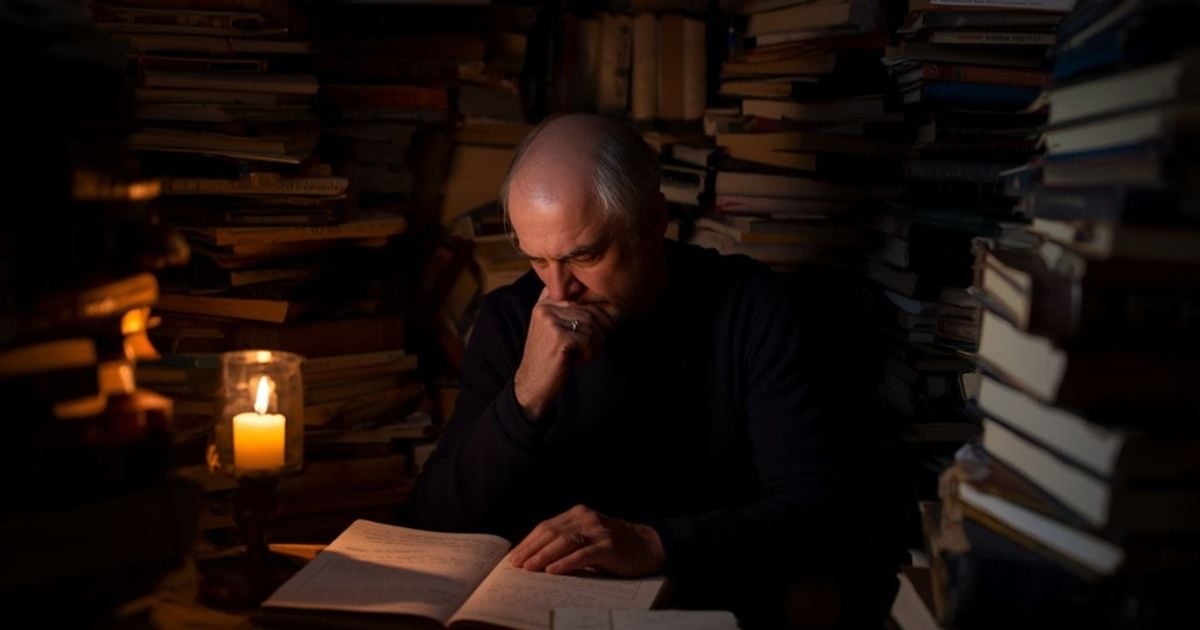
We meet our narrator: a 40-year-old former government clerk, now retired on a small inheritance, living alone in a wretched room on the outskirts of St. Petersburg. He opens with three blunt declarations, sick, spiteful, unattractive, and immediately demonstrates all three by admitting he refuses to see a doctor purely out of spite, knowing it only harms himself. He's been doing this for twenty years and sees no reason to stop.
He describes his years as a government official, where he took real pleasure in grinding his teeth at petitioners and making their visits as miserable as possible. His longest campaign: an eighteen-month feud with a particular officer who simply would not be humble, who walked with a swagger and refused to defer. The narrator eventually "won" by getting the man to stop clanking his sword. He offers this as evidence of his spite, then immediately undercuts it.
Because here is the confession that defines everything: he was never truly spiteful. At the very moment of his worst behavior, he was inwardly ashamed, knowing he was just "scaring sparrows", performing meanness while being perfectly capable of being appeased by a doll to play with or a cup of tea with sugar. He could foam at the mouth one moment and be genuinely touched the next, then spend months lying awake in shame over his own softness.
The deeper admission follows: he couldn't become anything at all, not spiteful, not kind, not a rascal, not an honest man. He felt what he calls "opposite elements" swarming in him constantly, craving an outlet he deliberately refused them. He ends with his central philosophical claim: an intelligent man in the nineteenth century cannot seriously become anything, because intelligence reveals too many sides of everything. Only fools, he argues, can act with real conviction, and so only fools can become anything. He will talk about himself to prove it.
Dostoevsky wrote this in 1864, but he was diagnosing something that feels painfully modern: the curse of too much self-awareness. The underground man isn't evil or even particularly unusual—he's what happens when intelligence turns inward and becomes self-consuming. He can analyze every motivation, see through every performance (including his own), and predict every outcome. But this hyper-consciousness doesn't make him wise; it makes him paralyzed. Today we might call it 'analysis paralysis' or 'overthinking,' but Dostoevsky understood something deeper: when you become too aware of your own psychological machinery, authentic action becomes nearly impossible. Everything feels performed, calculated, fake. The underground man's spite isn't really directed at others—it's his way of punishing himself for being unable to act naturally. This pattern shows up everywhere in modern life: the person who knows exactly how their anxiety works but can't stop the spiral; the worker who recognizes their people-pleasing behavior but continues anyway while hating themselves for it. The tragedy isn't that we lack self-knowledge—it's that we have too much of it without the tools to act despite imperfection. How do we break free from the prison of our own awareness?
Explore this chapter with AI to uncover deeper meaning and practical takeaways.
AI Discussion