
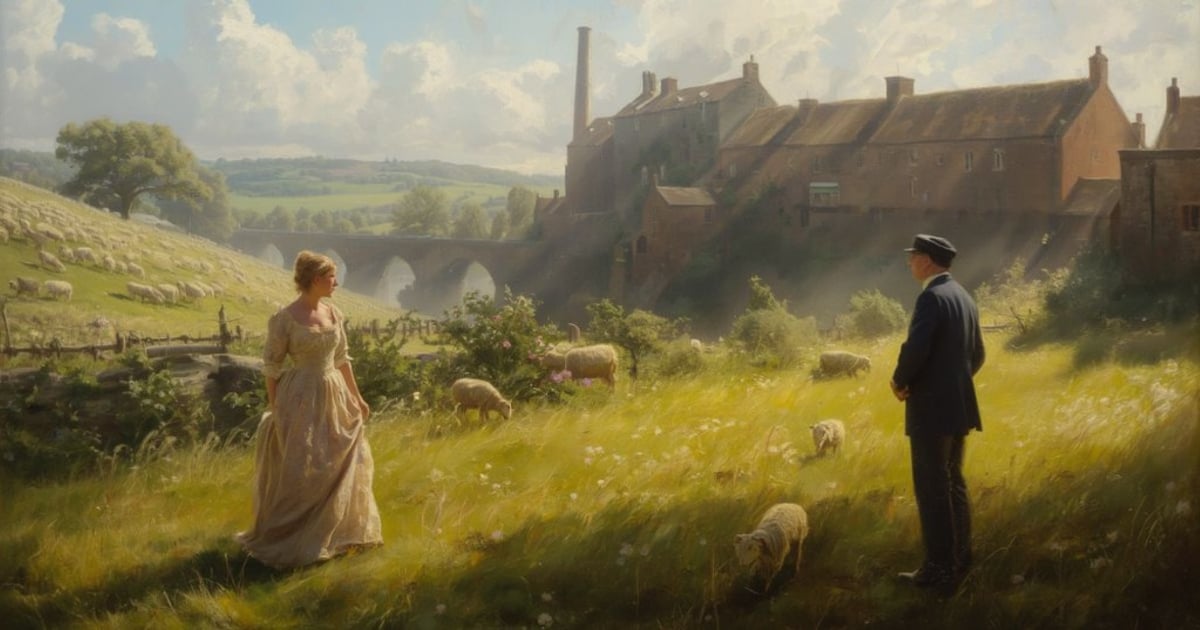
After Bessy Higgins dies, her father Nicholas heads for the gin-shop in raw grief. Margaret finds him in the street, brings him home despite Dixon's horror, and introduces him to Mr. Hale over tea in the drawing room. What begins as impropriety becomes one of the novel's frankest conversations: an ex-clergyman, a union weaver, and a gentlewoman talking across class lines because death has stripped away pretense. Margaret rushes to comfort Nicholas Higgins after his daughter Bessy's death, finding him wild with grief and heading for the gin-shop. In a bold move, she brings him home to meet her father, despite his drinking and radical views.
Higgins says he sounds like an infidel yet clings to God because Bessy is gone and unbelief would leave him nothing. He explains how the Union holds men to collective action, comparing slow pressure on reluctant members to torture, and defends the strike as answer to generations of oppression. Mr. Hale, expecting a drunken radical caricature, meets a shrewd, wounded man whose skepticism comes from experience, not performance. What follows is a remarkable evening of honest conversation between three very different people: Margaret the genteel southerner, her father the displaced clergyman, and Higgins the atheist union man.
Margaret translates and steadies both men when tempers rise. Higgins admits he despises Boucher's weakness yet shared his hunger. He asks whether Hale can help him find honest work now that mills blacklist union leaders. The evening ends with Higgins sobered, fed, and heard, not converted but no longer alone. Through their discussion of faith, labor strikes, and social justice, we see how tragedy strips away pretense. Higgins reveals he's not the hardened infidel he appears, grief has left him clinging desperately to belief in God as his only comfort. He explains the brutal reality of union enforcement, comparing it to slow torture, while defending it as necessary resistance to generations of oppression.
Margaret has turned private charity into a living alliance. Milton's divide remains, yet grief has opened a door the strike debates could not. Higgins leaves with something like trust in the Hale household, and Margaret with proof she can act, not only argue, when suffering confronts her. Hale, initially apprehensive about this 'drunken infidel weaver,' discovers a thoughtful man whose skepticism comes from lived experience, not mere rebellion. The chapter culminates in an extraordinary moment: the three kneel together for family prayer, 'Margaret the Churchwoman, her father the Dissenter, Higgins the Infidel. ' This scene demonstrates how genuine human connection transcends social boundaries when people meet in authentic vulnerability rather than defensive positions. By morning Mrs. Hale is weaker again, yet the household has crossed a line: Margaret has held death and public anger in the same night, and neither will leave her untouched.
Gaskell shows us something revolutionary: the drunk atheist union man, the displaced clergyman, and the genteel young woman discover they're not so different when grief strips away their social armor. This wasn't just progressive for 1854, it challenges us today. We live in bubbles of class, politics, and lifestyle that feel impermeable. The charge nurse doesn't socialize with the CNAs. The college graduate avoids the high school dropout. The church member judges the union organizer. Yet crisis has a way of revealing shared humanity beneath these categories. When the factory closes, when the diagnosis comes, when the child dies, suddenly our careful social boundaries seem absurd. The question isn't whether we should maintain these divisions, but whether we're brave enough to recognize our common ground when the moment arrives. Higgins wasn't really an infidel any more than Mr. Hale was really a snob, they were both just protecting themselves from a world that felt hostile. Margaret's genius was refusing to manage the awkwardness, allowing two defensive men to discover they were fighting similar battles with different weapons. How often do we miss these moments of potential connection because we're too busy maintaining our image?
Explore this chapter with AI to uncover deeper meaning and practical takeaways.
AI Discussion