
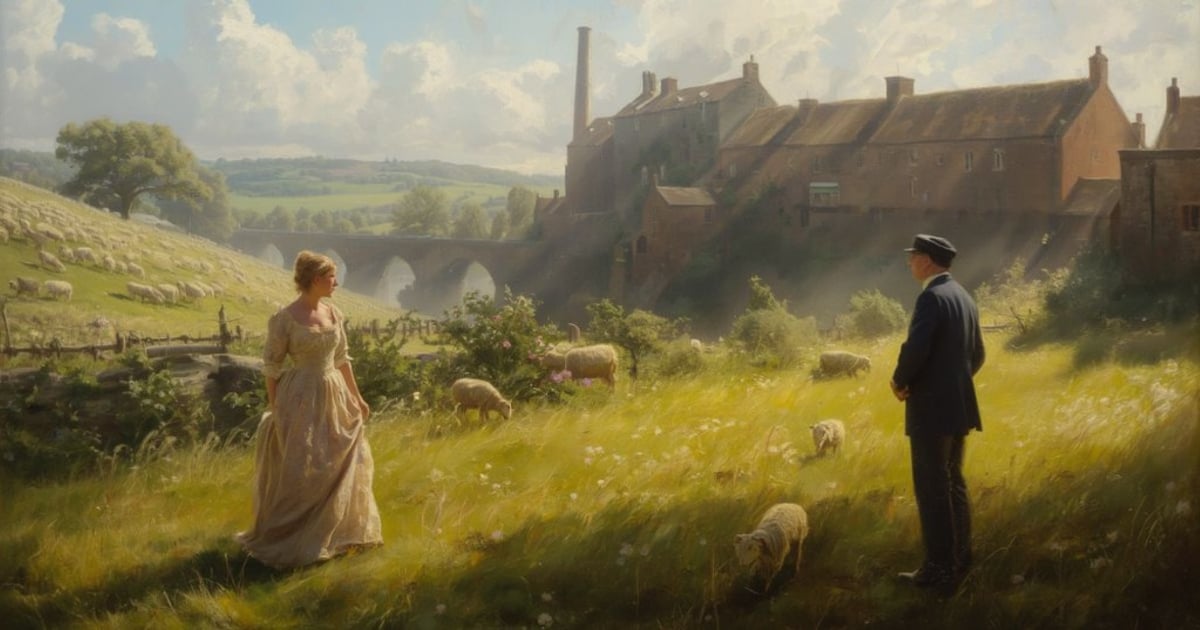
Mrs. Hale, an invalid with a shrinking world, fusses over Margaret's dress for John Thornton's dinner party with the excitement of a girl preparing for her first ball. Margaret tries on white silk, pink gauze, and green silk while her mother worries about yellowing fabric and social judgment. The domestic comedy sits beside Milton's graver mood: Bessy Higgins, feverish and failing, tells Margaret she dreamed her arriving in shining white to bring comfort, and begs to see her dressed on the twenty-first. Margaret prepares for the Thornton dinner party while navigating the complex social dynamics of Milton.
Bessy also names what Margaret will walk into. Thornton entertains the mayor, members of Parliament, and Milton's first families. Bessy fears Margaret will be looked down upon in print gown and poverty. Margaret laughs kindly and promises her best silk. Then Bessy turns to the strike: her father Nicholas and Hamper's men have turned out for five percent; women at the door tell tales of hunger, hatred, and children who cannot sleep for want of food. Bessy quotes scripture and hunger in the same breath. Her mother frets over dress choices with childlike excitement, revealing how illness can narrow one's world to small concerns.
Margaret visits Higgins's house and walks into Nicholas arguing with John Boucher, a weak neighbour whose wife and children are clemming. Boucher says he will fling the masters' money back if his wife dies waiting for the wage rise; he curses the Union that forbids him to break ranks. Nicholas, a committee-man, still pledges brass for milk and bread and insists the masters will yield. Margaret gives Bessy money for Boucher's children and asks her not to name the gift. Meanwhile, Bessy shares a mystical dream where Margaret appeared as an angel in white, foreshadowing their deepening bond across class lines.
Dr. Donaldson's treatment briefly lifts Mrs. Hale, but outside Milton broods with strike grievances Mr. Hale collects and Thornton explains away as trade's inevitable waves. Margaret must dine among owners while Boucher's baby sobs in a crowded room. Bessy plans one last visit to see her friend in white before death takes her. The conversation reveals the harsh realities of the ongoing strike, Bessy's father Nicholas and other workers have turned out, demanding a five percent wage increase while families like the Bouchers face starvation. Margaret witnesses a heartbreaking scene where Boucher, desperate and gaunt, describes his wife and children 'clemming' (starving) while the union demands solidarity.
Gaskell understood something we're still learning: geography shapes morality. Margaret can prepare for an elegant dinner while families starve because distance, physical, social, economic, creates moral distance. The suffering isn't abstract; it's invisible from where she stands. This isn't unique to Victorian England. Modern supply chains, corporate structures, and social media create the same moral geography. We buy clothes without seeing factory conditions, support policies without meeting affected families, make workplace decisions without facing consequences. The mechanism is identical: when we can't see, hear, or smell the results of our choices, our brains treat them as theoretical rather than real. Gaskell shows this isn't callousness, Margaret genuinely cares about the striking families. It's the natural result of how proximity shapes perception. The wealthy aren't evil; they're insulated. The poor aren't invisible; they're geographically separated from decision-makers. Understanding this pattern reveals why good intentions often produce harmful results. It explains how caring people participate in cruel systems. Most importantly, it suggests a solution: deliberate proximity. When facing decisions affecting others, we must actively seek out voices we can't naturally hear. The question becomes: what suffering am I too comfortable to see?
Explore this chapter with AI to uncover deeper meaning and practical takeaways.
AI Discussion