
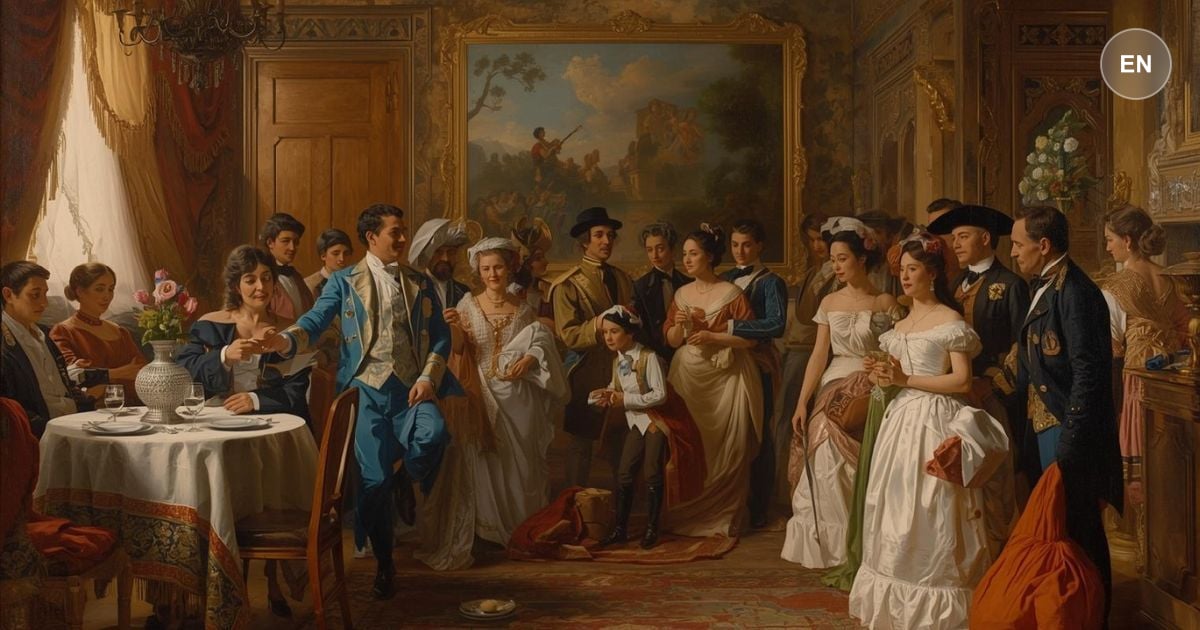
Ibarra reaches his room overlooking the river, too stunned to notice the lighted house opposite where music and dancers surround a beautiful Filipina in pearl and diamonds, likely Maria Clara, admired by friars and society while one pale young Franciscan watches from a distance. Ibarra sees none of it. His mind replaces the city with a prison cell where an old man lies dying alone, groaning a son's name, while elsewhere a feast laughs and pours wine.
The vision fuses father and son so that the cry is his own. When the music stops, the silence still carries that call. Only cockcrow, church clocks, and sentinels mark the night until exhaustion finally sleeps him.
Across town the same young friar keeps vigil at his window, staring toward Bagumbayan and the mist over the sea long after the star fades. Rizal sets celebration and grief side by side in one city: public charm on the riverbank, private desolation in the hotel, and a third watchfulness in the convent that suggests the church never stops observing. Ibarra's guilt for being absent during his father's end now colours everything he might have enjoyed, while the unseen party hints at the love and social world he has not yet reentered.
Rizal understood something psychologists wouldn't formally name for another century: trauma doesn't just create memories, it creates alternate timelines. Ibarra's experience reflects what we now call survivor's guilt - the crushing weight of being absent during someone else's suffering. But this chapter reveals something deeper about how guilt operates. It doesn't just make us feel bad; it literally splits our consciousness. While others celebrate, Ibarra lives in a shadow world where his father's death replays endlessly. This pattern shows up everywhere in working-class life. The single mother who can't enjoy her promotion because she's stuck reliving the moment she had to choose work over her sick child. The factory worker who sits through family dinners mentally replaying the accident that injured his coworker. The veteran who experiences every celebration as background noise to an internal war zone. These aren't character flaws - they're normal responses to impossible choices and traumatic losses. The key insight is recognizing when you're living in trauma-time versus real-time. Both realities exist, but only one is actually happening now. Healing isn't about forgetting the past or dismissing your pain - it's about reclaiming your right to exist in the present moment while still honouring what you've lost.
Explore this chapter with AI to uncover deeper meaning and practical takeaways.
AI Discussion