
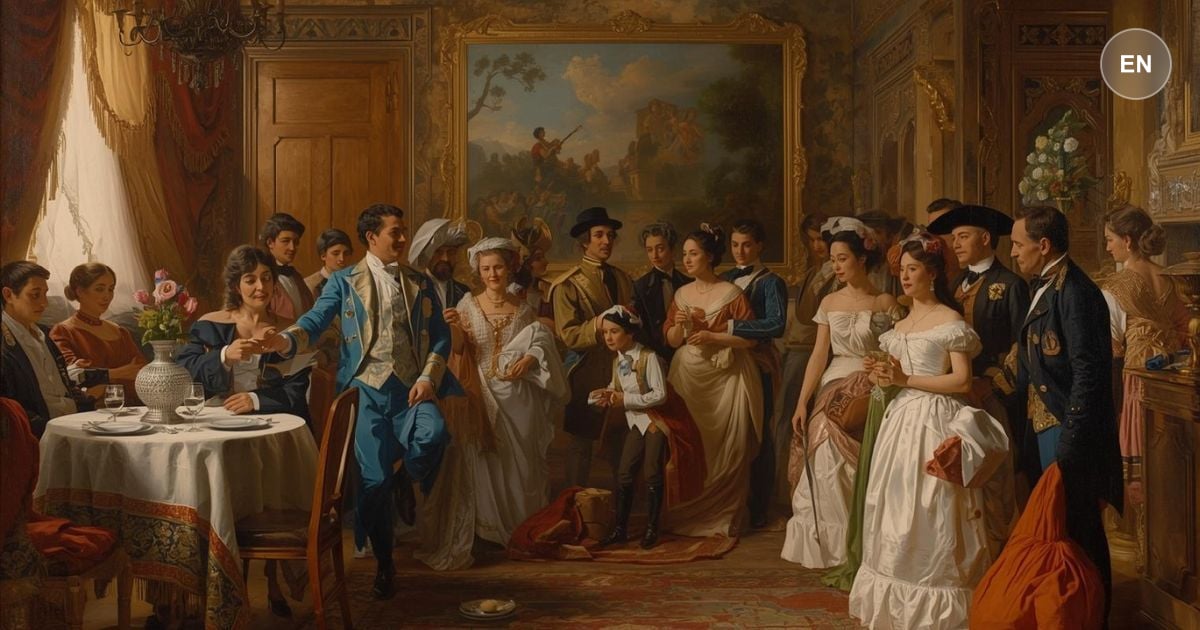
News of Ibarra striking Damaso races through San Diego. Students debate the friar's morning assault on a mestizo who claimed not to understand Tagalog; elders fear no one will forgive Ibarra for making authority afraid of a youth who dared answer back with his fist instead of his neck at a public feast.
Don Filipo says friars are always right because people allow it and offers to resign; the gobernadorcillo cites poverty and disunity as reasons to bow again before power. Women argue whether striking a priest is sin or whether a father's memory is more sacred than Padre Damaso, and every opinion reveals who profits from fear dressed as prudence and who secretly cheers the blow.
Rustics hear Crisostomo called plibustiero and mourn the unfinished school. Rizal maps how one act of resistance splinters the town by age, class, and courage, showing oppression sustained by labels too vague to refute in the plaza gossip that will reach Manila before nightfall and define a reformer as rebel though many whisper the friar deserved far worse than one open-handed blow in a province where priests have beaten boys for less and mothers call the strike a sin against heaven itself and the friars' comfort.
The most heartbreaking character in this chapter isn't the villain - it's the gobernadorcillo who says 'the friars are always right because we always allow them to be.' He sees the injustice clearly but feels powerless to act. This captures something universal about oppressive systems: they survive not just through force, but through the exhaustion and division they create among good people. The gobernadorcillo represents millions of workers who know their boss is wrong, parents who see their school board making bad decisions, and community members who watch corruption but feel too isolated to act. Rizal understood that the most dangerous moment for any corrupt system isn't when rebels attack from outside - it's when ordinary people stop making excuses for it. The chapter shows how one person's courage can shatter the collective illusion that 'this is just how things are.' But it also reveals the painful truth: most people will choose familiar oppression over uncertain freedom. The women debating whether principle is worth excommunication, the officials worried about practical consequences, the common people confused by the terminology of resistance - these aren't cowards, they're people trapped in a system designed to make resistance feel impossible. Understanding this pattern helps us navigate our own moments of choice with more compassion for others and more strategic thinking for ourselves.
Explore this chapter with AI to uncover deeper meaning and practical takeaways.
AI Discussion