
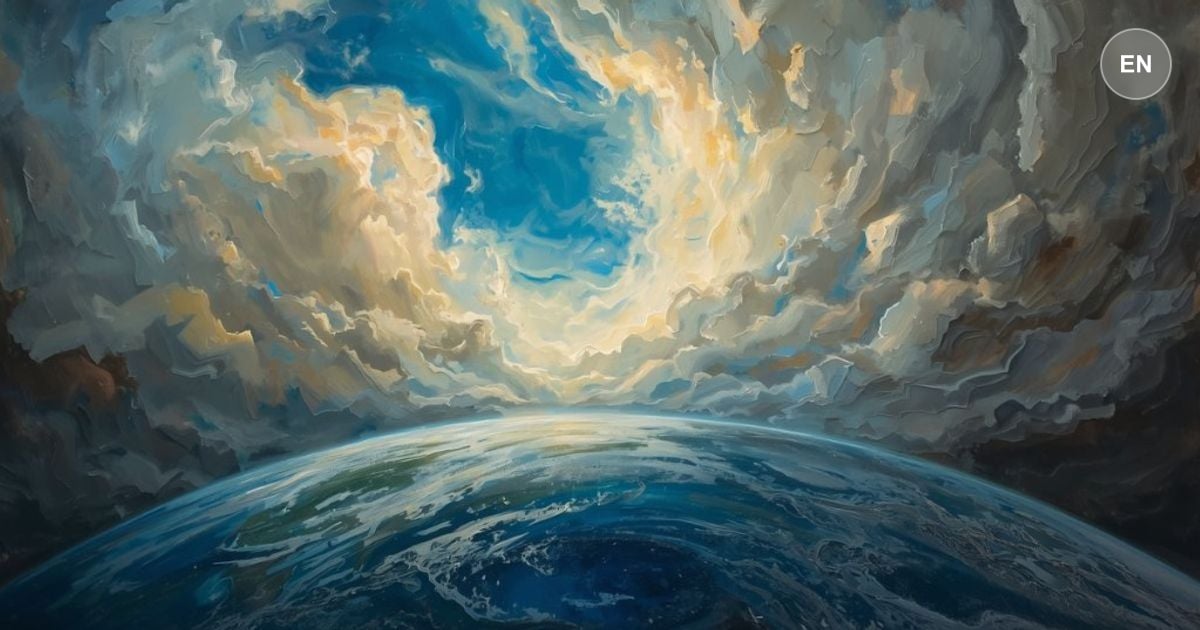
Ovid opens the Metamorphoses with a declaration, not a battle scene. He will tell of forms changed into new bodies, from the beginning of the world to his own Augustan age, and he asks the gods who performed those changes to favor the attempt. That framing matters. The poem is not a single hero's journey but a catalogue of instability: identity, landscape, and social order can all be remade under pressure. Before any nymph turns into a tree or a tyrant into a wolf, the reader meets Chaos, a rude and undigested mass where sea, earth, and heaven share one body and opposites fight inside the same substance. Cold strives with hot, moist with dry, soft with hard. Nothing has its present form. There is no sun to mark time, no moon cycling through phases, no coastlines where land and water keep their places.
To this discord God and bounteous Nature put an end. The creative act is separation and placement, not magic from nothing. Fire without weight rises to the highest vault; air follows; earth draws heavier atoms and compacts by gravity; encircling waters sink to the lowermost place around the solid globe. Elements released from confused heap are combined in harmonious unison, each in its proper station. Ovid's cosmology teaches a transferable skill: order begins when someone sorts what has been piled together without distinction. The Dryden translation, thick with scholarly footnotes, still preserves the core image. Stable reality is an achieved balance. Beneath every workable system sits memory of prior disorder.
After matter is arranged, living things appear and Prometheus molds earth tempered with water into human shape. Humanity enters a cosmos already governed by proportion and boundary. That sequence links personal stories later in the book to a universal law. Transformation is not an odd miracle stuck onto ordinary life. It is the deep grammar of existence. For a reader in a crowded emergency department or any overloaded institution, the opening offers a first move before drama arrives: name the elements, assign categories, and stop treating every signal as equally urgent. Classification is moral architecture. Without it, loudness replaces need.
The poem's scale also trains perspective. Ovid could have begun with Apollo or Daphne. Instead he begins with the whole universe, teaching that private crises participate in a larger pattern of form and re-form. World order is presented as work performed by intelligence on resistant mixture. It is never guaranteed. Even after creation, the text will show social life degrading, bodies changing under pursuit, and civilizations washed away. Chapter 1 therefore installs a double awareness: structure can be built, and structure can fail. Readers who internalize both halves are less likely to panic when stability cracks and more likely to ask what must be separated next to keep the vulnerable alive.
Dryden's edition surrounds the poetry with explanatory notes comparing Chaos to Genesis and Hesiod, yet the narrative spine remains legible. Creation is architectural: a divine intelligence ranges pre-existent matter into situations suited to each element's qualities. That philosophical detail matters for Thomas, the ER nurse who anchors this book's modern adaptation. His shift does not invent patients from nothing. It sorts arrivals already mixed together, assigns lanes, and makes a livable shift possible through deliberate boundaries. Ovid's opening is the mythic version of the same competence.
Once the cosmos exists, Ovid narrates human history as a sequence of ages, each morally poorer than the last. The Golden Age needs no laws because faith and rectitude govern without enforcers. Punishment and fear of punishment do not exist. Pines have not yet been cut to build ships that visit foreign shores. There are no trumpets, helmets, or swords because there is no occasion for soldiers. The earth itself, untouched by plough, yields food without compulsion. Eternal spring prevails; rivers of milk and nectar flow; honey distills from the green holm oak. The picture is not documentary history. It is a contrast that clarifies values: trust, abundance without extraction, and restraint without policing.
When Saturn is driven to Tartarus and Jupiter rules, the Silver Age arrives, inferior to gold but still precious. Jupiter shortens the former spring and divides the year into winter, summer, unstable autumn, and brief spring. Heat and ice appear. Humans enter houses, first caves and woven branches, then agriculture as Ceres' seeds go into furrows and oxen groan under the yoke. The Bronze Age follows, fiercer and war-prone yet still free from the worst impiety. Then comes hard iron, and crime bursts forth at once.
Modesty, truth, and honour take flight. Fraud, violence, and the cursed hunger for acquisition replace them. Sailors spread sails to winds they barely know; trees from mountain heights become ships on unknown waves. Land once common as sunlight is measured with boundaries. Men dig into the earth for riches that incentivize vice. War rises with iron and gold together. Guests are unsafe with hosts; brothers rarely feel goodwill; spouses wish each other dead. Astraea, virgin goddess of justice, is the last deity to abandon an earth drenched in slaughter.
Ovid's ages map a psychological habit as much as a mythic timeline. Every generation can name a lost golden moment when life felt simpler and people were more honest. The poem insists that each era demands more labor and offers less security. Silver brings seasons and shelter; bronze brings organized conflict; iron brings betrayal inside the household. This is not mere nostalgia. It is a warning that moral drift is gradual and habit-based. Communities normalize violence when restraint weakens. The Golden Age cannot be restored as policy. Time moves forward through crisis and adaptation. The practical question is which virtues can be recovered inside damaged systems: fairness, attentiveness, and restraint inside permanent urgency.
The chapter also tells how giants piled mountains toward the stars to seize heaven, and how Jupiter's lightnings broke Ossa from Pelion and buried them under their own structure. Earth, drenched with their blood, shaped the warm gore into a new human generation: despisers of the gods, greedy for slaughter, eager for violence. That origin story links cosmic rebellion to terrestrial corruption. Disorder at the largest scale breeds populations that inherit appetite for ruin. Ovid prepares the flood not as a random divine tantrum but as surgery on a body politic that admits no cure except removal of the diseased part. Readers who track the ages learn to watch for the moment when necessity language begins justifying domination, because that is the bridge from manageable hardship to the kind of world Jupiter will drown.
After cosmic and historical frames, Ovid turns to bodies in motion under unequal power. The Apollo and Daphne story begins with Cupid, not with romance. Proud Apollo, fresh from slaying Python, mocks the boy's bow. Cupid answers that his arrow will pierce the god himself, and shoots two shafts: one of repelling lead into the nymph, one of golden desire into Apollo's marrow. Daphne flees the very name of lover, hunting in woods, devoted to virginity like Diana, refusing marriage though her father Peneus asks for grandchildren. Apollo burns anyway, praising what he sees and pursuing what he covets. He calls after her that he is not an enemy, comparing himself to wolf, lion, and eagle only to insist that love, not hatred, drives the chase. Daphne runs faster. The asymmetry is the point. A god experiences pursuit as admiration; the pursued body experiences it as danger.
When capture nears, Daphne prays to her father and is changed into laurel. Bark closes over her limbs, hair becomes leaves, arms become branches. Apollo still claims her: he will wear her leaves as crown and honour her as his tree. Metamorphosis here is simultaneous rescue and loss. Agency survives as refusal, but human form is the price. Ovid refuses a comfortable romance. He forces the reader to ask who narrates an episode as devotion and who lives it as coercion. The pattern repeats across institutions now. The same shift can be called motivational by authority and humiliating by the person whose body absorbs the cost.
The Io narrative extends pursuit into surveillance and disguise. Jupiter, detected again by Juno, turns Inachus' daughter into a sleek heifer to hide the affair. Juno, suspecting the trick, demands the cow as a gift and assigns watchful Argus, whose hundred eyes take turns sleeping so someone always watches Io. She lows instead of speaks, licks her father's hand, and writes her name in dust with her hoof. Inachus learns the truth and grieves that gods cannot die to end such pain. Mercury, sent by Jupiter, lulls Argus with story and music, then cuts off his sleeping head. Juno sets Argus' eyes in the peacock's tail. Io, tormented by Juno's fury, wanders until she reaches the Nile, where Jupiter swears she will trouble Juno no more and restores her human shape. She becomes worshipped in Egypt as Isis. The arc shows transformation as punishment, communication, and eventual restoration, but only after exile and terror.
Pan and Syrinx add a lighter variant on the same structure. Pan pursues the nymph; blocked by Ladon's stream, she prays to watery sisters and becomes reeds. Pan's grasp closes on marsh plants, not flesh. Wind in the reeds produces a mourning sound; he binds unequal pipes with wax and keeps her name on the instrument. Desire that cannot possess converts its object into art or tool. Across these myths, Chapter 1 trains moral attention at intimate scale. Power pursues; the less powerful transform to survive. Sometimes the new form is honour, sometimes captivity, sometimes music. Accurate reading begins by separating the storyteller's frame from the embodied cost.
These pursuit stories also appear after flood and repopulation in Ovid's book order, which is itself instructive. Civilization can be rebuilt and still reproduce coercion at the level of gods and nymphs. Renewal does not erase appetite or surveillance. Io's letters traced in dust, Daphne's bark climbing her skin, and Syrinx's hollow pipes all show communication transformed when speech is denied. The chapter asks whether you are hearing the pursuer's story or the pursued body's record. That distinction is the ethical hinge for every retelling of Metamorphoses in classrooms, clinics, and courts.
Collective catastrophe follows personal pursuit in Ovid's architecture. Jupiter, seeing universal corruption and recalling Lycaon's polluted banquet, convenes the gods on the Milky Way. He swears by the rivers of Hell to destroy the human race wherever ocean surrounds the earth. Some gods urge vengeance; others grieve that earth will lack worshippers. Jupiter promises a wondrous new generation unlike the last. Disguised as a mortal, he visits Arcadia and finds guilt everywhere. At Lycaon's palace he is mocked, tested, and threatened with murder in sleep. Lycaon serves human flesh to see whether his guest is truly divine. Jupiter overthrows the house with avenging flames and turns the king into a wolf who still retains ferocity in his features. The episode proves that impiety is not abstract. It is hospitality violated, flesh commodified, and power daring to consume the sacred.
Because one house alone does not deserve to perish, Jupiter resolves on universal flood. He lays aside thunder lest heaven catch fire and instead shuts the North Wind in Aeolus' cave and unleashes the South Wind. Iris gathers waters; crops collapse; Neptune opens river mouths and strikes earth with his trident. Sea and land lose distinction. Men climb hills or row over submerged fields; wolves swim among sheep; lions and tigers ride the same waves; birds fall exhausted into water. The boundless sea overwhelms mountains. Only after this annihilation does mercy appear with precision. Deucalion and Pyrrha, the most upright man and most devout woman, survive together on Parnassus in a small ship. When Jupiter sees guiltless worshippers alone remaining, he disperses clouds, calms the sea, and commands Triton to sound the retreat on his shell so waters withdraw within shores and rivers within banks.
The world returns empty and silent. Deucalion weeps to Pyrrha that they two are the whole people of the earth. He wishes he could repeople the world as Prometheus once molded clay. Themis instructs them to veil their heads, loosen their garments, and throw the bones of their great mother behind them. They interpret the oracle: great mother is earth, her bones are stones. Stones thrown backward soften and take human shape. Thus renewal arrives through disciplined obedience to ambiguous instruction. They do not rebuild by restoring the past exactly. They improvise from what remains, trusting courage and interpretation together. Hard matter becomes living community when read faithfully.
Chapter 1 closes by linking scales. Cosmic order emerged from sorting chaos. Social decay emerged through ages and giant-born violence. Personal survival required radical form change under pursuit. Collective rebirth required flood, remnant, and ritual reinvention. Ovid ends Book 1 with Io restored and Epaphus born, pointing toward Phaethon's pride in the next chapter. For modern readers, especially anyone working inside crisis systems, the lesson is practice, not fantasy of control. When the world becomes unrecognizable, name elements clearly, read power honestly, and choose forms that protect life. Deucalion's stones are today's protocols, handoffs, and compassionate repetition after the surge recedes.
Jupiter's council on the Milky Way also contains a political aside comparing divine wrath to Roman fear after Caesar's murder and gratitude for Augustus' survival. Ovid binds myth to his present, reminding readers that catastrophes feel universal when they arrive. The gods debate whether anyone will burn incense if humanity vanishes, a question any institution asks after layoffs or disaster: who will keep the rituals that hold community together? Deucalion and Pyrrha answer by becoming the ritual themselves, walking veiled, throwing stones, and accepting unclear instructions until new life appears. That is the chapter's final transferable skill: faithful experimentation when maps are gone but duty remains.
Ovid's four ages, from Golden to Iron, aren't just ancient nostalgia. They map our psychological response to complexity and moral compromise. The Golden Age represents that time when life felt simpler, when right and wrong seemed clear, when we didn't have to make impossible choices between competing values. Every generation looks back and sees a time when people were more honest, when communities were stronger, when work had meaning. But notice the pattern: each age requires more effort and offers less security. The Silver Age brings seasons and the need for shelter. The Bronze Age brings conflict. The Iron Age brings our current reality, where good people make morally complex decisions just to survive. This isn't decline; it's the natural progression of systems becoming more complex. When we romanticize the past, we're really mourning the loss of simple solutions to complex problems. The Golden Age never existed as Ovid described it, but the longing is real. It represents our desire for a world where doing right doesn't require choosing between competing goods, where survival doesn't demand compromise, where we don't have to separate ourselves from parts of our humanity just to function. Understanding this pattern helps us stop waiting for simpler times to return and start building order within the complexity we actually face.
Explore this chapter with AI to uncover deeper meaning and practical takeaways.
AI Discussion