
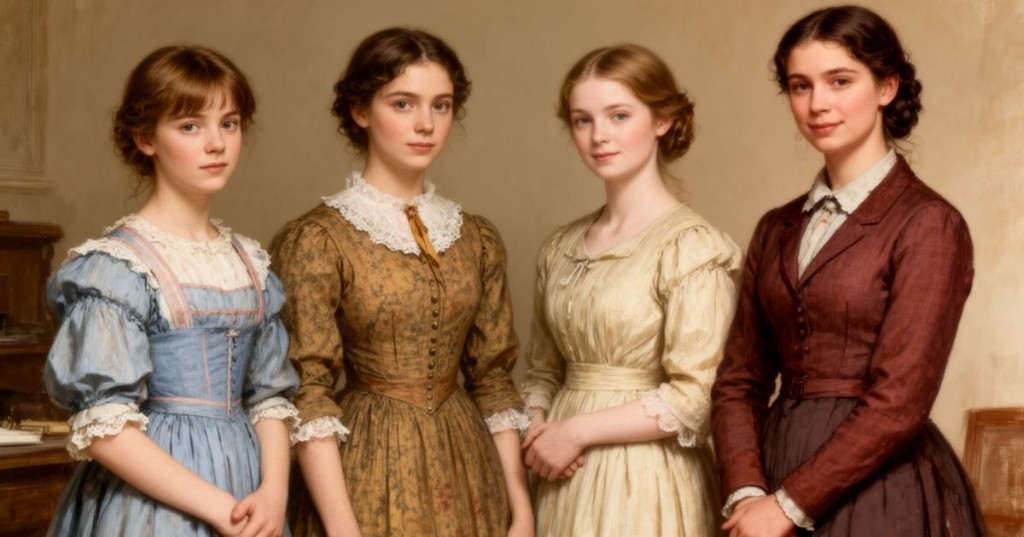
On the eve of twenty-five Jo lies on Beth's red pillow, planning stories and fearing a literary spinster future with nothing to show for her years. The narrator pauses for a long homily on old maids, courtesy, and hidden sacrifices before Laurie himself appears, substantial and lifelike, and kisses her before she can believe it is he. She cries, Oh my Teddy, and learns in the same breath that Amy is his wife, kept secret until he could tell Jo first.
He describes a quiet wedding at the American consul's in Paris, a honeymoon at Valrosa, and Beth remembered in their happiness. Laurie asks forgiveness for boyish passion, explains how Amy replaced Jo in his heart in Switzerland, and Jo answers that they can be brother and sister but never boy and girl again. They laugh like the old days, yet an invisible barricade of time and change sits between them until honest words clear the air.
The whole family pours in to celebrate the returned travellers. Amy glows with new tenderness; Mr. Laurence beams at my children; Meg feels her dress eclipsed and still rejoices; Jo watches and thinks Laurie has found the accomplished partner she could never be. Mercy on us, how they talk until tea saves their voices. Beth's empty chair, her unfinished basket, and her smiling picture preside while Amy sings Beth's songs with a tenderness no master could teach, and the hymn breaks when Amy reaches heaven cannot heal.
Jo calls for Mignon's song, and Mr. Bhaer sings while Jo warbles beside him, glorifying the plain man she tries not to stare at. When the party thins, Jo lingers with Hannah, feels sudden loneliness on the stairs, and opens the door to Professor Bhaer beaming from the darkness. He is welcomed for Jo's sake and kept for his own, wins the children, confounds Laurie briefly, and stays late while Jo knits and steals glances. She walks to bed wondering what business brought Fritz to town, while he kisses her published portrait in private, a clue she has not yet seen. The evening holds Laurie's altered love, Amy's transformed dignity, Beth's unseen blessing, and Jo's birthday fear dissolving into two arrivals she did not plan and cannot yet measure. Jo thinks herself an old maid with a pen for a spouse until the room fills with living proof that her work, grief, and loyalty already amounted to a life, even before Fritz crosses the threshold in a new black suit with gold sleeve-buttons shining.
Hannah mixes poetry and hash at supper; Demi smuggles tarts; Laurie offers welcome across the way; and Jo stands companionless a moment on the stairs before the knock that brings Fritz. The narrator's birthday homily on spinsters lingers over Jo's fear before joy proves her wrong in the same hour.
Jo faces what might be literature's most mature moment: watching someone you loved choose someone else—your own sister—and responding with grace instead of devastation. In 1868, this scenario could destroy families permanently. Women had few options if they 'lost' their romantic chance. Today, we face similar emotional territory but with different stakes. Your ex gets engaged to your coworker. Your adult child chooses a partner you didn't expect. Your best friend gets the promotion you wanted. The same choice remains: make it about your worth, or recognize that others' happiness isn't your failure. Alcott shows us that clinging to old versions of relationships kills them, while graceful adaptation lets them evolve into something potentially better. Jo doesn't pretend it doesn't hurt, but she separates the hurt from her value as a person. She stays open to Professor Bauer's interest precisely because she didn't close her heart in bitterness over Laurie. The pattern reveals itself everywhere: resistance breeds resentment, acceptance creates space for new possibilities. The most emotionally intelligent people understand that most relationship 'endings' are actually transformations—but only if we let them be. How do we practice this kind of grace when our ego wants to make everything personal?
Explore this chapter with AI to uncover deeper meaning and practical takeaways.
AI Discussion