
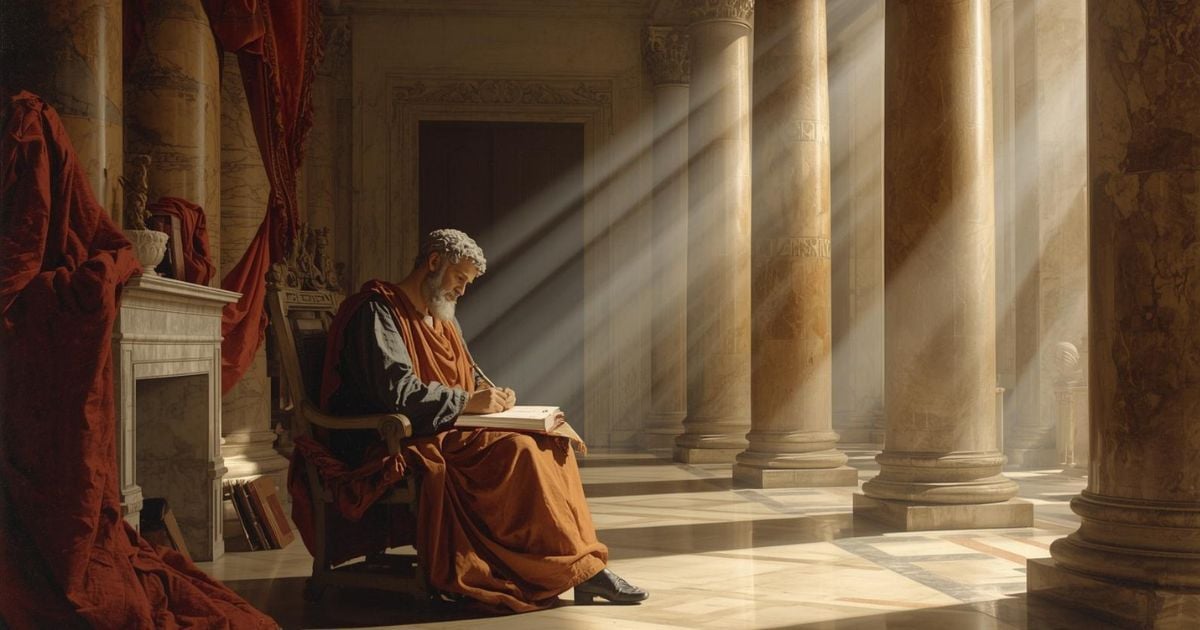
Time doesn't feel fast until you look backwards. Letter 49 opens with Seneca passing through Campania and being struck by a sudden sharp sense of Lucilius's absence, memories not dead but dormant, roused by a familiar landscape. Then the meditation on time itself: it was but a moment ago that he sat in the philosopher Sotion's school as a boy, but a moment ago he began pleading in the courts, but a moment ago he lost the desire to. All past time lies in the same place. It all looks the same from a distance.
Everything slips into the same abyss. His conclusion is sharp: life is a point, nay, even less than a point, and nature has mocked us by making it seem longer through its division into stages. How many steps for how short a climb. The practical application is anger. Given how little time there is, how can any of it be spent on dialectical puzzles?
A soldier under siege doesn't sit solving riddles. Seneca is under siege. What he needs, and what he asks philosophy to deliver, is courage to face hardship, calm before the unavoidable, and a way of understanding that the good in life depends not on its length but on how it is used. Death may come tonight.
Life may not return tomorrow. Say this clearly, and say it often.
Seneca discovered something that neuroscience now confirms: our brains are terrible at accurately perceiving time's passage. We experience the present moment-by-moment, making time feel abundant, while memory compresses years into what feels like 'just yesterday.' This creates a systematic bias toward procrastination on life's most important decisions. In Seneca's Rome, people wasted precious time on elaborate rhetorical games and meaningless intellectual debates while neglecting wisdom and virtue. Today, we see the same pattern: endless scrolling through social media while avoiding difficult conversations with family members, debating celebrity gossip during breaks while postponing career development, or spending hours on fantasy sports while delaying financial planning. The mechanism is identical—we mistake urgent trivia for important fundamentals because trivia feels immediate and manageable, while fundamental changes feel overwhelming and can be 'handled later.' But Seneca's insight cuts deeper: recognising time's true scarcity isn't meant to create anxiety, but clarity. When you truly understand that your time is limited, you naturally prioritise what matters. The coworker who finally has the difficult conversation with their teenager. The friend who stops talking about 'someday' and enrolls in night classes this semester. The family member who schedules the long-overdue medical checkup. Time blindness isn't a personal failing—it's a universal human pattern. But once you can name it, you can navigate it. What important conversation or decision have you been postponing, assuming you have unlimited time to address it later?
Explore this chapter with AI to uncover deeper meaning and practical takeaways.
AI Discussion