
Edgar leads Gloucester to the supposed edge of Dover cliff: which is, in fact, flat ground. He constructs the height entirely in words: fishermen below the size of mice, a ship reduced to a buoy, samphire gatherers hanging halfway down. Gloucester gives him a purse, says farewell, and leaps.
He falls forward onto level earth. Edgar, stepping into a new character, a bystander on the beach below, tells Gloucester he has survived a fall of ten masts in height. The thing that led him to the edge, Edgar says, was a fiend with a thousand noses and eyes like full moons. The gods preserved him. Gloucester accepts this. "I do remember now: henceforth I'll bear / Affliction till it do cry out itself / 'Enough, enough,' and die." The therapeutic fiction has worked. Edgar's aside, spoken before the leap: "Why I do trifle thus with his despair / Is done to cure it."
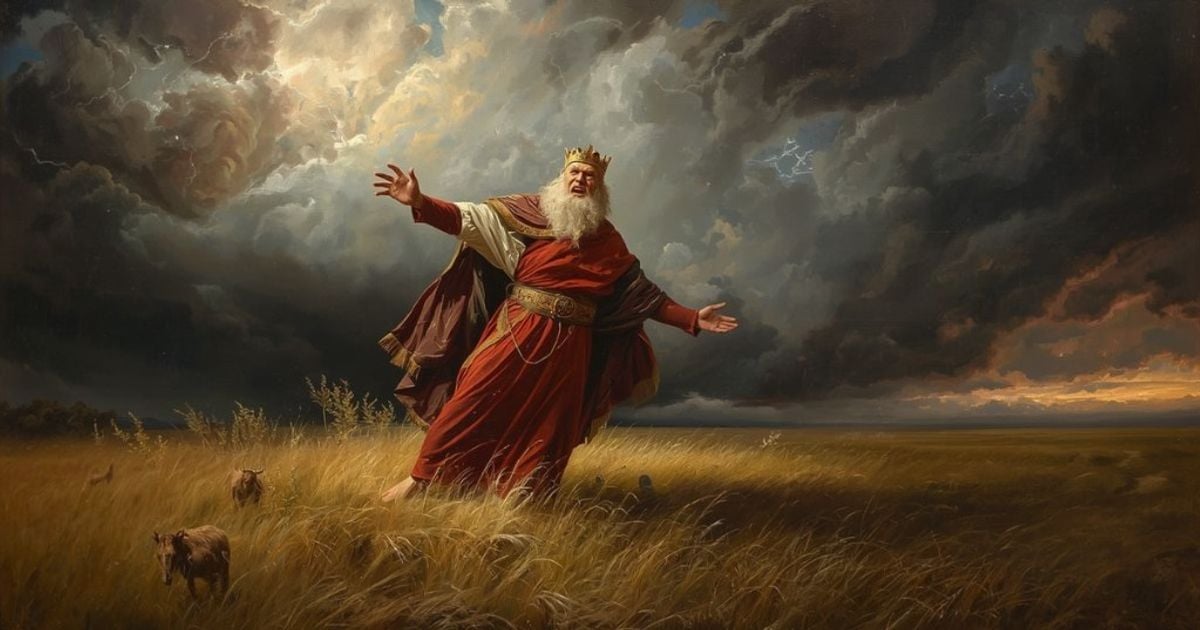
Then Lear arrives; fantastically dressed with wild flowers, his mind ranging freely across law, war, and sex in the way that madness sometimes produces unexpected clarity. He recognises Gloucester's voice. Gloucester reaches to kiss his hand. Lear says: "Let me wipe it first; it smells of mortality."
Lear speaks on justice with sudden lucidity: "Through tatter'd clothes great vices do appear; robes and furr'd gowns hide all. Plate sin with gold, and the strong lance of justice hurtless breaks; arm it in rags, a pygmy's straw does pierce it." He tells Gloucester to look with his ears; to see how the justice rails at the thief, and ask himself which is which when you swap their clothes.
Gloucester says he sees the world "feelingly." Lear tells him: "When we are born, we cry that we are come / To this great stage of fools."
Cordelia's attendants arrive and Lear runs. A gentleman notes to Edgar that one daughter "redeems nature from the general curse which twain have brought her to."
Oswald arrives to collect the bounty on Gloucester's head. Edgar kills him and searches the body. Goneril's letter to Edmund is there: a direct instruction to murder Albany so Edmund can take his place. Edgar buries Oswald and keeps the letter.
Gloucester prays he will not be tempted to end his life again before the gods are ready. Edgar takes his arm. Drums can be heard in the distance.
Edgar's elaborate deception raises uncomfortable questions about honesty that most of us would rather avoid. We're taught that truth is always better than lies, but Shakespeare shows us a father ready to die and a son who saves him with fiction. Edgar doesn't minimize Gloucester's pain or offer false comfort. Instead, he creates a story that gives his father permission to choose life while keeping his dignity intact. This pattern shows up constantly in working-class life, where people face situations that truth alone cannot fix. The nurse who tells a family their loved one 'went peacefully' when the death was actually difficult. The friend who says 'you'll bounce back from this' after a devastating job loss, even when the industry is dying. The parent who promises a struggling child that 'everything will work out' when the family is facing eviction. These aren't cruel deceptions or manipulation. They're recognition that sometimes people need hope more than information, especially when they're drowning and truth won't teach them to swim any faster. The key is understanding the difference between lies that open doors and lies that close them. Therapeutic deception gives people strength to keep fighting when they otherwise might give up. But it only works when the liar genuinely cares about the other person's wellbeing, not their own convenience. How do we know when someone needs truth versus when they need hope?
Explore this chapter with AI to uncover deeper meaning and practical takeaways.
AI Discussion