
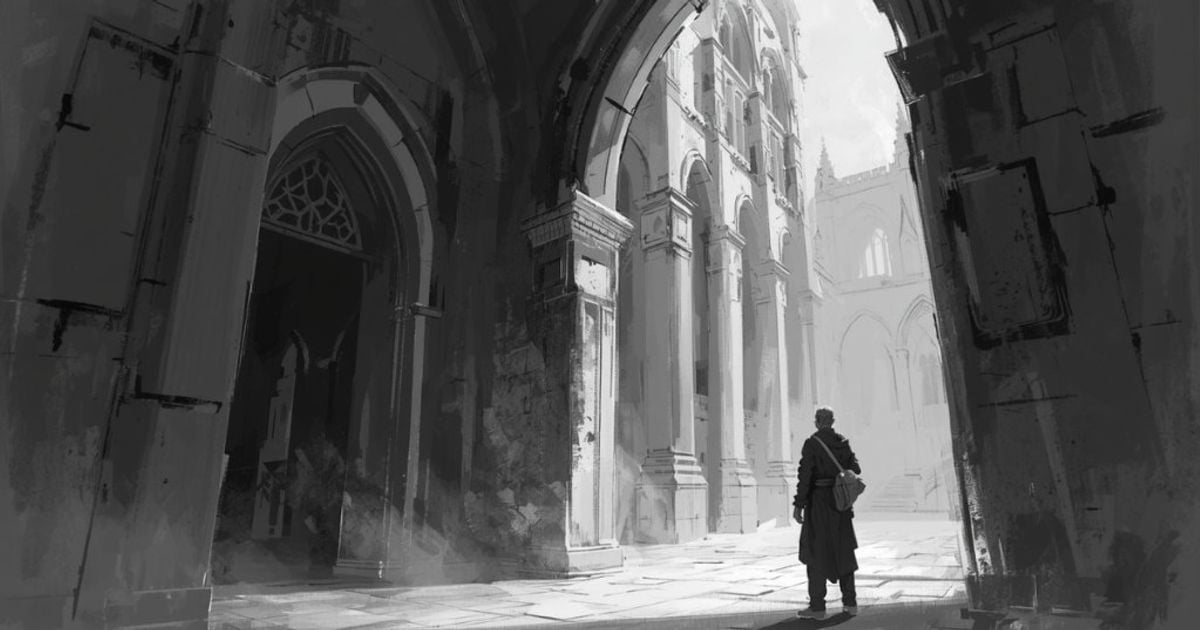
Leafy summer, Remembrance Week. Arabella heats an umbrella-stay in a candle and curls her hair, practises a dimple, and waits for her father to take her place. Bells hum round Jude's head. She gauges his ebbing life and slips out. The town is putting up awnings for a ball. A concert rolls through yellow blinds as far as his room. He wakes. A little water, please. Sue. Arabella. Nothing but the deserted room. Hurrahs from the river. Let the day perish wherein I was born. The crowd answers Hurrah.
She looks in at Cardinal, nods to a carpenter who once worked with him, and says there is no dancing for her. At the door Stagg asks her to the boat-bumping. Father is with him, she believes. Father is not. Jude has slipped flat. Fingers cold, chest still. The bumping of near thirty years has ceased. To think he should die just now. She closes the door and tells the men he is sleeping quite sound. On the river Vilbert's arm steals round her waist. She remembers an inquest if he is found dead alone, elbows through to a woman who lays out the poorer dead, and calls at the sexton's about the bell. By ten he lies straight under a sheet, a waltz coming in from Cardinal.
Two days later Mrs. Edlin looks at the open coffin and says how beautiful he is. He's a handsome corpse, Arabella answers. From the theatre, honorary degrees and young lungs. His dog-eared Greek Testament pales on the shelf. Will she come? She swore not to see him again. She has found peace, the widow says. She may swear it on the cross upon her necklace, Arabella answers. She's never found peace since she left his arms, and never will again till she's as he is now.
Hardy wrote this chapter in 1895, but the pattern feels painfully current. When someone is truly suffering, being present requires emotional labour that many people simply won't invest. Crystal's behaviour isn't just callous—it's economically rational from her perspective. Staying with sick Jude costs her networking opportunities, fun, and potential advancement. The company barbecue offers immediate social and professional rewards. Her choice makes perfect sense if you view relationships as transactions. This dynamic intensifies in working-class communities where opportunities feel scarce and competition is fierce. Missing one company event might mean missing the only promotion chance this year. The tragedy isn't that Crystal is uniquely selfish—it's that economic pressure creates systems where caring becomes a luxury many feel they can't afford. Yet Hardy also shows us the alternative: the few people who do stay during crisis reveal themselves as genuinely trustworthy. Mrs. Edlin, who appears briefly, represents those rare individuals who show up without calculating personal cost. In our gig economy world, where job security is minimal and social safety nets are thin, this pattern has only intensified. The question becomes: how do we build relationships that transcend transactional thinking, and how do we recognise the difference between fair-weather friends and genuine allies before we need them most?
Explore this chapter with AI to uncover deeper meaning and practical takeaways.
AI Discussion