
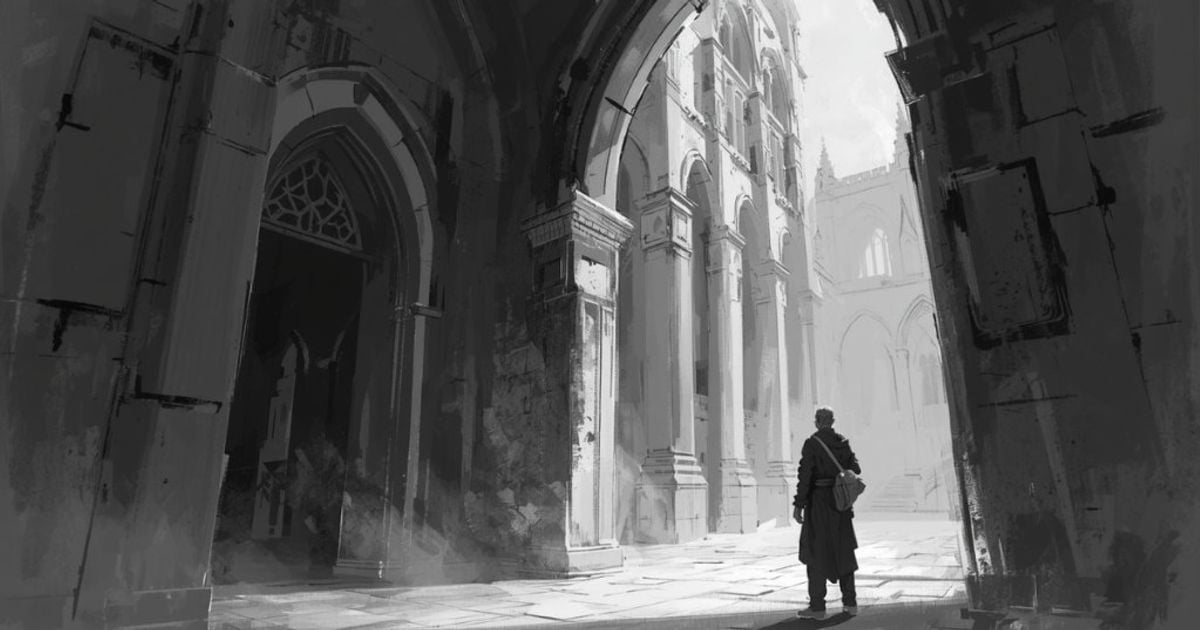
Jude arrives at the ancient ridgeway, the Icknield Street, a Roman road that has run east and west across the high plateau since before living memory, on a hazy afternoon. The northern landscape spreads below him for forty or fifty miles, bluer and moister than the upland air he lives in. He climbs a ladder on the Brown House barn where two tile-workers are repairing the roof and asks them to point toward Christminster. They do, but the mist is too thick for anyone to see anything.
When the men finish their work and descend, Jude stays on the ridge, unwilling to leave without at least trying. He climbs the ladder a second time alone. In a gesture of pure, unselfconscious faith, he kneels on the third rung and prays for the mist to clear. He has read in a tract that prayer works for some people and not others, depending on obscure circumstances. Ten minutes later the mist dissolves. As the sun breaks through at the western horizon, the spires, domes, and lit windows of Christminster appear as tiny points of topaz light before fading again with the last of the day.
He watches until they go dark. Later, having grown bolder, he makes a second evening pilgrimage to the same spot after dark to see the city's glow against the sky, inhaling the northeast wind as though it carries particles of Phillotson's breath from the streets of the city itself. He meets a coal carter who has never visited Christminster but delivers a vivid, partly invented account of its scholars, church music, college halls, and foreign languages, getting his authority from a friend who once cleaned boots at a hotel there. Walking home alone in the dark, Jude invents a private catechism for the city he cannot yet enter. Each phrase carries him further from the boy who left Marygreen that afternoon. He calls Christminster a city of light, a tree of knowledge, a place that teachers of men spring from and go to, and finally a castle manned by scholarship and religion. His last whispered verdict is the simplest: it would just suit me. Hardy has moved Jude from yearning to intention, from rumor to personal covenant.
The chapter is a study in how hope is kept alive. Jude goes to the ridge-top not because it advances his learning but because looking toward Christminster makes him feel like the person he intends to become. Hardy treats this seriously, even warmly. The prayer is answered. Whether by weather or grace the narrative does not decide. What matters is that Jude interprets it as confirmation and walks home more certain than he arrived. Sometimes the maintenance of a dream requires ritual rather than progress, and Jude knows this instinctively at eleven years old.
Explore this chapter with AI to uncover deeper meaning and practical takeaways.
AI Discussion