
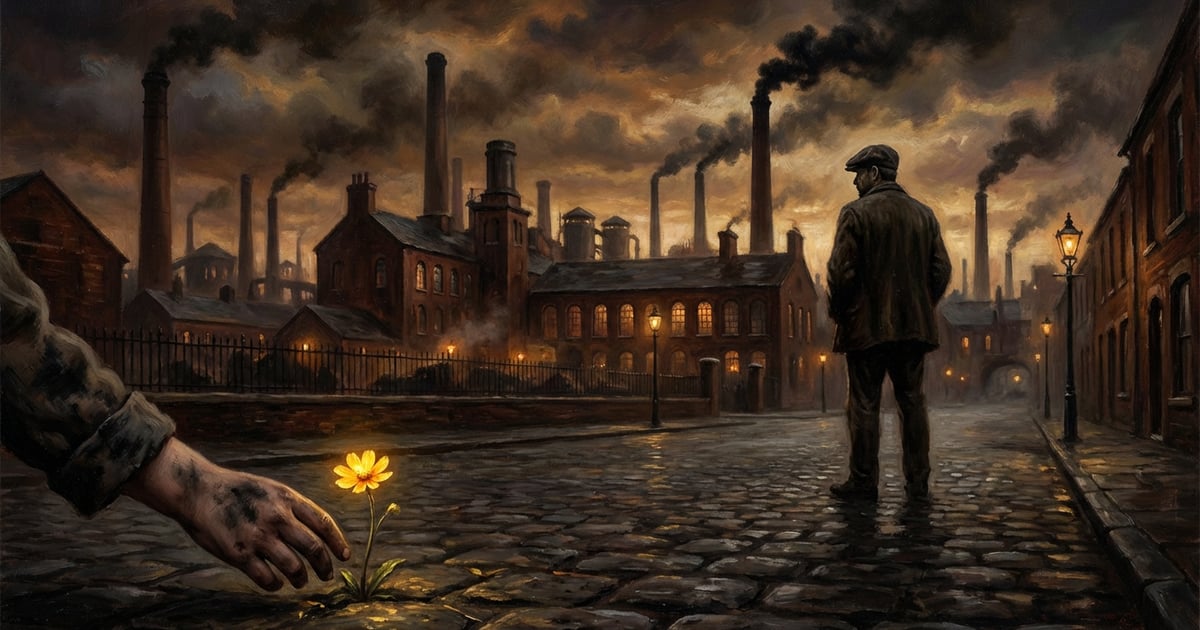
Gradgrind and Bounderby walk into Coketown, and Dickens paints the industrial town as a triumph of fact: red and black brick, serpents of smoke, identical streets, identical lives, and fact stamped on everything from the M'Choakumchild school to the relations between master and man. Chapels look like warehouses. The jail might be the infirmary. What cannot be weighed, priced, or charted simply does not count.
Yet Coketown does not thrive. The laboring people skip the churches whose bells drive the sick mad. Reformers arrive with tabular statements: they drink, they take opium, they haunt low singing rooms. Gradgrind and Bounderby add their own verdict: the workers are restless, ungrateful, and impossible to satisfy despite fresh butter and prime meat. Dickens asks the sharper question behind all the charts: is there any analogy between these people and the little Gradgrinds, starved of fancy and now hungry for a circus? Monotonous work without relief, he suggests, creates craving that must go somewhere.
The walk turns personal at Pod's End. Sissy Jupe runs through the streets, chased by Bitzer, who insists he only wanted to drill her on defining a horse. Gradgrind sends Bitzer home and orders Sissy to lead them to her father. She carries nine oils for his circus bruises, not gin. Bounderby tells her performers deserve their injuries for being idle and boasts again of harsher bruises from his own childhood. At twilight they reach a shabby public house, the Pegasus's Arms, where Merrylegs the dog barks upstairs. Bounderby laughs: pretty well, for a self-made man.
Chapter 5 is one of Dickens's great set pieces. Before the plot advances far, he gives us the music of the book: Coketown as fact made visible. The description is satirical, angry, and precise. Every brick seems to say that imagination is waste.
The turn to Sissy and Bitzer keeps the portrait from becoming abstract. Bitzer chases a girl for knowing the wrong kind of knowledge. Bounderby hears liniment and thinks gin, then idleness. Gradgrind, meanwhile, is not cartoon evil; Dickens says he might have been kind if a long-ago arithmetic error had gone differently.
That nuance matters. The town is not failing because one villain exists. It fails because an entire method of living has edited out mercy.
Explore this chapter with AI to uncover deeper meaning and practical takeaways.
AI Discussion