
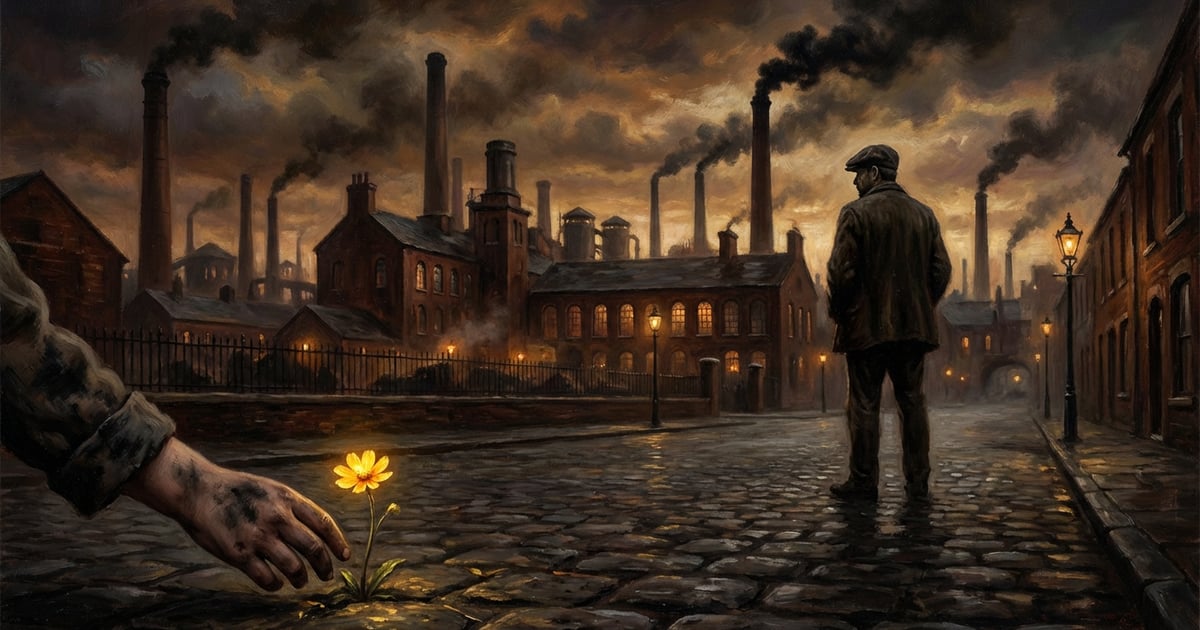
Book the Second opens on a rare sunny midsummer day in Coketown, which from a distance is only a sulky blotch of soot: you know a town must be there because nothing else could make so formless a smear on the landscape. Dickens satirizes the mill owners as fragile china, ruined whenever children were sent to school, whenever inspectors looked into their works, whenever anyone doubted they were quite justified in chopping people up with machinery, utterly undone when told they might make less smoke. Another town fiction holds that any challenge to their privilege makes them threaten to pitch property into the Atlantic; they never do, and the town keeps growing.
Heat fries the streets in oil and steam. Factory pistons beat like melancholy mad elephants, unchanged by weather. Boys row a dyed black river; the sun engenders more death than life where sordid hands intervene. Mrs. Sparsit keeps her afternoon post at the Bank, still pitying Bounderby as Victim a year into his marriage, fancying herself the Bank Fairy while passersby see a dragon guarding treasure she only half understands.
Bitzer knuckles his forehead over tea, reports workers uniting, and trades gossip about an improvident individual at the Bank without naming Tom. Sparsit forbids names under her roof while extracting coded intelligence. Bitzer praises his own savings, rejects recreation and families for workers, and boasts of putting his mother in the workhouse on principle while allowing her half a pound of tea a year.
James Harthouse arrives with a letter from Gradgrind MP, mistakes the Bank for Bounderby's house, and charms Mrs. Sparsit into giving directions. He asks whether Louisa is repellently clever; she laughs and says a chit, not twenty when married. He leaves astonished. Bitzer suspects he games. Mrs. Sparsit watches darkness climb the chimneys without lighting a candle, then sits alone at supper and mutters, O, you Fool, without naming whom she means. The chapter ends with a new predator entering Coketown just as union heat and bank gossip tighten around the Gradgrind circle. Harthouse's bored polish will soon target Louisa, while Sparsit's lonely vigil at the Bank already names the fool she means to ruin.
Chapter XVII is the true opening of Reaping: wide lens on Coketown heat and owner hypocrisy, then the camera moves inside the Bank. Mrs. Sparsit is comic and dangerous at once, Bank Fairy to herself and dragon to the street. Bitzer is Gradgrind education perfected: no passions, only calculation, mother in the workhouse to prove a point.
Harthouse's entrance is deliberately flat. He is exhausted gentility asking aesthetic questions. The Louisa exchange is brief and devastating: she was not twenty, and his surprise tells you how wrong the Gradgrind reputation is. Sparsit's closing fool is the chapter's snap. Someone has already misread the board.
No money is missing here. That placeholder missed the whole chapter.
Explore this chapter with AI to uncover deeper meaning and practical takeaways.
AI Discussion