
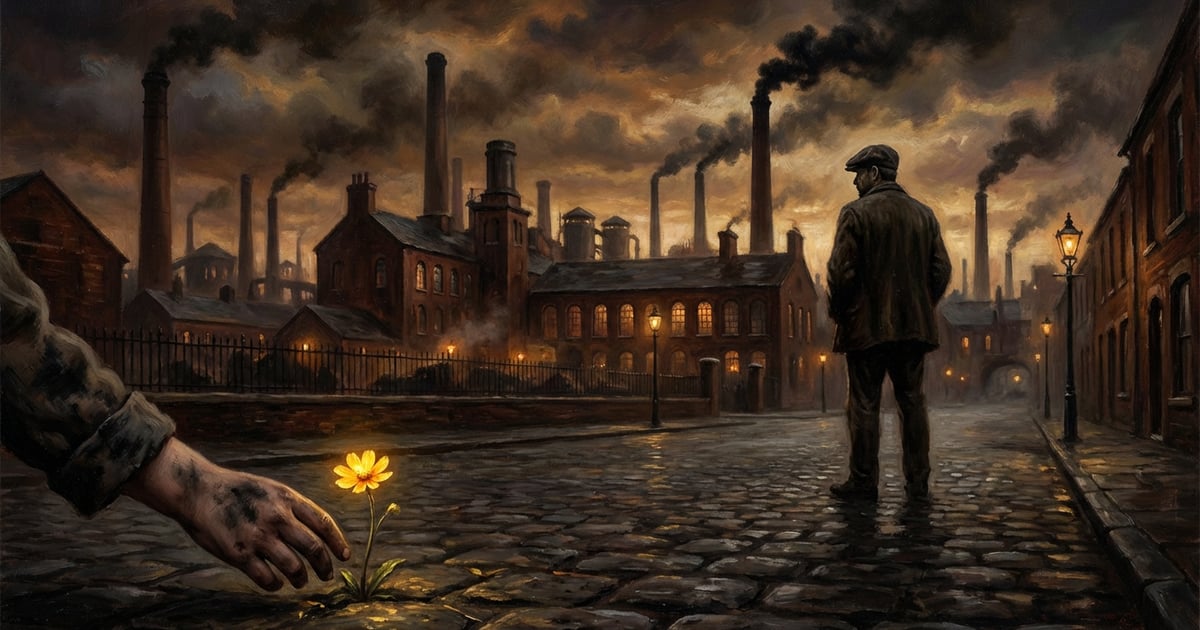
Hard Times opens with a manifesto, not a plot. In a plain, bare, monotonous vault of a schoolroom, an unnamed speaker tells the schoolmaster that what he wants is Facts: teach these boys and girls nothing but Facts, plant nothing else, and root out everything else. You can only form the minds of reasoning animals upon Facts, he insists, and he brings up his own children on the same principle. Stick to Facts, sir. The scene is the book's keynote before Gradgrind is even named.
Dickens makes the philosophy physical. The speaker's square forefinger underscores every sentence on the schoolmaster's sleeve. His forehead is a wall, his mouth wide and hard set, his voice inflexible and dictatorial, his bristling head like a plantation of firs or a crust of knobs, as if it scarcely had warehouse-room for the hard facts stored inside. Square coat, square legs, square shoulders, even a neckcloth trained to take him by the throat like a stubborn fact: the man looks less like a person than a geometry lesson stored in human form.
He repeats that in this life we want nothing but Facts, and the three grown persons present step back and sweep their eyes over the inclined plane of little vessels arranged in order, ready to have imperial gallons of facts poured into them until they are full to the brim. No child speaks. The system has already decided that humanity is a container problem, and the room is waiting to prove it.
Hard Times opens with a manifesto, not a plot. Dickens gives the utilitarian case its strongest voice before he dismantles it. The speaker is not twirling a mustache. He believes Facts save children from nonsense. That sincerity is what makes the scene frightening.
The chapter's genius is physical. Square forehead, square legs, square coat, neckcloth like a stubborn fact at the throat: the body becomes architecture for a worldview. By the time the children appear as vessels, the reader already feels the room shrinking.
This is the book's warning in miniature. Any system that starts by asking what can be poured in, and which must be rooted out, will eventually treat workers, students, and children as interchangeable storage. The rest of the novel will show the bill coming due.
Explore this chapter with AI to uncover deeper meaning and practical takeaways.
AI Discussion