
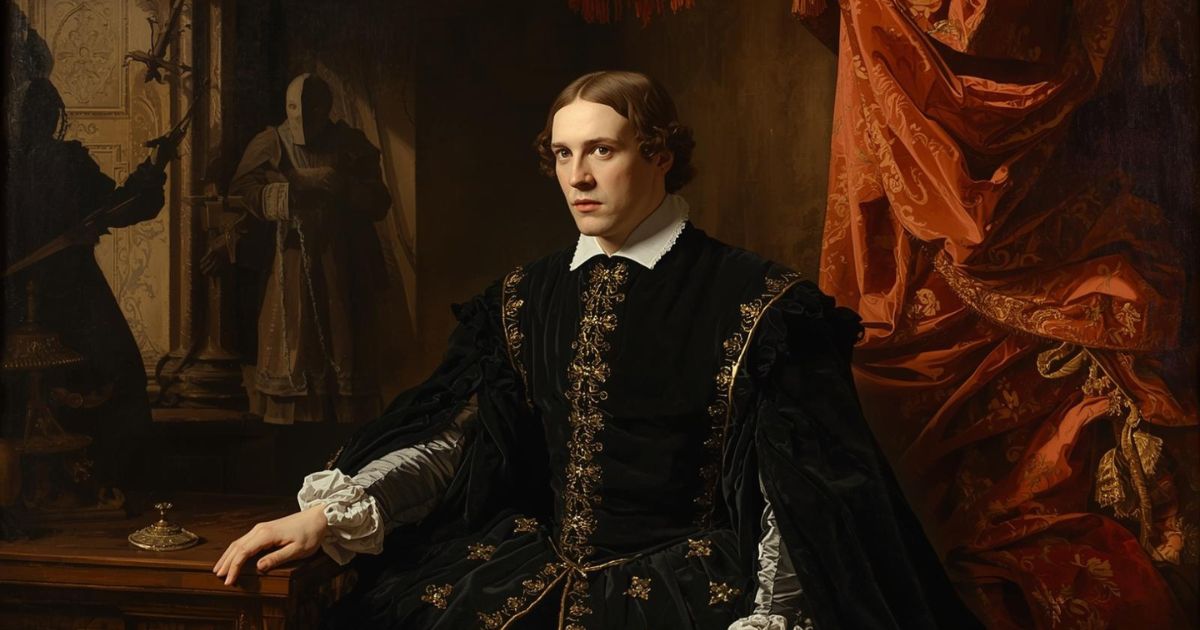
On the castle walls of Elsinore, guards Francisco and Barnardo are changing shifts when something extraordinary happens. Barnardo and Marcellus have seen a ghost that looks exactly like Denmark's recently dead king, but their friend Horatio doesn't believe them. They convince the sceptical scholar to join their watch, and sure enough, the ghost appears again.
This time, Horatio sees it with his own eyes and is shaken to his core. The ghost looks exactly like the dead king in his battle armour, but it won't speak to them and vanishes when the rooster crows at dawn. Horatio explains the political backdrop: the dead king had defeated Norway's king in combat, winning his lands.
Now Norway's son is gathering mercenaries to take back what his father lost, which explains why Denmark is frantically preparing for war. The ghost's appearance seems connected to this brewing conflict. By the end, Horatio is convinced they need to tell Prince Hamlet about his father's ghost, believing it will speak to the son even though it remained silent with them.
This opening scene establishes that something is deeply wrong in Denmark's royal court, and supernatural forces are at work. The guards represent ordinary people caught up in events beyond their control, while Horatio shows how even sceptics must eventually face uncomfortable truths when the evidence becomes undeniable.
Horatio's scepticism about the ghost reflects a deeper human tendency: we often resist uncomfortable truths that others see plainly, especially when accepting them would force us to take difficult action. In Shakespeare's time, seeing ghosts meant confronting supernatural forces that challenged rational understanding. Today, the 'ghosts' are different but equally disruptive - the signs that our marriage is failing, our boss is setting us up to fail, our teenager is using drugs, or our elderly parent can no longer live safely alone. Like Horatio, we demand overwhelming proof before we'll believe what threatens our sense of stability. This resistance isn't weakness; it's a psychological defence mechanism that protects us from constant anxiety. But it becomes dangerous when we ignore mounting evidence from trusted sources. The guards in Hamlet aren't hysterical or unreliable - they're experienced men doing their job. Similarly, when multiple people in your life point out the same pattern, it's worth investigating rather than dismissing. The key insight is that denial has a breaking point. Reality doesn't care about our comfort level, and delaying acknowledgment often means facing the truth under worse circumstances with fewer options. The question becomes: what would it look like to trust the people who care about you enough to risk your anger by telling you hard truths?
Explore this chapter with AI to uncover deeper meaning and practical takeaways.
AI Discussion