
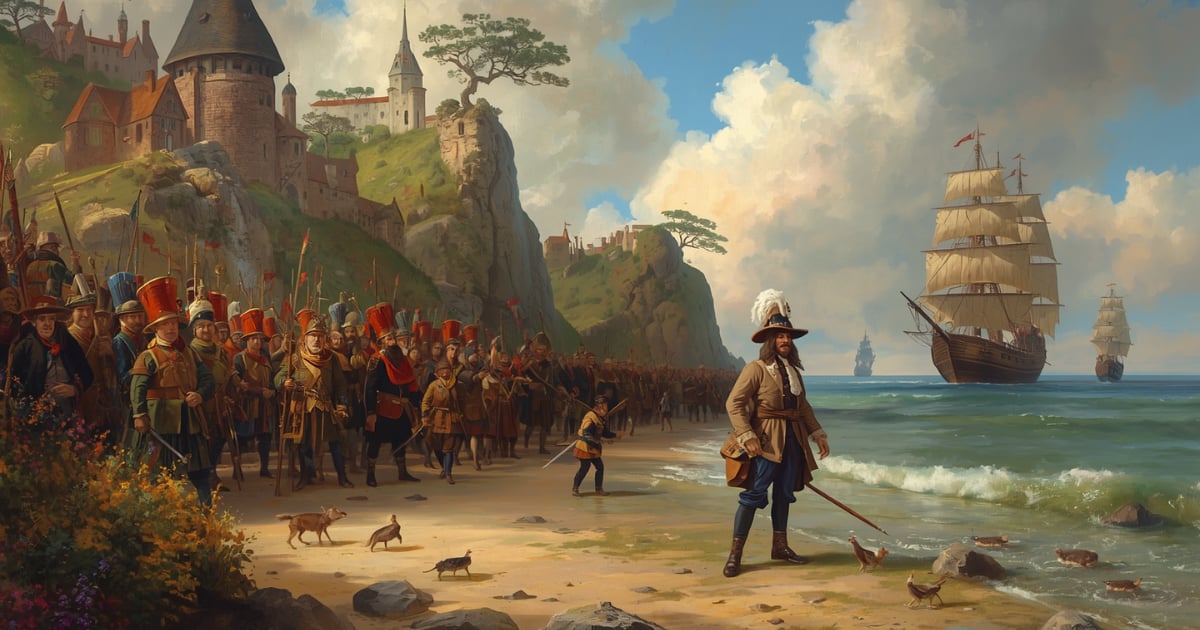
Three days after arriving in Blefuscu, Gulliver walks the north-east coast and spots something half a league out to sea, a capsized boat, probably driven from a ship in a storm. He wades out to confirm it, then returns to the city and borrows 20 of the Emperor's remaining vessels and 3,000 seamen under a vice-admiral. The fleet sails around while Gulliver swims directly to the boat, fastens a cord to its prow, and tries to tow, but out of his depth he cannot work. He swims behind and pushes it forward with one hand in stages, resting between each shove, until the water is down to his armpits. Then he rigs the ship cables and has the seamen tow while he pushes, until the boat is 40 yards from shore. At low tide he walks to it dry. Two thousand men with ropes and engines help flip it right side up, it is only slightly damaged. It takes another ten days to paddle it to the royal port. He asks the Emperor for permission and materials to fit it up, which is granted after some gentle reluctance. He then wonders why no message has come from Lilliput. He learns privately that the Lilliput emperor had assumed Gulliver was simply completing his licensed visit and would return on his own. After waiting out a long absence, Lilliput finally dispatched an envoy with the articles of impeachment, describing the sentence of blinding as "great lenity" and demanding Gulliver be returned to face it "bound hand and foot." The Blefuscu emperor took three days to compose his reply: impossble to send him bound; Gulliver had done the empire great service in the peace; but "both their majesties would soon be made easy," as Gulliver has found a vessel and will depart. The Emperor then tells Gulliver everything and offers private protection if he will stay in Blefuscu's service. Gulliver thanks him and declines.
He has decided, he writes, "never more to put any confidence in princes or ministers, where I could possibly avoid it." He tells the Emperor he would rather venture himself on the ocean than be a cause of further dispute between the two empires. The Emperor is not displeased. Gulliver later learns that the Emperor and most of the ministers were glad of his resolution. The departure preparations take a month. Five hundred workmen sew two sails from thirteen folds of the strongest linen. Gulliver twists ropes by hand from ten, twenty, and thirty of their own strands. A large stone from the shore serves as his anchor. The tallow of 300 cows goes to greasing the boat. Ship, carpenters smooth the oars and masts after he does the rough cutting. At the farewell ceremony the Emperor gives him 50 purses of 200 sprugs each, plus his portrait at full length, which Gulliver immediately puts into one of his gloves to keep it from damage. He stores the boat with 100 oxen carcasses, 300 sheep, meat ready, dressed by 400 cooks, six cows and two bulls alive, ewes and rams, hay and corn. He asks to take a dozen natives; the Emperor refuses and searches his pockets. He sails 24 September 1701 at six in the morning.
On 26 September he sights an English sail, gains on it, and is taken aboard. The ship is an English merchantman returning from Japan; the captain, John Biddel of Deptford, thinks Gulliver raving from his ordeal until Gulliver takes the tiny cattle out of his pocket. The captain is convinced. An old friend, Peter Williams, is aboard and vouches for him. Gulliver gives the captain two purses of 200 sprugs and promises him a cow and a pregnant sheep on arrival in England. He lands at the Downs on 13 April 1702. One rat had got into his things during the voyage and stripped a sheep to the bones; the rest survive. He puts the cattle to graze at Greenwich, where the grass is so fine they do better than he expected. He earns a considerable profit showing them to persons of quality and sells the lot for £600 before his second voyage. He stays two months with his wife and family, sets her up with £1,500 in a house at Redriff. His son Johnny is at the grammar school; his daughter Betty is at her needlework. He boards the Adventure, bound for Surat under Captain John Nicholas of Liverpool. Part I ends here.
Swift understood something we still struggle with: the difference between help and control. In his era, patronage systems made this explicit, wealthy patrons supported artists, writers, and scholars in exchange for loyalty and favourable work. Today's version is more subtle but equally pervasive. Your boss who 'mentors' you expects you to work unpaid overtime and cover their mistakes. The family member who helps with rent uses that debt to control your life choices. Healthcare systems offer 'patient advocacy' that primarily protects them from lawsuits. Even government assistance programs come with restrictions that can trap people in cycles of dependence. The mechanism is always the same: create dependency, then leverage it. Gulliver's choice to risk the open ocean rather than accept the Blefuscu emperor's 'protection' seems extreme until you realise what he understood, that comfortable cages are still cages. The emperor didn't want to help Gulliver; he wanted to own him. Modern working, class Americans face this choice constantly: accept help that comes with strings, or maintain independence at the cost of security. There's no easy answer, but recognising the pattern is the first step toward navigating it successfully.
Explore this chapter with AI to uncover deeper meaning and practical takeaways.
AI Discussion