
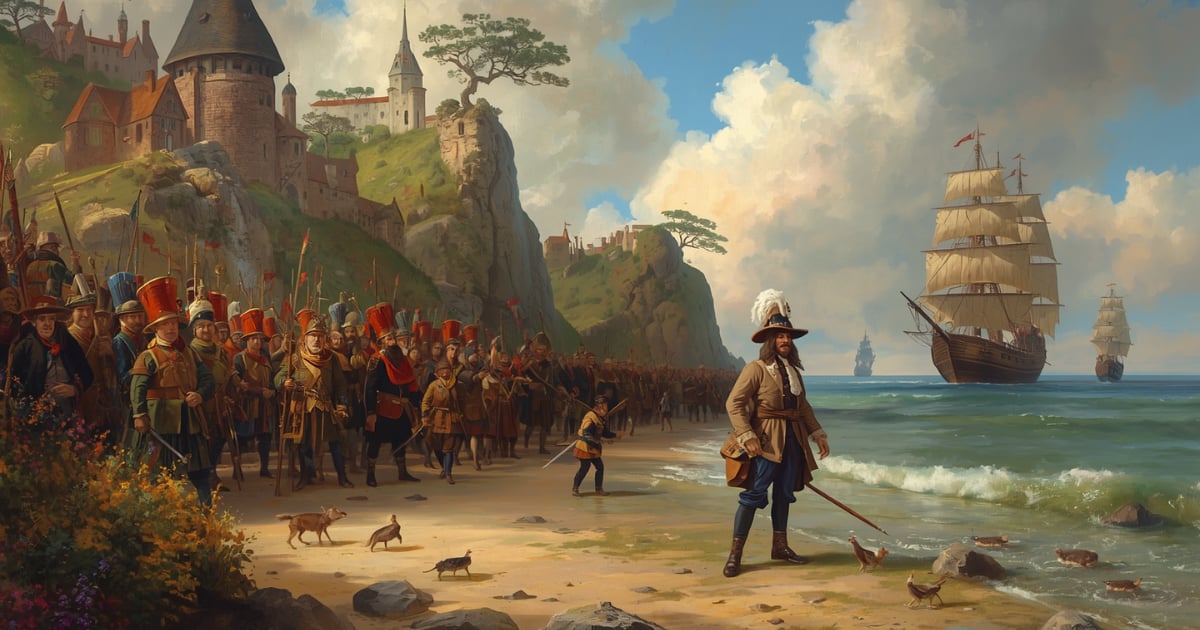
Gulliver leaves Laputa through a kinsman of the king who seems stupid to Laputians because he cannot keep time or prove geometry, yet listens to Europe with real attention and sends Gulliver down to Lagado with letters and money. On firm ground at last, he is housed by Lord Munodi, once governor of the metropolis, now dismissed as insufficient though the king still treats him kindly. Munodi drives him through Lagado: half the size of London but houses oddly built and falling apart, people in rags with fixed wild eyes, fields full of busy labour and excellent soil that grows neither corn nor grass. Gulliver says plainly he has never seen a country so miserably managed. Munodi deflects with courtesy until they reach his own estate twenty miles out, where vineyards, corn, and neat farmhouses suddenly appear.
His neighbours despise him as backward for clinging to old forms; he sighs that even he may have to tear down his houses and plantations to match modern usage or be branded proud, ignorant, and disloyal. After supper Munodi explains the ruin. Forty years ago visitors returned from Laputa with volatile spirits and a smattering of math, patented an academy of projectors, and spread experimental colleges through every town promising one man to do the work of ten and palaces built in a week. None of it works; the country wastes while hope and despair drive them harder. Munodi keeps his ancestors' ways and is scorned as lazy.
He points to a ruined mill on a mountain: projectors convinced him to destroy a working river mill, cut canals, pipe water uphill because wind on heights would make it fitter for motion. A hundred men, two years, total failure; they blamed Munodi and keep trying the same experiment elsewhere. Munodi will not enter the grand academy himself but sends Gulliver with a friend, introducing him as a curious believer in projects. Gulliver admits that was once true of him too.
Swift understood something crucial about human psychology: we're vulnerable to being impressed by complexity, even when simplicity works better. The Balnibarbi catastrophe wasn't caused by evil people, it was caused by social pressure to appear progressive. When the Laputans' abstract theories became fashionable, questioning them meant social exile. Sound familiar? We see this pattern everywhere today. Hospitals adopt electronic health records that slow down patient care, but questioning them marks you as 'resistant to change.' Schools abandon phonics for experimental reading methods that leave kids struggling, but teachers who object get labeled as dinosaurs. Corporate consultants sell complex solutions to simple problems, and managers who prefer straightforward approaches get written up for lacking vision. The mechanism is always the same: innovation becomes a status symbol rather than a practical tool. People adopt new methods not because they work, but because using them signals sophistication. Meanwhile, the gap between promise and reality grows wider, but admitting the emperor has no clothes requires courage most people don't have. Swift shows us that sometimes the most radical thing you can do is stick with what functions. The question isn't whether you're progressive or traditional, it's whether you prioritize results over reputation.
Explore this chapter with AI to uncover deeper meaning and practical takeaways.
AI Discussion