
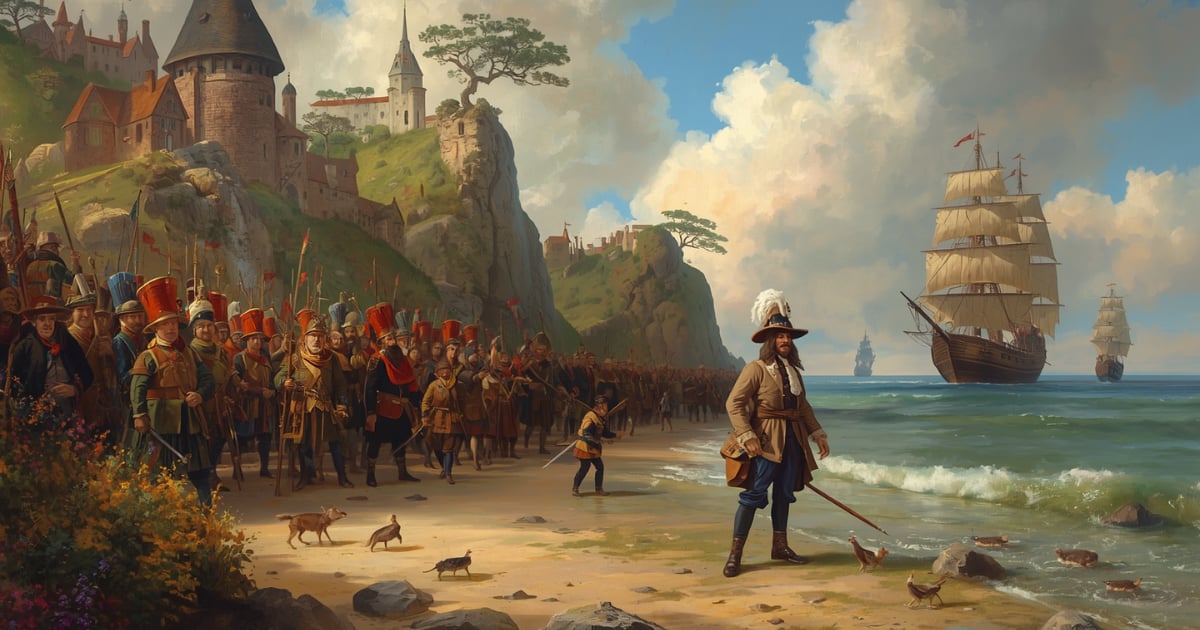
The farmer's daughter is nine years old and about forty feet high, which is small for her age. She and her mother fit up her baby, doll's cradle for Gulliver's bed, placing the drawer containing it on a high shelf to keep off the rats. She teaches him the language by pointing at objects and naming them; in a few days he can call for what he needs. She makes him seven shirts from the finest linen she can get, which is still coarser than sackcloth. She names him Grildrig, meaning little man; he calls her Glumdalclitch, little nurse. He credits her with his survival. He writes with guilt that he fears he was "the innocent, but unhappy instrument of her disgrace." A neighbouring farmer friend, old and very dim, sighted, visits to inspect the strange animal. Gulliver is placed on the table and performs: walks, draws his hanger, greets the visitor in his own language. The old man puts on his spectacles, and Gulliver bursts out laughing, because the eyes behind them look like the full moon shining through two windows. The old farmer is offended; he is a noted miser; and his cursed advice to Gulliver's master is to take the creature to market. Glumdalclitch weeps. She fears rude crowds will squeeze or break him; she also knows her parents' pattern, last year they promised her a lamb, and sold it to a butcher when it was fat.
Gulliver is less troubled than she is. He has a strong hope of eventually recovering his liberty, and as for the ignominy of being shown as a monster: "the King of Great Britain himself, in my condition, must have undergone the same distress." The master carries Gulliver to the neighbouring town in a box, a little door, gimlet holes for air, Glumdalclitch's baby, quilt on the floor. The journey is only half an hour but the horse trots at forty feet per stride, making the agitation equal to a ship in a great storm, but more frequent. At the inn, the sign of the Green Eagle, the farmer hires a crier (the grultrud) to announce a strange creature not so big as a splacnuck but shaped in every part like a human, able to speak several words and perform a hundred diverting tricks. Gulliver is put on a table in a room about three hundred feet square. Glumdalclitch stands on a stool beside him. Thirty people are admitted at a time; Gulliver walks, answers questions in their language, drinks their health from a thimble, cup, draws and flourishes his hanger, and exercises a piece of straw as a pike. He is shown to twelve sets of company in one day, half dead with weariness by the end. A schoolboy aims a hazel, nut at his head (nearly the size of a small pumpkin) and nearly brains him; the boy is well beaten and turned out. The farmer announces a second market, day. Gulliver needs three days to recover, but gets no rest at home either: gentlemen ride from a hundred miles around to see him, and the farmer charges the rate of a full room even when it is a single family calling.
The farmer sees there is money to be made on a longer circuit. He closes up his affairs and sets out on 17 August 1703 for the capital, situated about three thousand miles away. Glumdalclitch rides behind her father with Gulliver's box on her lap, the box lined with soft cloth and quilted underneath, furnished with her baby's bed and a clean change of linen. To spare Gulliver from the violence of faster trotting, she tells her father she is tired whenever he pushes the pace; the easy stages average about 140 to 160 miles a day. She often takes him out of the box for air, always holding him on a leading, string. The landscape is extraordinary: the rivers they cross are broader than the Nile or the Ganges; there is hardly a rivulet so small as the Thames at London Bridge. In ten weeks they pass through eighteen large towns, as well as villages and the houses of private families. They arrive at the metropolis, Lorbrulgrud, "Pride of the Universe", on 26 October. The master takes a lodging near the royal palace and hires a room three to four hundred feet wide. He sets up a sixty, foot, diameter table, palisaded three feet from the edge to prevent falls, and shows Gulliver ten times a day. By now Gulliver speaks the language well and has learned the alphabet; Glumdalclitch has been teaching him from a small children's book she kept in her pocket, a common religious primer no bigger than a Sanson's Atlas.
Swift reveals one of life's cruelest patterns: those who love us most are often least able to protect us from harm. Glumdalclitch's tears can't stop her father's exploitation of Gulliver, just as a caring nurse can't override hospital policies that hurt patients, or a loving teacher can't prevent budget cuts that damage their students' education. This dynamic appears everywhere in working, class life, immediate supervisors who genuinely care about their teams but can't prevent corporate layoffs, social workers who advocate for families while being constrained by bureaucratic rules, or adult children who love their aging parents but lack the authority to override siblings making financial decisions. The pattern creates a painful triangle: the vulnerable person needs protection, the caring person wants to provide it but lacks power, and the powerful person makes decisions without emotional investment. Recognising this pattern prevents us from wasting energy blaming the powerless for failing to protect us, or expecting emotional support to translate into practical change. Instead, we can appreciate care for what it is while directing our advocacy efforts toward those who actually control outcomes. The most sophisticated response involves building relationships with both groups, accepting comfort from the caring powerless while strategically engaging the powerful decision, makers. When we understand that love and power rarely reside in the same person, we can navigate these relationships more effectively and with less resentment toward those who genuinely want to help but simply cannot.
Explore this chapter with AI to uncover deeper meaning and practical takeaways.
AI Discussion