
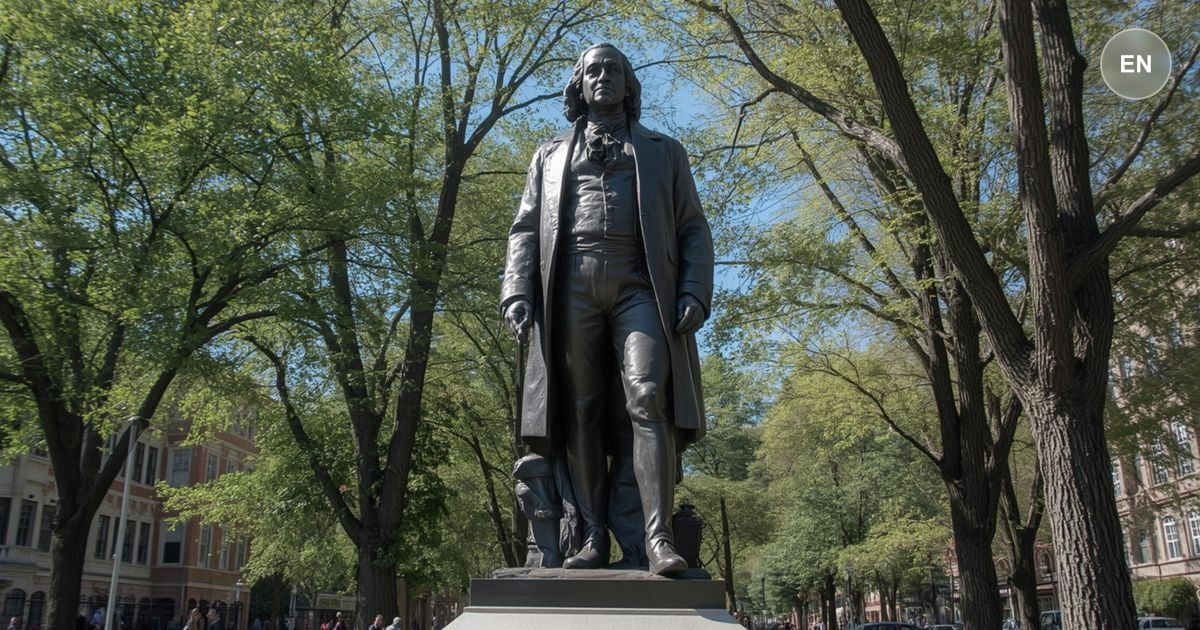
Benjamin Franklin is an old man when he starts writing his life story. He admits vanity is one reason he writes, but he also wants his mistakes and lessons to help someone else. He tells where his family came from: generations of workers in England who hid their Bible under a stool when reading it was illegal. His father Josiah moved to Boston, raised many children on hard work, and invited neighbours to dinner so his sons would hear good talk. Young Ben did not want to make candles. He loved the water, led other boys, and once stole stones to build a fishing dock. His father taught him that nothing useful can be built on dishonesty. Later Franklin placed a marble stone on his parents' grave praising their long marriage and steady labour.
At twelve, Ben became an apprentice in his brother James's print shop. He spent spare money on books and read late into the night. He taught himself to write by copying famous essays from memory, then checking his version against the original. He practised math alone, read philosophy, and picked up the Socratic method of asking questions. At first he used it to win arguments, then he learned softer language that persuaded people better. He wrote anonymous pieces and slipped them under the shop door at night. James's literary friends praised them without knowing the author was the teenage apprentice. He also tried selling ballads about shipwrecks and pirates, but his father mocked verse-making and pushed him toward prose. A vegetarian diet let him board himself cheaply and buy more books. He stayed alone in the shop after light meals so he could study while others ate.
The brothers were already tense because James was both family and boss. James sometimes beat him, and their fights went before their father, who often sided with Benjamin. When James got in trouble with the government over a political article and went to jail, Benjamin briefly ran the newspaper himself. He gave the rulers sharp criticism while James was locked up. Officials then ordered James to stop printing the paper called the New England Courant. James's friends cooked up a scheme to keep the paper alive by printing it under Benjamin's name while hiding the old apprenticeship papers.
Benjamin was still legally bound to James, but the public fight had shown him how much he wanted freedom. The chapter ends with that risky plan taking shape and with a young printer who has taught himself to think, write, and survive in a world that has not yet given him a fair place. He is still poor, still young, and still learning that skill alone does not remove the power other people hold over your time. The name-change trick is about to force the next fight between brother and apprentice.
Franklin opens his autobiography knowing that most people who read it will assume his story belongs to a different category of person than themselves. He was a Founding Father. He invented things. His face is on the hundred-dollar bill. But the chapter he actually writes is about a kid who stole rocks to build a fishing dock, got caught, and spent his teenage years reading borrowed books in a print shop at midnight because that was the only school available to him. The gap between those two images, the icon and the apprentice, is the whole point.
Franklin is careful to show us the mechanism, not just the result. He does not say he was gifted. He says he copied the Spectator essays from memory and then compared his version to the original to find where he fell short. He turned prose into verse to stretch his vocabulary. He practised arithmetic alone. He used the Socratic method badly at first, backing people into corners, then noticed what he was doing and changed his approach. Every one of those steps is repeatable. None of them required money or connections or a school that would have him.
This matters enormously for anyone who has ever been told, directly or by implication, that their starting point is also their ceiling. Life on a wage carries invisible ceilings: the assumption that a certain kind of job is your kind of job, that certain rooms are not for you, that wanting more is somehow a betrayal of where you come from. Franklin's chapter does not argue against those pressures. It just shows someone moving through them anyway, quietly, before anyone was watching.
The question worth sitting with is this: what is the thing you are actually hungry to learn, and what is the smallest version of it you could start tonight, before anyone gives you permission?
Explore this chapter with AI to uncover deeper meaning and practical takeaways.
AI Discussion