
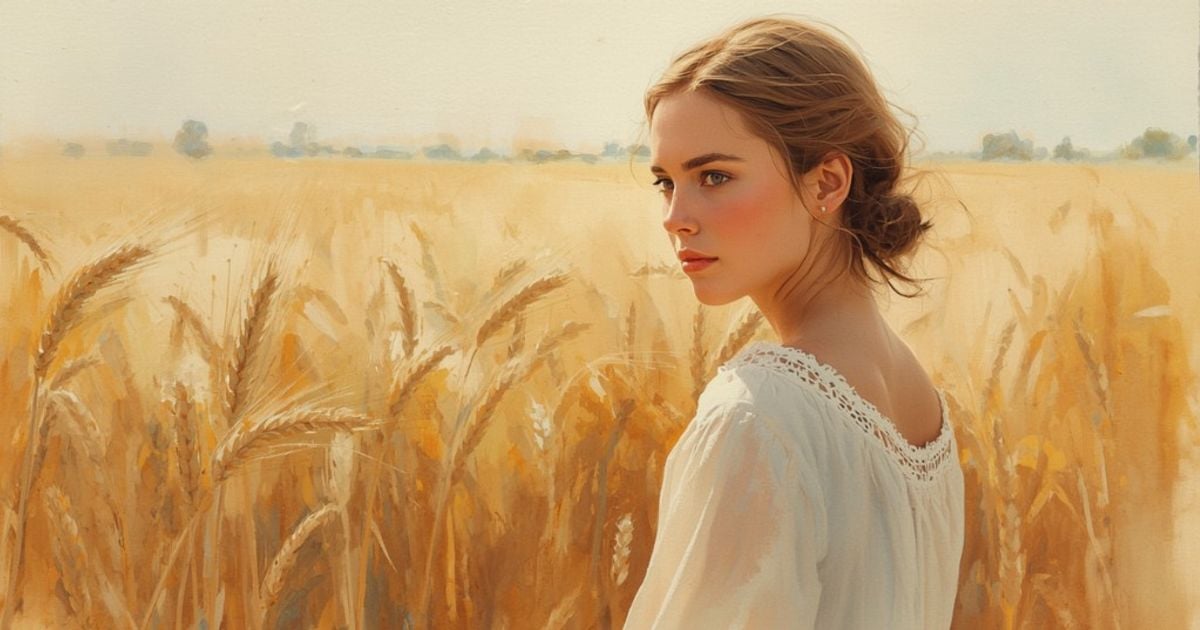
By daylight Bathsheba's farmhouse turns out to be an old memorial hall, handsome and mossy at the front, as if when it was turned to farming the life of the house had turned round inside it to face the other way. Upstairs, Bathsheba and Liddy sit on the floor among her late uncle's papers and bottles with dust on their hands, while Maryann Money scrubs next door. Then a horse comes up the mossy footpath to the very door, which nobody does, and a crop taps. Bathsheba, in a flutter of romantic possibilities, tries to send Maryann, then Liddy, but both are filthy, and in the end Mrs Coggan, floury to the elbow, goes down. Bathsheba will not be seen in this state. The visitor is Mr Boldwood, and in a deep, indifferent voice he says that all he wanted was news of Fanny Robin. He rides away.
Bathsheba's curiosity is stronger than her dust. Boldwood, she learns, is a farmer of forty, handsome, stern, rich and unmarried, who put Fanny to school when she had no friends and found her this place. Mrs Coggan adds that he is hopeless with women. Jane Perkins, the two Miss Taylors and Farmer Ives's daughter have all tried him, to no effect. Little Teddy Coggan arrives with a penny Boldwood gave him for opening the gate, and with the news that he told Boldwood, for the penny, that his mistress is a staid woman. Bathsheba is stung at being published as old and snaps at Maryann. When Liddy asks whether anyone ever wanted to marry her, she cannot resist: a man did once, she says, and Gabriel Oak rises before her. He was not quite good enough, she says. She rather liked him, she adds. Does she now? Of course not, she says, and asks what footsteps those are.
They belong to the farm hands, who cross the courtyard at dusk in a crooked file, as if they had one will between them. 'The Philistines be upon us,' says Liddy. Bathsheba tells Maryann to keep them in the kitchen until she is dressed, and then to show them in to her in the hall.
Hardy understood something we still struggle with: success can be isolating, not because other people change, but because we do. Bathsheba inherits property and suddenly Gabriel Oak 'wasn't quite good enough'—the same man who might have been her salvation just months earlier. This isn't unique to the Victorian era. Watch any workplace promotion: the newly-minted supervisor who stops eating lunch with their former peers, the nurse who becomes a manager and suddenly finds her old friends 'too negative,' the small business owner who starts networking only with 'successful people.' The pattern is ancient but the stakes are modern. In Hardy's time, a woman's survival often depended on marriage, making these calculations somewhat practical. Today, we have more options, but the psychological trap remains the same. We mistake circumstances for character, elevation for evolution. The real tragedy isn't that Bathsheba aims higher—it's that she's forgotten how to judge what actually matters. Boldwood interests her not because of who he is, but because of what he represents: wealth, status, and the ultimate challenge of winning someone 'unwinnable.' Meanwhile, Gabriel's steady character becomes invisible next to Boldwood's shiny reputation. The question Hardy poses through Bathsheba's choice haunts us still: When we climb higher, do we see more clearly, or do we just get better at looking down on others?
Explore this chapter with AI to uncover deeper meaning and practical takeaways.
AI Discussion