
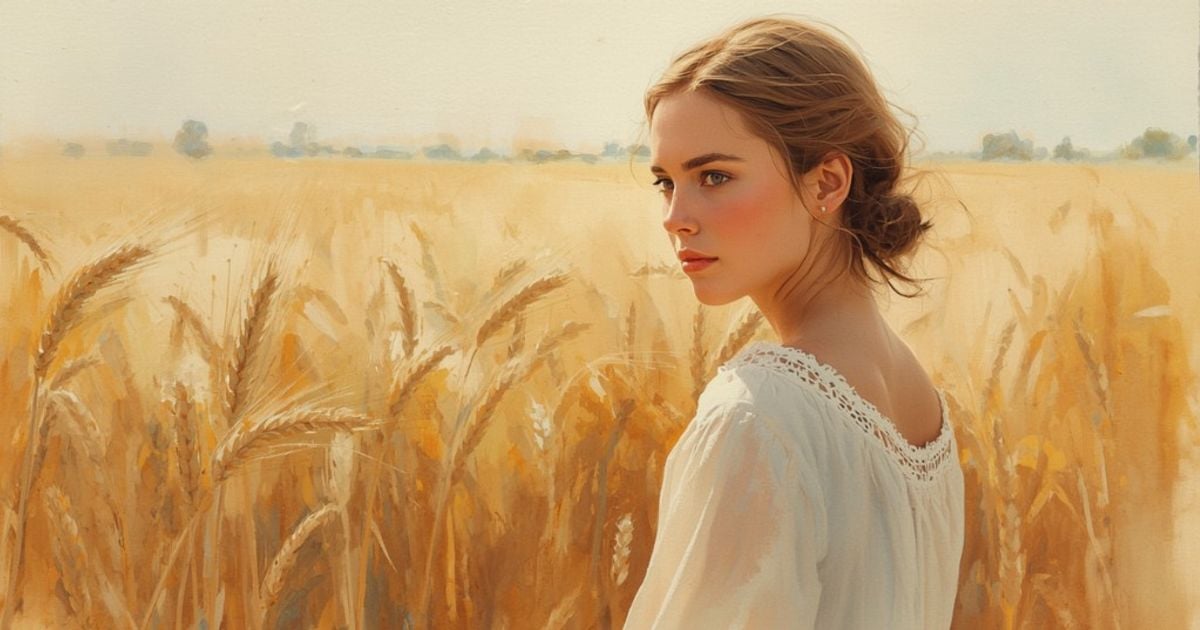
At daybreak Gabriel goes back to the plantation for no better reason than that the night's discovery happened there. He finds the girl's lost hat in the ditch, and he is about to hand it over when she rides up the path on an auburn pony and does something that stops him. The boughs are too low to ride beneath, so, after checking that nobody is watching, she drops flat along the pony's back with her head by its tail, as quick as a kingfisher. Once clear, she sits up again, astride because she has no side-saddle, and trots off to the mill for bran. Gabriel keeps the hat and keeps quiet, amused and a little astonished.
When she returns with her pail, he rises from behind the hedge, hat in hand. She is bright and sure of herself, and Hardy allows that she has reason. Their talk goes well enough until he tells her that he saw her ride through the plantation. She turns every shade of red, then slips away like a dead leaf. For five mornings and evenings she milks the cows without once looking his way. It was not that he saw her, Hardy says, but that he let her know it.
Then a hard frost comes. Gabriel closes the slide on the windward side of his hut and, instead of opening the other, sits down to let the stove warm the place first. He falls asleep. He wakes with his head in her lap and his face wet with the warm milk she threw over him, because his dog howled at the hut and pulled at her skirt. They part clumsily. He holds her hand too briefly, then too long, and she snatches it back from a kiss she has half offered. She will not tell him her name, only that he may ask at her aunt's. He knows the door.
Hardy shows us something profound about human connection: we bond most deeply not during good times, but during moments of crisis and vulnerability. When Gabriel nearly dies and the mysterious woman saves him, they instantly move from awkward strangers to intimate allies. This wasn't romance—it was recognition. Crisis strips away our social masks and reveals who we really are underneath. In our modern world, we see this pattern everywhere. Healthcare workers form unbreakable bonds during emergencies. Neighbors who barely spoke become lifelong friends after helping each other through natural disasters. Parents connect deeply in hospital waiting rooms in ways they never would at school pickup. The mechanism is always the same: when someone sees us at our most vulnerable and chooses to help anyway, trust forms instantly. But here's what's interesting—we don't have to wait for major crises to access this pattern. Small moments of vulnerability work too. Admitting when we're struggling, asking for help, offering support when others are having a tough day. The key insight is that our culture teaches us to hide our struggles and project strength, but Hardy shows us that our weaknesses, when shared with the right person, become our greatest strengths. The question becomes: are we brave enough to let people see us as we really are?
Explore this chapter with AI to uncover deeper meaning and practical takeaways.
AI Discussion