
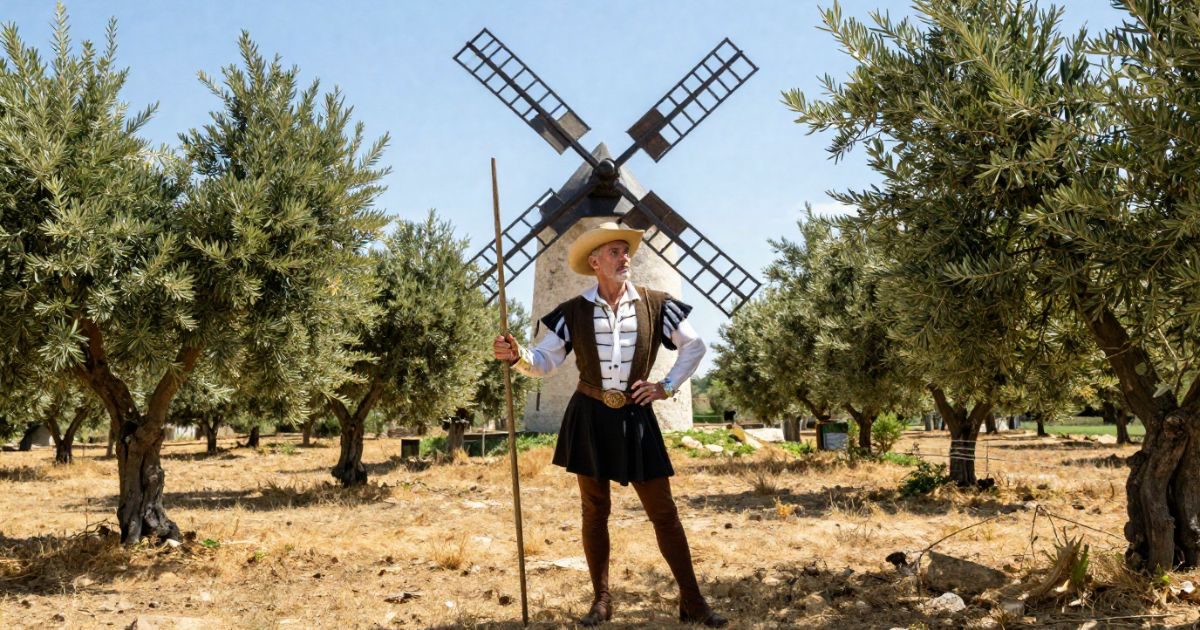
Don Quixote rides on after defeating the Knight of the Mirrors, treating every future peril as already solved and every past beating as beneath notice. Sancho still sees Tom Cecial's enormous nose and insists the vanquished knight was his gossip; Quixote answers with enchanter theory, saying malignant magicians sent Carrasco's face to stay his sword, and again cites Dulcinea's transformation as proof that enchanters swap countenances at will. Sancho knows the Dulcinea change was his own invention, but stays silent lest he expose his trickery.
They overtake Don Diego de Miranda, a wealthy gentleman in green on a handsome flea-bitten mare. Reading curiosity in his stare, Quixote preempts every question with a self-introduction: he revives dead knight-errantry, succours widows and orphans, and claims thirty thousand volumes of his history are on the road to thirty thousand thousands more. He names himself the Knight of the Rueful Countenance. Diego, amazed that such knights could exist in print, blesses heaven if Quixote's true deeds will drive out fraudulent romances.
Diego describes a discreet La Mancha life with wife, children, neighbours, hunting, fishing, honest books, daily mass, and charity without display, and confesses his studious poet son troubles him because learning without virtue is a pearl on a dunghill. Sancho leaps from Dapple to kiss Diego's stirrup, calling him the first saint in the saddle he has ever seen. Quixote replies with a long discourse on poetry as guarded maiden, natural genius, and the pen as tongue of the mind, nearly persuading Diego that he is sane. Then Quixote spots a cart covered with royal flags, calls for his helmet, and a new adventure begins.
Don Quixote rides on after defeating the Knight of the Mirrors, treating every future peril as already solved and every past beating as beneath notice. Sancho still sees Tom Cecial's enormous nose and insists the vanquished knight was his gossip; Quixote answers with enchanter theory, saying malignant magicians sent Carrasco's face to stay his sword, and again cites Dulcinea's transformation as proof that enchanters swap countenances at will. Sancho knows the Dulcinea change was his own invention, but stays silent lest he expose his trickery. They overtake Don Diego de Miranda, a wealthy gentleman in green on a handsome flea-bitten mare. Reading curiosity in his stare, Quixote preempts every question with a self-introduction: he revives dead knight-errantry, succours widows and orphans, and claims thirty thousand volumes of his history are on the road to thirty thousand thousands more. He names himself the Knight of the Rueful Countenance. Diego, amazed that such knights could exist in print, blesses heaven if Quixote's true deeds will drive out fraudulent romances. Cervantes makes the cost visible: not only what the characters suffer, but what bystanders must decide once the story can no longer stay private. The chapter asks whether comfort, silence, or intervention is the truer form of care when someone is living inside a plot of their own.
Explore this chapter with AI to uncover deeper meaning and practical takeaways.
AI Discussion