
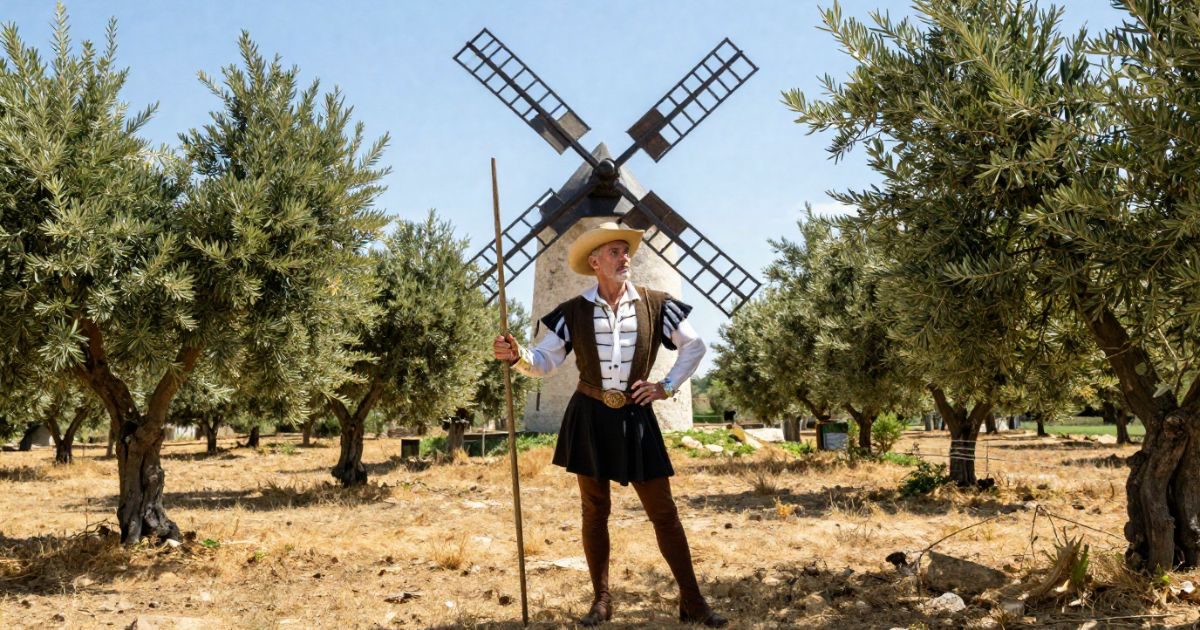
The captive begins in the mountains of Leon with a prodigal soldier father who cannot keep an estate. Rather than ruin his sons like a stepfather, he divides the property in four: three shares in cash, one kept to live on, and a proverb to steer them. In this Spain of ours, he says, it is the church, or the sea, or the king's house; better a king's crumb than a lord's favour. The eldest chooses arms, the second the Indies and trade, the youngest Salamanca. Each takes three thousand ducats. The captive, unwilling to leave the old man stripped, gives two thousand back; his brothers give a thousand each, and an uncle buys the land to keep it in the family. They part in tears, promising news. Twenty-two years pass without a word home, though he has written.
He ships from Alicante to Genoa, arms himself in Milan, and joins the Duke of Alva in Flanders, present at the deaths of Egmont and Horn, promoted ensign under Diego de Urbina. When Pius V, Venice, and Spain league against the Turk after the loss of Cyprus, he leaves a captaincy almost in his grasp to follow Don John of Austria to Messina. At Lepanto, the day Ottoman pride is broken and fifteen thousand Christian rowers get their liberty, he alone is miserable. Relieving a Maltese galley, he leaps onto El Uchali's ship; it sheers off; his men cannot follow; he is taken wounded, fettered on the night of victory.
The years at the oar run through Constantinople, Navarino, the Prize galley where Barbarossa's son is bitten to death bench by bench, and the fall of the Goletta and the fort in seventy-four, which he thinks a mercy to Spain even as it swallows money and men. He will not write to his father for ransom. Among the captured is Don Pedro de Aguilar, soldier and poet, who shares his bench and makes epitaph sonnets on the lost fortresses. Don Fernando's party smiles. One gentleman says Pedro is his brother, now at home, rich, married, with three children. The captive answers that there is no happiness on earth to compare with recovering lost liberty. The gentleman offers to recite the verses, which he knows by heart, and the tale waits on the first sonnet.
The captive begins in Leon with a prodigal soldier father who divides his estate among three sons and quotes the proverb: the church, the sea, or the king's house. The eldest chooses arms, the second the Indies, the youngest Salamanca; each takes three thousand ducats and the father keeps enough to live on. Twenty-two years pass without news home. The captive serves under Alva in Flanders, joins Don John of Austria, and fights at Lepanto on the day Ottoman pride is broken. Fifteen thousand Christian rowers regain liberty, but he alone is miserable: wounded and captured when he leaps onto an enemy galley and his men cannot follow. Years follow at the oar in Algiers and Constantinople, through Navarino, the fall of the Goletta, and the slaves' revenge on Barbarossa's cruel son, while he refuses to write his father for ransom. Cervantes makes the cost visible: not only what the characters suffer, but what bystanders must decide once the story can no longer stay private. The chapter asks whether comfort, silence, or intervention is the truer form of care when someone is living inside a plot of their own.
Explore this chapter with AI to uncover deeper meaning and practical takeaways.
AI Discussion