
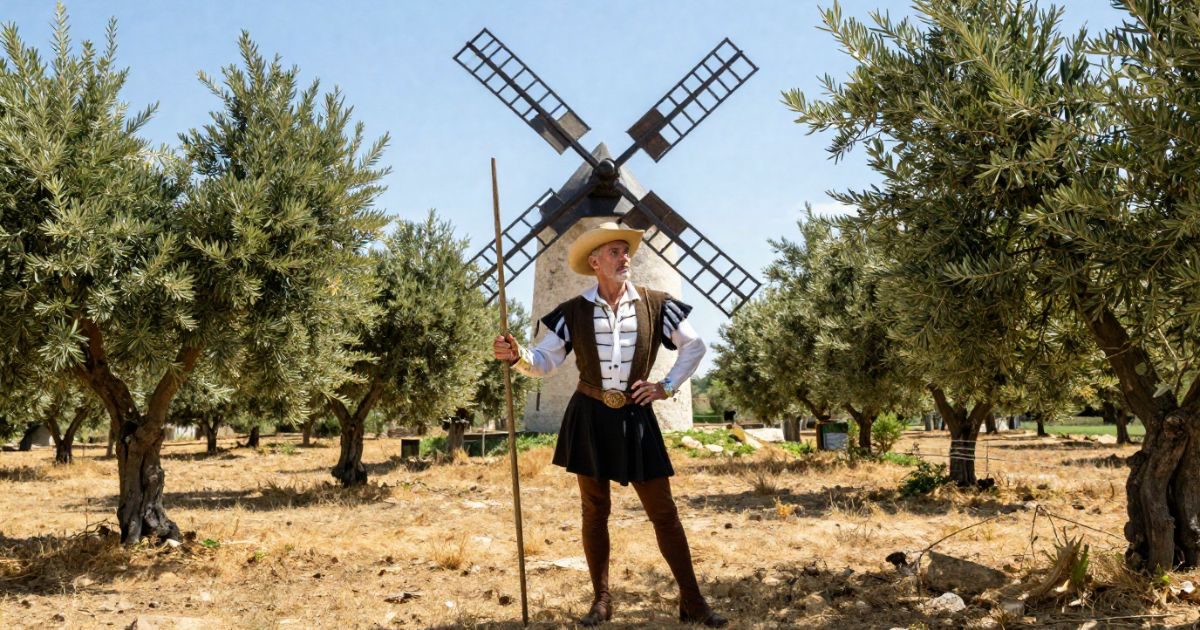
Everyone at the inn is full of contentment except Sancho, who watches his county vanish in smoke: Princess Micomicona has turned into Dorothea, the giant into Don Fernando, and his master is sleeping through the ruin of both. The landlady, promised payment for wine-skins and tail, is in the highest spirits. Sancho goes in with a long face and tells the Knight of the Rueful Countenance he may as well sleep on, for the giant and the kingdom are settled. Quixote answers with a prodigious battle and a head tumbling to the ground, blood in rivulets. "Like red wine," Sancho says: the dead giant is a hacked wine-skin, four-and-twenty gallons, and the cut-off head is the bitch that bore him. Quixote is not surprised. Last time, everything in this house was enchantment. Sancho will believe that of anything except the blanketing, which was real enough: he saw this same landlord holding a corner.
The curate explains the Peña Pobre stratagem to Don Fernando and the rest, who laugh and then have to invent a new way home now that Dorothea's luck has ended the princess plot. Cardenio offers Luscinda as understudy. Fernando refuses: Dorothea shall follow the idea out, and he will ride the two days to the village himself. Quixote comes out in full panoply, Mambrino's dinted helmet on his head, and addresses the lady whose greatness, Sancho says, has been annihilated. If her father's magic did this for fear the knight would fail, the magician did not know half the mass. Dorothea, easy and grave, says she is the same as yesterday, only fortune has altered her, and they will set out tomorrow. Quixote turns on Sancho as the greatest little villain in Spain for the Dorothea report, then forgives him when the fiction needs keeping. Fernando proposes pleasant conversation tonight and company on the road tomorrow.
A traveller in a short blue coat, yellow buskins, and a Moorish cutlass asks for a room and is told there is none. Behind him on an ass comes a woman dressed in the Moorish fashion, face veiled. Dorothea offers to share quarters with Luscinda. The captive says the damsel hardly understands his language; in dress she is a Moor, at heart a Christian who left Algiers without time for baptism. They ask her to unveil. She looks to him, hears Arabic, and shows a face that for some rivals even the Spanish ladies. He names her Lela Zoraida. She breaks in with displeasure: "No, not Zoraida; Maria, Maria!" Luscinda answers, "Yes, yes, Maria." At supper they put Quixote at the head of a long refectory table, Micomicona at his side. He leaves off eating and begins the old question of arms and letters: letters seek justice, arms seek peace, and peace is the greatest boon men can desire, the first news the angels sang. For the moment nobody takes him for a madman. The gentlemen of birth listen while he goes on to weigh a student's soup against a soldier's trade, and the comparison is not yet finished.
Everyone at the inn celebrates the reconciled lovers while Sancho alone mourns: his county dream is vanishing in smoke, Princess Micomicona has turned into Dorothea, and the giant into Don Fernando. Don Quixote wakes convinced he slew a giant in a prodigious battle; Sancho tells him the blood was red wine from hacked wine skins and the severed head was the bitch that bore him. The curate explains Quixote's madness to the gentlemen while Don Fernando offers to escort the knight home. Dorothea smoothly resumes her princess role for the journey, and Quixote rages at Sancho for calling the queen a private lady named Dorothea, then forgives him when the fiction needs keeping. Quixote still treats enchantment as the explanation for every transformation. Cervantes makes the cost visible: not only what the characters suffer, but what bystanders must decide once the story can no longer stay private. The chapter asks whether comfort, silence, or intervention is the truer form of care when someone is living inside a plot of their own.
Explore this chapter with AI to uncover deeper meaning and practical takeaways.
AI Discussion