
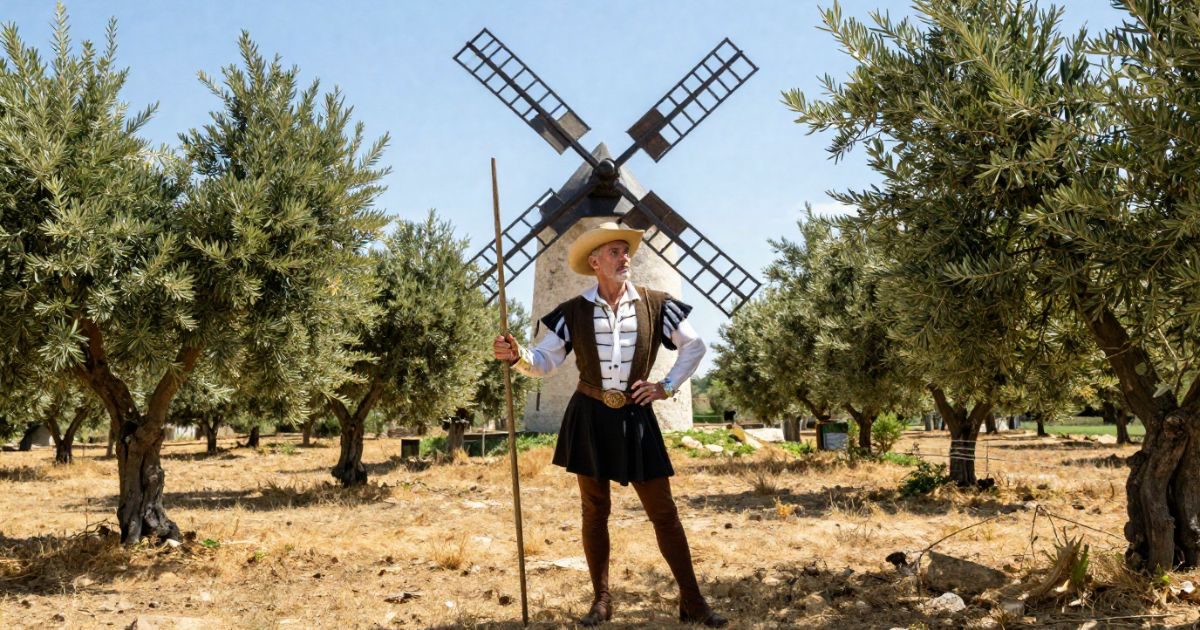
Don Quixote comes out of his swoon calling for Sancho as he did in the vale of the stakes. Sancho cannot sleep because all the devils have been at him. Quixote makes him swear secrecy until after his death, then explains that the daughter of the lord of this castle came to his bed until a giant's hand bloodied his jaws: an enchanted Moor must be guarding her treasure. Sancho answers that more than four hundred Moors have thrashed him, and that the adventure left his master with the beauty while the squire took the heaviest whacks of his life.
The cuadrillero returns with a lamp. Sancho asks if the enchanted Moor has come back for more castigation. Quixote says those under enchantment do not let themselves be seen. Sancho replies that if they don't let themselves be seen, they let themselves be felt. The officer asks how it goes, good man. Quixote calls him a booby for addressing a knight-errant so. The lamp full of oil comes down on his head. Quixote sends Sancho for oil, wine, salt, and rosemary, brews the balsam of Fierabras in a pigskin, pours it into a tin flask with more than eighty paternosters, drinks near a quart of what will not fit, vomits, sweats, sleeps three hours, and wakes believing himself cured and ready for any combat. Sancho gulps the dregs, is seized with gripings before he can vomit, and for two hours thinks his last hour has come. Quixote says the mischief comes of his not being dubbed.
Eager to take the road, Quixote saddles Rocinante, helps Sancho onto the ass, and at the gate thanks the alcaide of the castle, offering to avenge any arrogant foe. The innkeeper wants only the score for straw, barley, supper, and beds. Then this is an inn? Quixote will not contravene the rule that knights-errant never pay for lodging. He calls the host a stupid, scurvy innkeeper and rides out before anyone can stop him. Sancho refuses to pay on the same chivalric privilege. Four woolcarders, three needle-makers, and two lodgers from the Fair of Seville dismount him, find the ceiling too low, and take him into the yard, where they blanket him as they would a dog at Shrovetide. Quixote hears the cries, finds the gate shut, and from Rocinante's back sees his squire rising and falling with such grace that, had rage allowed, he would have laughed. He cannot climb the wall. When they leave off, Maritornes fetches well-water; Quixote shouts not to drink it, to take two drops of balsam instead. Sancho, asquint, will not vomit up what bowels he has left, drinks wine she pays for herself, and passes out well pleased at having paid nothing, though the innkeeper detains the alforjas and Sancho in his flurry never misses them.
Once a story owns you, every bruise can look like enchantment and every vomit like a cure. Don Quixote wakes at the inn and tells Sancho the lord's daughter came to his bed until a giant's hand bloodied his jaws. Sancho answers that four hundred Moors beat him worse than the Yanguesan stakes. The Holy Brotherhood officer enters with a lamp. Sancho asks if the enchanted Moor has returned; Quixote says invisible fiends do not show themselves, and Sancho replies that they certainly can be felt. Quixote insults the officer, who smashes the lamp on his head. Quixote brews oil, wine, salt, and rosemary into balsam, drinks a quart, vomits, sleeps, and declares he has found the true potion of Fierabras. Cervantes makes the cost visible: not only what the characters suffer, but what bystanders must decide once the story can no longer stay private. The chapter asks whether comfort, silence, or intervention is the truer form of care when someone is living inside a plot of their own.
Explore this chapter with AI to uncover deeper meaning and practical takeaways.
AI Discussion