
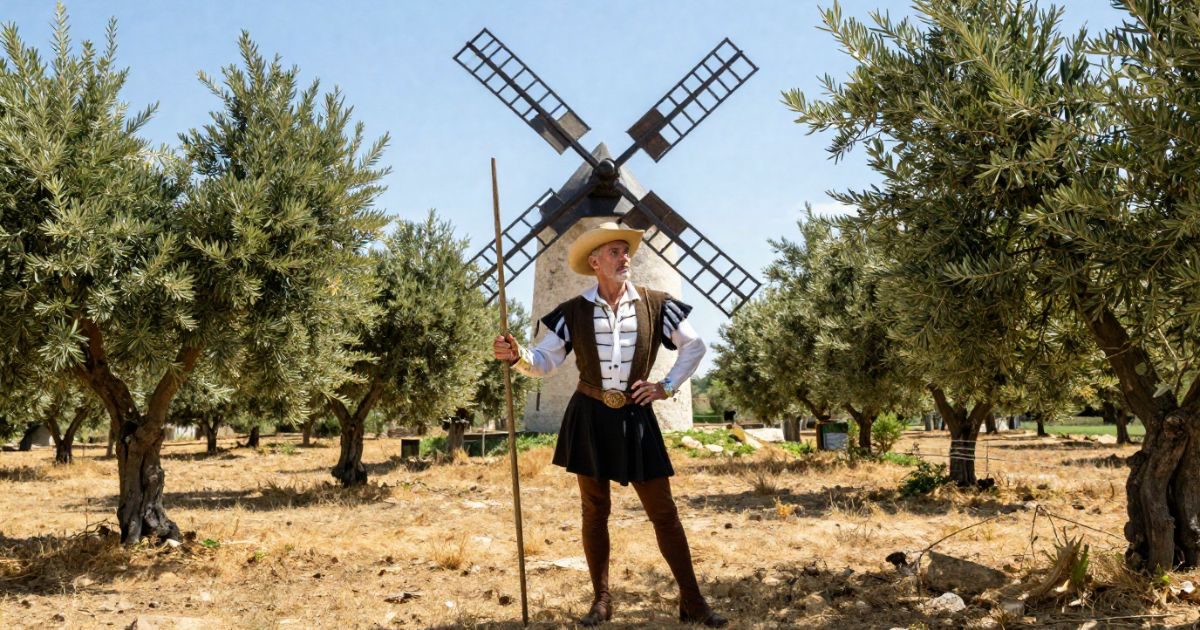
Under a tree after his fall, thoughts crowd Don Quixote like flies on honey about Dulcinea's disenchantment and enforced retirement while Sancho praises Tosilos; Quixote still calls the lacquey enchanted and asks after Altisidora, insisting a knight may resist love but not gratitude because her kerchiefs, tears, and public curses prove adoration, and he again urges Sancho to whip himself for Dulcinea. Sancho refuses the logic, saying if your head aches rub ointment on your knees and that no knight-errant history disenchants anyone by whipping.
At the meadow where the bulls trampled them, Quixote proposes they turn shepherds for his year of exile, buying ewes and roaming as the shepherd Quixotize and the shepherd Panzino singing and lamenting in Arcadian imitation; Sancho names Teresa Teresona, warns about Sanchica among shepherds, and Quixote plans Samsonino, Niculoso, and Curiambro while lecturing on albogues and listing Morisco words in Spanish that begin with al. Their proverb war follows: Sancho warns come for wool and go back shorn, Quixote calls it preaching in the desert, Sancho retorts with the frying-pan and the kettle, and Quixote answers that his proverbs fit like a ring to the finger while Sancho's drag in by the head and shoulders because a proverb not to the purpose is nonsense not a maxim. They turn off the road, sup poorly against Sancho's will, and pass the night with Sancho sleeping soundly while his master wakes.
Under a tree after his fall, thoughts crowd Don Quixote like flies on honey about Dulcinea's disenchantment and enforced retirement while Sancho praises Tosilos; Quixote still calls the lacquey enchanted and asks after Altisidora, insisting a knight may resist love but not gratitude because her kerchiefs, tears, and public curses prove adoration, and he again urges Sancho to whip himself for Dulcinea. Sancho refuses the logic, saying if your head aches rub ointment on your knees and that no knight-errant history disenchants anyone by whipping. At the meadow where the bulls trampled them, Quixote proposes they turn shepherds for his year of exile, buying ewes and roaming as the shepherd Quixotize and the shepherd Panzino singing and lamenting in Arcadian imitation; Sancho names Teresa Teresona, warns about Sanchica among shepherds, and Quixote plans Samsonino, Niculoso, and Curiambro while lecturing on albogues and listing Morisco words in Spanish that begin with al. Their proverb war follows: Sancho warns come for wool and go back shorn, Quixote calls it preaching in the desert, Sancho retorts with the frying-pan and the kettle, and Quixote answers that his proverbs fit like a ring to the finger while Sancho's drag in by the head and shoulders because a proverb not to the purpose is nonsense not a maxim. They turn off the road, sup poorly against Sancho's will, and pass the night with Sancho sleeping soundly while his master wakes. Cervantes makes the cost visible: not only what the characters suffer, but what bystanders must decide once the story can no longer stay private. The chapter asks whether comfort, silence, or intervention is the truer form of care when someone is living inside a plot of their own.
Explore this chapter with AI to uncover deeper meaning and practical takeaways.
AI Discussion