
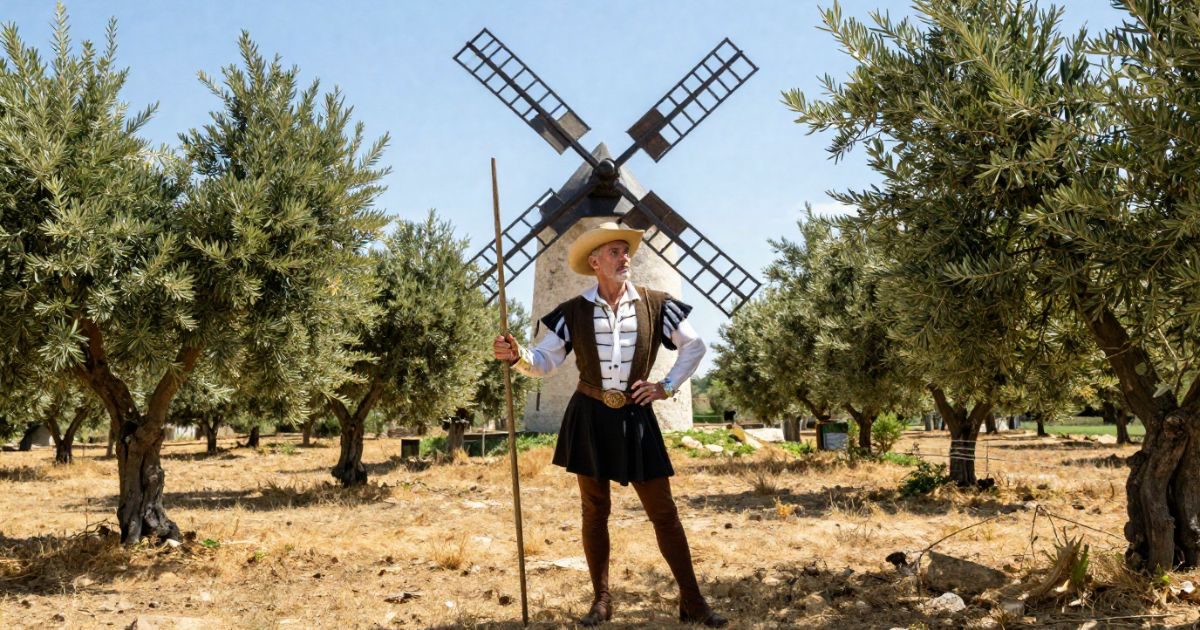
Quixote broods on the enchanted head's promise of Dulcinea's disenchantment while Sancho still misses giving orders even in jest; Don Antonio brings them to the galleys where awnings drop, clarions ring, the general marks the day with a white stone meeting the pattern of knight-errantry, and the crew salutes Hu, hu, hu as Sancho is hoisted and whirled bench to bench until bruised and breathless he thinks the devils themselves were flying away with him, though Quixote calls it cakes and fancy bread beside what follows.
Quixote asks if whirling newcomers is custom and threatens anyone who touches him; yards rattle, Sancho ducks thinking heaven will fall, and oars move like red feet while Sancho calls it hell or at least purgatory and Quixote says he might disenchant Dulcinea cheaply if Sancho took lashes among the rowers until Monjui signals an oared vessel, the galleys chase an Algerine brigantine, the chief galley overhauls her, rash drunken Turks kill two soldiers when surrender seemed near, and the general vows to hang every captive especially the handsome rais while the yard is lowered for the noose.
The youth says I am neither Turk, nor Moor, nor renegade but a Christian woman; Ana Felix tells how Morisco expulsion sent her to Barbary, how she hid Don Gaspar Gregorio dressed as a Moorish woman in the king's house, and how greedy Turks spoiled their plan to land in Christian dress; the viceroy unties her, Ricote the pilgrim cries I am thy father Ricote, Sancho confirms he knows them from the road, and the general says your tears will not allow me to keep my oath and bids live, fair Ana Felix while the two Turks hang.
Ricote offers more than two thousand ducats in pearls and gems; a Spanish renegade proposes a six-banked boat with Christian rowers to Algiers to rescue Gregorio; Don Antonio takes Ana Felix and Ricote home amid the waiting crowd while the viceroy promises hospitality, and Quixote's galley day ends in mercy, hanging, and a rescue yet to sail as the city prepares to flock to the fair Morisco.
Quixote broods on the enchanted head's promise of Dulcinea's disenchantment while Sancho still misses giving orders even in jest; Don Antonio brings them to the galleys where awnings drop, clarions ring, the general marks the day with a white stone meeting the pattern of knight-errantry, and the crew salutes Hu, hu, hu as Sancho is hoisted and whirled bench to bench until bruised and breathless he thinks the devils themselves were flying away with him, though Quixote calls it cakes and fancy bread beside what follows. Quixote asks if whirling newcomers is custom and threatens anyone who touches him; yards rattle, Sancho ducks thinking heaven will fall, and oars move like red feet while Sancho calls it hell or at least purgatory and Quixote says he might disenchant Dulcinea cheaply if Sancho took lashes among the rowers until Monjui signals an oared vessel, the galleys chase an Algerine brigantine, rash drunken Turks kill two soldiers, and the general vows to hang every captive especially the handsome rais. Cervantes makes the cost visible: not only what the characters suffer, but what bystanders must decide once the story can no longer stay private. The chapter asks whether comfort, silence, or intervention is the truer form of care when someone is living inside a plot of their own.
Explore this chapter with AI to uncover deeper meaning and practical takeaways.
AI Discussion