LIVE
OCD← Home
Don Quixote cover
1605
Don Quixote
Miguel de Cervantes Saavedra · The Birth of a Delusion
Chapter 1
Reading
Ch. 1
Ch. 2
Loading audio...
0:000:00

A gentleman bordering on fifty lives quietly in an unnamed village of La Mancha until chivalry books take over his life. He neglects field sports and property management, sells tillage land to buy more volumes, and stays up nights wrestling with the ornate prose of Feliciano de Silva. The narrator states plainly that with little sleep and much reading his brains got so dry that he lost his wits.

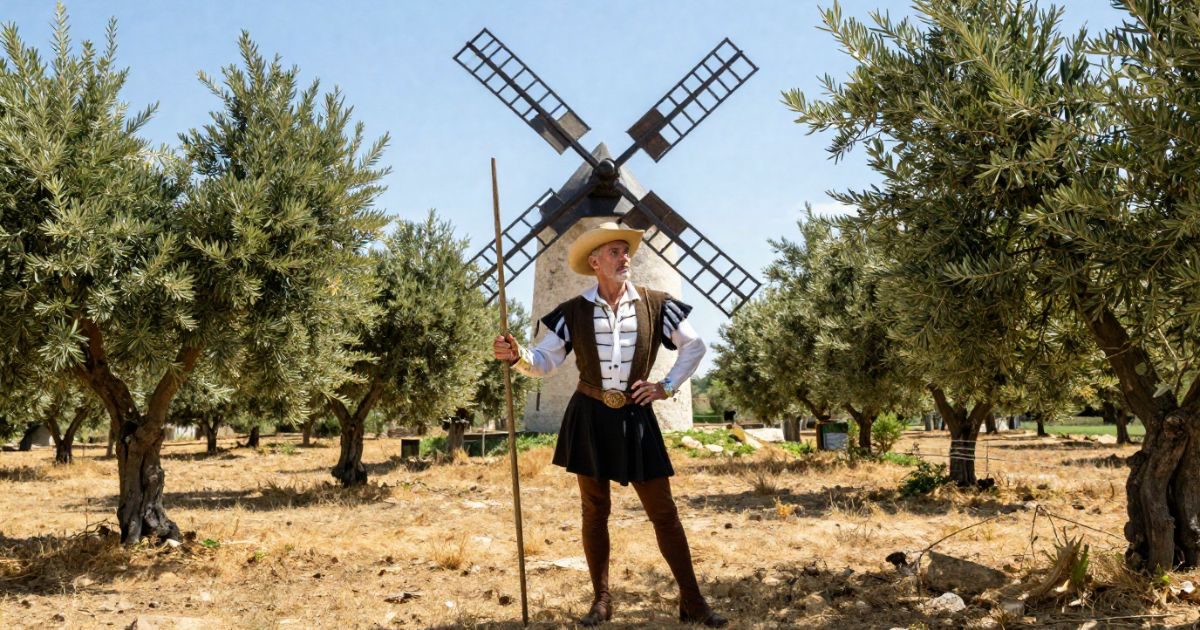
Fantasy soon outranks fact. He decides that no history in the world had more reality in it than the romances he devours, and he ranks fictional knights above real ones, preferring the Knight of the Burning Sword to the Cid because one back-stroke can split two giants. His wits being quite gone, he resolves not to play at knighthood but to become a knight-errant, roaming the world to right wrongs and win eternal fame. Already he sees himself crowned by the might of his arm Emperor of Trebizond at least.

Then the preparation begins in earnest. He cleans his great-grandfather's rusted armour, builds a pasteboard half-helmet that fails its first slash test and reinforces with iron bars, spends four days naming his hack Rocinante and eight more naming himself Don Quixote of La Mancha. A knight-errant must have a lady, so he rehearses the speech a vanquished giant will deliver on his knees: I am the giant Caraculiambro, sent by Don Quixote to present myself before your Grace. Delighted with that fantasy, he elevates Aldonza Lorenzo, a farm girl who never knew his love, to Dulcinea del Toboso.

Amplified Discussion
Why Story-Driven Identity Formation Matters Here

A gentleman bordering on fifty lives quietly in an unnamed village of La Mancha until chivalry books take over his life. He neglects field sports and property management, sells tillage land to buy more volumes, and stays up nights wrestling with the ornate prose of Feliciano de Silva. The narrator states plainly that with little sleep and much reading his brains got so dry that he lost his wits. Fantasy soon outranks fact. He decides that no history in the world had more reality in it than the romances he devours, and he ranks fictional knights above real ones, preferring the Knight of the Burning Sword to the Cid because one back-stroke can split two giants. His wits being quite gone, he resolves not to play at knighthood but to become a knight-errant, roaming the world to right wrongs and win eternal fame. Already he sees himself crowned by the might of his arm Emperor of Trebizond at least. Cervantes makes the cost visible: not only what the characters suffer, but what bystanders must decide once the story can no longer stay private. The chapter asks whether comfort, silence, or intervention is the truer form of care when someone is living inside a plot of their own.

Explore this chapter with AI to uncover deeper meaning and practical takeaways.

AI Discussion
Why it matters

Detecting Story-Driven Delusion

The stories we consume most intensely can start rewriting what we treat as real. Quixote reads until he loses his wits, crowns himself Emperor of Trebizond in his own mind, rehearses the vanquished giant Caraculiambro's speech, and renames Aldonza Lorenzo Dulcinea del Toboso before she ever knows him. Notice when you are living inside a narrative's logic, when you begin scripting other people's roles, and when renaming the world feels like progress instead of warning.

Lessons

PracticeThis week, when you feel certain about a big life story you are consuming, write down one fact from your actual week that the story cannot explain without bending.

Psych reading

Story-Driven Identity Formation

Deep narrative immersion reshapes how a person sees reality until they begin living inside the story's roles and logic.

In the mind

When someone consumes one narrative world long enough, a pattern emerges: the story stops being something they read and becomes something they inhabit. Don Quixote sells land for books, loses sleep, and ranks fictional knights above historical ones until the romances feel more real than his village. That is not random eccentricity. It is identity reconstruction through immersion.

The pattern escalates through ritual. He cleans armour, tests a pasteboard helmet, names his horse and himself with the gravity of a coronation, then invents a lady because the genre demands one. By the time he rehearses the Caraculiambro speech, he is no longer quoting fiction. He is blocking out a future in which every role has already been cast.

You see the same shape in modern life when a person rebuilds themselves around a subculture's logic: the side hustle guru who sells furniture to buy courses, the true-crime obsessive who treats podcast episodes like case files, the reform crusader who scripts victory before the hearing. The content is different. The mechanism is identical: immersion, renaming, rehearsal, then reality bent to fit the plot.

When you recognise story-driven identity formation, you gain a navigation tool. Ask whether someone is learning from a narrative or becoming it. Notice when preparation turns into casting calls for people who never agreed to the script. Quixote is sincere, methodical, and brave. That is exactly what makes the pattern dangerous. When you can name it, predict the renaming stage, and navigate by separating inspiration from instruction

When you can name the pattern, predict the next move, and navigate by separating inspiration from instruction, you have a practical map for the next decision.

Find the right chapter

Each mood maps to a life skill. Each skill connects to the patterns in classic literature.

😔How do you feel😊

Personalize your match

Optional—life stage, what you need today, and what you're navigating help us pick chapters that fit—not generic lists. You may also freeform using the feeling search below.

Sign in to save your profile

Choices stay on this device until you sign in.

Browse the Full Library
4,582Chapters
118+Books
86Authors