
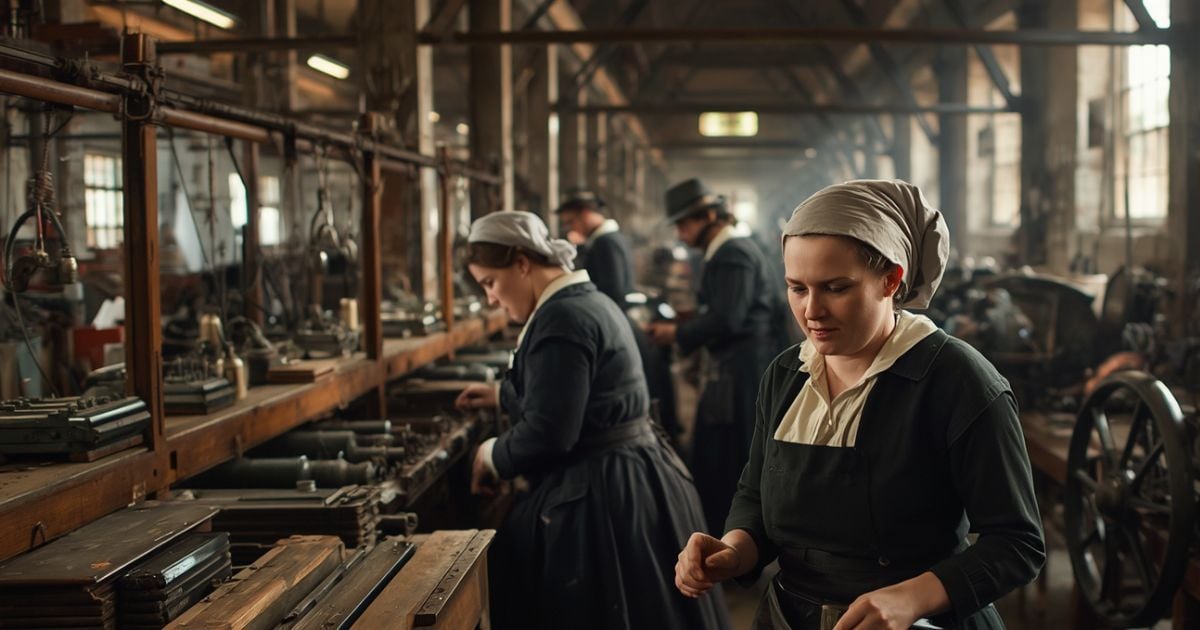
The peasants thrown off the land did not simply move to town. Fewer hands now worked the soil, yet it gave as much as before, because farming methods improved, the means of production were gathered together and the farm labourers still on the land were worked harder. The food the evicted families once grew for themselves was set free as well, and they now had to buy it back, in the form of wages, from the industrial capitalist. Raw materials changed in the same way. Take the Westphalian peasants who, in Frederick II's time, all spun flax. Some were driven off, others became day labourers for big farmers, and large spinning and weaving works rose where the freed men now worked for wages. Not a fibre of the flax changed, Marx says, but a new social soul had popped into its body. Once the extra income of many peasant families, it became the profit of a few capitalists. Spindles and looms that had been scattered over the country were crowded into a few labour-barracks, where they commanded the spinners and sucked unpaid labour out of them.
A visitor to the big factories and big farms would never guess that each was many small producers thrown into one. Popular speech knew better. In Mirabeau's day the large workshops were still called manufactures réunies, as one speaks of fields thrown into one. Mirabeau warned that such a workshop would enrich one or two entrepreneurs while its labourers stayed journeymen with no share in the success, whereas scattered workshops tied to small holdings were the only free ones. The same events also created the home market. Yarn, linen and coarse woollen cloth, whose raw materials every peasant family had once handled for its own use, now became goods made by manufacturers, and the country districts became their customers. The many scattered buyers of the stray artisan became one great market served by industrial capital.
The age of manufacture did not finish the job. It destroyed rural domestic industry in one place and called it up again in another, because it needed villagers to prepare raw material. That produced small villagers who farmed on the side and lived by industrial labour. It is one reason why historians find complaints about the ruin of the peasantry from the late fifteenth century onwards, and yet find the peasantry turning up again, fewer and poorer. The chief reason, Marx adds, is that England swung between growing corn and raising cattle, and peasant farming swelled and shrank with it. Only modern industry, with its machinery, uproots the farming population for good, tears out the spinning and weaving that were the roots of rural industry, and wins the whole home market for industrial capital. In a footnote Marx mocks the economists who now ask the landowners where all the freeholders have gone. They come, he answers, from the destruction of those freeholders. Why, he asks, do they never ask where the independent weavers, spinners and artisans have gone?
Marx shows us something unsettling: the same flax that German peasants once grew, spun, and sold as cloth ends up being processed in factories by those same peasants, now working for wages. The product looks identical, but everything has changed about who controls it and who benefits. This pattern repeats constantly in modern America. Independent bookstores close, then former owners work at Barnes & Noble. Family farms get bought by agribusiness, then hire the original farmers as seasonal workers. Freelance journalists lose newspaper jobs, then write for content mills at fraction of their old pay. Local repair shops close, then skilled mechanics work at corporate chains for less money. Each time, we're told it's more efficient, more modern, better for consumers. But efficiency for whom? The work often stays the same—sometimes it's even done by the same people in the same building. What changes is ownership, control, and who gets the profits. The peasant who once kept everything from his flax now gets only wages. The bookstore owner who once chose which books to highlight now follows corporate displays. We've been taught to see consolidation as inevitable progress, but Marx helps us recognize it as a choice about how to organize society. When we can see this pattern clearly, we can ask better questions: Who really benefits from this change? What independence are we trading away? Are there alternatives that distribute power rather than concentrate it?
Explore this chapter with AI to uncover deeper meaning and practical takeaways.
AI Discussion