
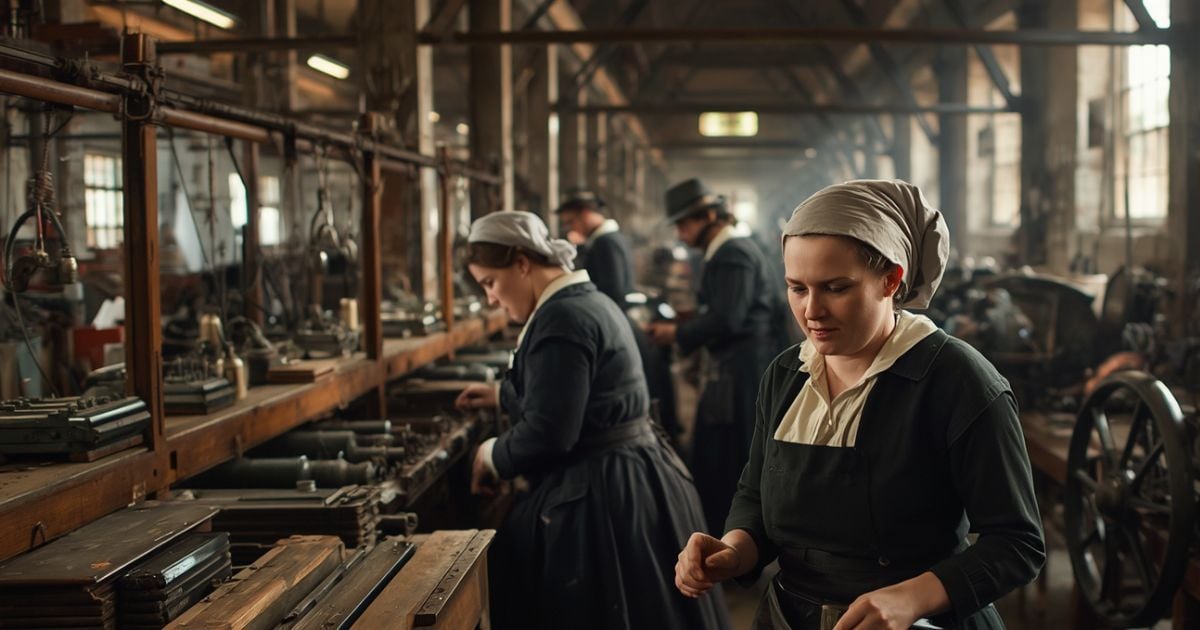
Marx opens with one question: what does the growth of capital do to the worker's lot? The answer turns on how a capital is split. Part is spent on means of production, such as machines, raw material and buildings. Part is spent on wages. He calls these the constant and the variable parts, and their usual mix the organic composition of capital. He starts with the case that suits labour best, where that mix never changes. Then each new pound of capital needs its share of new hands, the demand for labour grows as fast as capital does, and sooner or later employers run short of workers and wages rise. England heard that complaint in the fifteenth century and again in the first half of the eighteenth. Marx will not call this a rescue, because accumulation of capital is increase of the proletariat. John Bellers wrote in 1696 that the labour of the poor is the mine of the rich. Bernard de Mandeville said the poor should be kept from starving but should receive nothing worth saving. Sir Frederic Eden wanted labourers in "easy and liberal dependence". Better food and clothes, says Marx, no more end the exploitation of a wage worker than they end a slave's. A rise in wages only lets the golden chain the worker has forged for himself hang a little looser. Nor can a rise go far, because the buyer wants only one thing: more value out of the worker than he pays for. If dearer labour blunts the lure of profit, accumulation slows, and the shortage of hands that caused the rise fades. Wages then sink to what the growth of capital needs. So the rate of accumulation is the independent variable and the rate of wages the dependent one. The economists' "natural law of population" is only the relation between unpaid labour turned into capital and the paid labour needed to set that capital moving. In religion, Marx says, man is ruled by the products of his own brain. In capitalist production he is ruled by the products of his own hand. That calm case is only one phase. As accumulation goes on, the productivity of labour becomes its strongest lever, and each worker handles far more machinery and raw material. A capital once split fifty-fifty may come to be eighty to twenty. In spinning, Marx says, it was half and half early in the eighteenth century and is now seven parts in eight constant. The wage bill can still grow in pounds. Take £6,000 that grows to £18,000 and is now split eighty to twenty: the wage part rises from £3,000 to £3,600. But where a 20 per cent rise in capital once raised the demand for labour by 20 per cent, the same rise now needs the original capital to triple. Large-scale work needs capital in private hands, and large-scale work makes more capital faster, so the two feed each other. Individual capitals also grow by splitting and competing, as family fortunes are divided and rivals multiply. Against that comes centralisation, where big capitals swallow small ones. Cheaper goods win the battle of competition. Credit creeps in as a humble helper and becomes a terrible weapon. Joint-stock companies do in a moment what slow accumulation never could, and Marx says the world would still have no railways if it had waited for single capitals to grow big enough. Centralisation also hurries the renewal of old capital, which sheds its skin and returns in a form where fewer hands move more machinery. So new capital draws in fewer workers for its size, and old capital pushes out more of the workers it once had.
From this Marx takes his central step. Let the ratio of constant to variable capital move from 1:1 to 2:1, 3:1, 4:1, 5:1, 7:1. Then only a third, a quarter, a fifth, an eighth of the whole goes into wages. Demand for labour follows the variable part alone, so it falls compared with total capital, and falls faster as capital grows. At the other pole the working population seems to swell more quickly than the jobs. Marx says capitalist accumulation itself keeps producing, in proportion to its own energy, a population larger than capital's average needs. The labouring population makes the means by which it becomes superfluous. Every mode of production has its own law of population, and this is the capitalist one. Then comes the turn. This surplus is a lever of accumulation and a condition of capitalism. It is a disposable industrial reserve army that belongs to capital as completely as if capital had bred it at its own cost. When a market suddenly widens, or a new branch such as railways opens, great masses of men can be thrown on the decisive point without starving production elsewhere. The ten-year cycle of modern industry, with its average activity, high pressure, crisis and stagnation, rests on the constant making, absorbing and remaking of this reserve. Political economy blames the swings of credit. Marx calls credit only a symptom. In the childhood of capitalism the composition of capital changed slowly, so the cycle could not have existed. The apologists half admit all this. H. Merivale, once Professor of Political Economy at Oxford, asks what would follow if the nation sent a few hundred thousand superfluous arms abroad after a crisis. At the first return of demand there would be too few, he says, and manufacturers must have hands ready to use the brisk moment. Malthus agrees that overpopulation serves modern industry. Political economy then speaks to the unemployed in the voice of an old maid: we manufacturers do what we can, and you must adjust your numbers to the means of subsistence. The reserve grows faster than machines alone explain. A capitalist would rather press a given amount of labour from fewer hands, so he swaps skilled workers for less skilled, adults for young people and children, men for women. The overwork of those in jobs swells the reserve, and the pressure of the reserve forces the employed to accept overwork. In 1863 the cotton-spinners of Blackburn protested that some hands were kept at twelve or thirteen hours a day while hundreds sat idle. Marx adds that if labour in England were cut tomorrow to a rational amount and shared by age and sex, the workers to hand could not run production at its present scale. Wages therefore follow the split of the working class into active army and reserve, not the bare head-count. The economists' story runs the other way: wages rise, the poor breed, the market fills, wages fall, and so round again. Marx calls it a beautiful mode of motion, and says the campaign would be won or lost long before a child grew old enough to work. Between 1849 and 1859 farm wages in Wiltshire rose from 7s. to 8s. a week, and in Dorsetshire to 9s. The London Economist spoke of "a general and substantial advance". The farmers did not wait for the labourers to multiply. They bought machinery, and in a moment the labourers were redundant again, this time in absolute numbers. The apologists also say that machines which throw weavers out "set free" capital for workers. Marx replies that machines also free the workers' future replacements, so new capital only soaks up those already thrown out. Capital works on both sides of the market, and the dice are loaded. Workers who learn this, and who try through trade unions to bring the employed and the unemployed together, are told they offend the "sacred" law of supply and demand. In the colonies, where no reserve army exists, capital itself rebels against that law and calls on the State.
Marx now sorts the reserve into forms. The floating form lives in factories, ironworks and mines, where workers are thrown out and taken on again. Boys are hired in large numbers, and most are dismissed when they reach manhood, so capital wants many youths and few adults. Labour is used up so fast that a worker is spent half-way through life. Dr Lee, Manchester's Medical Officer of Health, reported an average age at death of 38 for the upper middle class and 17 for the labouring class, and 35 against 15 in Liverpool. Early marriage and the premium on child labour keep the generations coming. The latent form sits in the countryside. When capital takes over farming, demand for farm hands falls outright, so part of the rural population is always on the edge of moving to the towns, and the farm labourer stands with one foot in the swamp of pauperism. The stagnant form is the active army with irregular work: the longest hours, the lowest pay, the domestic industry seen in earlier chapters. It is recruited from decaying trades, and its families are the largest, because family size runs inversely to wages. Below it lies pauperism: those able to work, whose numbers rise with every crisis and fall with every revival; orphans and pauper children, who are enrolled in the active army when trade booms, as in 1860; and the ragged, the mutilated, the sickly and the widowed. Pauperism, Marx says, is the hospital of the active labour army and the dead weight of the reserve. From this he states what he calls the absolute general law of capitalist accumulation. The greater the social wealth and the energy of its growth, the greater the reserve army, and in the end the greater official pauperism. Productivity rises, but because the means of production employ the labourer and not the other way round, the more productive his labour is, the more precarious his living becomes. The law rivets the labourer to capital more firmly than the wedges of Vulcan did Prometheus to the rock. Wealth piles up at one pole, and misery, toil, ignorance and brutality pile up at the other. Marx lines up writers who noticed the same thing, and some who welcomed it. The Venetian monk Ortes said the great riches of a few are always matched by the privation of many. The parson Townsend said hunger is a peaceable, silent and unremitted pressure, the most natural motive to labour, and that the Poor Law spoils that order. Storch said progress breeds a useful class that takes on its shoulders everything servile and disagreeable, and asked what civilisation gains over barbarism. His answer was one word: security. Sismondi said the multiplied power of labour can only add to the luxury of the idle rich. Destutt de Tracy blurted out that in poor nations the people are comfortable and in rich nations they are generally poor. Then Marx tests the law on England from 1846 to 1866. Population growth slowed from 1.533 per cent a year in 1811 to 1821 to 1.141 per cent in 1851 to 1861. Yet profits liable to income tax rose 50.47 per cent from 1853 to 1864, against about 12 per cent for the population, and the yearly rate quickened from 1.73 per cent in 1853 to 1857 to 9.30 per cent in 1861 to 1864. In ten counties, farms under 100 acres fell from 31,583 to 26,597 in ten years as larger farms swallowed them. Gladstone, in 1843, called it melancholy that privation grew while wealth gathered in the upper classes. In 1863 he praised an "intoxicating augmentation of wealth and power", confined to classes of property, and said that while the rich grew richer the poor grew less poor, though whether the extremes of poverty were less he did not presume to say. Marx answers that if the poor are only "less poor" in proportion as they produce wealth for the rich, they are as poor as before, and if the extremes of wealth have grown, so have the extremes of poverty. The accounts of the London Orphan Asylum show food prices 20 per cent higher in 1860 to 1862 than in 1851 to 1853. Official paupers in England numbered 877,767 in 1856 and 971,433 in 1865, and passed a million in 1863 and 1864 because of the cotton famine. The crisis of 1866 pushed pauperism in London up 19.5 per cent over 1865. Even so, deaths by starvation in London rose, because working people dread the workhouse as a place of punishment for misery.
Marx now follows the workers home. In 1862, during the cotton famine, Dr Smith worked out for the Privy Council that an adult needs about 28,600 grains of carbon and 1,330 of nitrogen a week to avert starvation diseases. Lancashire's unemployed cotton hands were eating almost exactly that, 29,211 grains of carbon and 1,295 of nitrogen. In 1863 Dr Simon sent Dr Smith to inquire among the worst fed: silk-weavers, needlewomen, kid-glovers, stocking-weavers, glove-weavers, shoemakers and farm labourers. The families chosen were the healthiest and best off in each trade. Even so, only one indoor trade just passed the standard for nitrogen, one nearly reached it, and two fell short on both counts. More than a third of the farm families lacked enough nitrogenous food. Half of the town families had no beer and 28 per cent had no milk. On the farms the shortage fell on women and children, because the man must eat to do his work. Dr Simon adds that hunger comes late. Long before, clothing, fuel, space and cleanliness have gone, and work that cannot support its worker is only a longer or shorter circuit to pauperism. Housing shows the law more plainly still. The faster capital accumulates, the worse the workers' dwellings become. Town "improvements" pull down slum quarters to make room for bank palaces, warehouses and wide streets for carriages, and the poor are driven into worse and more crowded corners. Dr Hunter found about twenty colonies in London of some 10,000 people each, in a state worse than twenty years before. In one parish off the Strand the Officer of Health counted 581 persons to the acre. After railway works in the City, families were seen wandering the East End one Saturday night with their goods on their backs and nowhere to go but the workhouse. A landowner whose house is pulled down gets full payment and extra comfort for his "abstinence", while the labourer is thrown into the street, and is prosecuted in the name of sanitation if he crowds into a district that insists on decency. Newcastle packs 34,000 people into single rooms, and Dr Embleton blamed its typhus on overcrowding, with the night shift taking the beds the day shift had just left. In Bradford trade revived, the reserve army flowed in, and Dr Bell found 223 houses with 1,450 inhabitants, 435 beds and 36 privies. Fear of contagion that might reach "respectability" produced ten Acts of Parliament on sanitation between 1847 and 1864, yet Dr Simon still wrote that the evils were uncontrolled. Next come the workers who move. The "nomad population" is the light infantry of capital, thrown wherever navvies are wanted for draining, brick-making and railway-making. Wherever it camps it brings smallpox, typhus, cholera and scarlet fever. Contractors build huts and charge rent, so the contractor exploits his men twice, as soldiers of industry and as tenants. At Sevenoaks, where a railway was being built from Lewisham to Tunbridge, the parish's Nuisances Removal Committee wrote to the Home Secretary in September 1864. The huts had no ventilation or drainage and took in lodgers. Mr Jay, the contractor, had twice promised a hut for the sick and never provided one. There had been ten smallpox deaths in the parish in five months, four of them in the huts. Even the best paid workers, the miners, live in cottages owned by the pit. In Durham, Dr Stevens found the collier "bound" to the owner for twelve months, marked in the viewer's book if he complained, and "to all intents and purposes a serf". Even the aristocracy of labour is not safe. The crisis of 1866 broke with the failure of a huge London bank, and London's iron shipbuilders, who had overproduced and speculated on credit, stopped work. A Morning Star correspondent found in the East End at least 15,000 workmen and their families destitute, and 3,000 skilled mechanics breaking stones in a workhouse yard for threepence and food. A woman showed him her bank-book. She and her husband had saved twenty pounds against old age, beginning with a five-shilling deposit, and the book ran down until the last entry made it as worthless as a blank sheet. Her sons had been out of work for twenty-six weeks. On 5 April 1867 the Standard counted 40,000 helpless, starving people packed beside "the most enormous accumulation of wealth the world ever saw". In January that year posters went up on London's walls: "Fat oxen! Starving men!" English capitalists praised Belgium as a paradise of labour, since neither trade unions nor Factory Acts limited "freedom of capital" there. Marx turns to Ducpétiaux, inspector-general of Belgian prisons. His typical Belgian family of six, with four members at work all year, could earn at best 1,068 francs. A sailor's diet would cost 1,828 francs, a soldier's 1,473, and even a prisoner's 1,112. Few labouring families, he admits, reach the prisoner's level. They get by on rye bread, little or no meat, one crowded room and no Sunday outings, until a rise in food prices or a stoppage ruins them and the family joins the pauper list. Of 450,000 working-class families in Belgium, over 200,000 are on it.
Nowhere, Marx says, does the antagonism of accumulation show more brutally than on the English farm. In 1771 Arthur Young found the labourer far worse off than his forebear of the fourteenth century. Farm wages fell by nearly a quarter between 1737 and 1777, and Dr Price feared the kingdom would end up as gentry and beggars. The average wage in pints of wheat was 90 in 1770 to 1771, 65 in Eden's time and 60 in 1808. In Northamptonshire a family of six in 1795 earned 7s. 6d. a week, and the parish made up a yearly deficit of £6 14s. 5d. By 1814 the parish was paying £18 6s. 4d., more than half the wage. The labourer was part wage worker and part pauper, a serf of his parish. The Swing riots of 1830 showed by the light of blazing corn-stacks how fiercely misery smouldered. Sadler called the farm hands "white slaves", and Wakefield said the peasant was not a freeman nor a slave but a pauper. Before the Corn Laws were repealed, the factory owners and the landed aristocrats each exposed the other's cruelty to the labourer, and when thieves fall out honest men come by their own. The Morning Chronicle named wages in villages owned by Mr Bankes and by Lord Shaftesbury, who pocketed part of them as rent. Weekly income per head fell as low as 7d. Repeal then gave farming a great push. There was drainage, steam, new machinery, and Mr Pusey said costs had fallen by nearly half. The cultivated area grew by 464,119 acres between 1846 and 1856, yet farm labourers fell from 1,241,396 in 1851 to 1,163,217 in 1861. By the book, Marx says, the labourer should have been drunk with happiness. Instead Professor Rogers concluded that the peasant had again become a serf. Dr Hunter wrote that the hind is a zero in the farmer's sums. A government inquiry in 1863 found convicts better fed than paupers or free labourers while doing about half a labourer's work, and a labourer might well say he was better off in prison. English farm labourers were the worst fed in the United Kingdom, behind Wales, Scotland and Ireland. Housing was no better. Dr Hunter surveyed 5,375 cottages and found 2,195 with one bedroom. Landowners tore cottages down so that their parishes would carry fewer poor. In 821 parishes houses were destroyed while population rose 5⅓ per cent and house-room fell 4½ per cent. In "show-villages" only shepherds, gardeners and gamekeepers were allowed to live, and the labourers walked in from "open villages" where speculators crammed up cheap hovels. Lord Leicester, congratulated on completing his estate at Hookham, said: "I am the giant of Giant Castle, and have eat up all my neighbours." At Beenham in Berkshire a daughter came home with scarlet fever and died, then a child, and the mother was down with typhus when the doctor arrived. In Bradenham, thirty cottages held 130 to 140 people. At Langtoft a man walked twelve miles a day to a cottage where he could have a place of his own. So the flight to the towns, the merging of farms and the destruction of cottages go hand in hand. The land is overpopulated and underpopulated at once, with too many hands for ordinary work and too few for spring and harvest. The cure for that gap is the gang. In Lincolnshire and its neighbours, new farms were made from drained fen, with almost no cottages. One fen farmer with 320 acres had one labourer, four horsemen lodging about, and "light work done by gangs". A gang was ten to fifty women, young people of thirteen to eighteen, and children of six to thirteen, led by a gang-master who was himself a restless labourer with a dash of enterprise, a Pied Piper of Hamelin. He bargained piece-work with the farmer and drove his gang six to eight months a year. The farmers had found that women and children, once set going, spend their life-force impetuously. The price was overwork, marches of five to seven miles, drinking on the road home, and open villages that Marx calls Sodoms and Gomorrahs, with twice the national rate of illegitimate births. The system exists for the farmer, who gets labour kept well below the normal level, an extra hand always ready, and adult men made "redundant". One farmer told the inquiry that the hubbub was all because of the name, and that if it were called the Agricultural Juvenile Industrial Self-supporting Association everything would be well. The cleanly weeded land and the uncleanly human weeds of Lincolnshire, Marx says, are pole and counterpole of capitalist production.
Marx ends in Ireland. Its population was 8,222,664 in 1841 and about five and a half millions in 1866. It lost more than five-sixteenths of its people in under twenty years, beginning with the famine year of 1846, and 1,591,487 of them emigrated between May 1851 and July 1865. The number of farms fell by 120,000, all of them farms under fifteen acres swallowed by larger ones. In the five years from 1861 to 1865 horses and cattle fell in number while sheep and pigs rose. Cereal acreage dropped by 428,041 acres, and in 1865 alone the potato crop fell by 446,398 tons. Yet rents and farmers' profits rose. Small holdings became large ones, ploughland became pasture, more of the produce became surplus-produce, and English prices for meat and wool climbed. Irish profits under Schedule D grew by only 0.93 per cent a year from 1853 to 1864, against 4.58 per cent in Great Britain. The famine of 1846 killed more than 1,000,000 people, Marx writes, "but it killed poor devils only", and did the wealth of the country no harm. Emigration became a lucrative branch of Irish export trade, because exiles in the United States send home passage money and each party that leaves draws another after it. Orthodox economy holds that misery springs from absolute surplus population and that depopulation restores balance. Here, Marx says, is that experiment on a large scale. For the labourers left behind the relative surplus population was as great as before 1846, wages were as low, and oppression had grown. The Poor Law inspectors reported that money wages had risen 50 to 60 per cent in twenty years, to 6s. to 9s. a week. But an Irish workhouse spent 3s. 1¼d. a head on provisions and clothing in 1869 against 1s. 6¼d. in 1849, and the labourer's cabin, potato plot and pig were gone. Labourers had once been the smallest of small farmers. Since 1846 they have been purely wage workers. The first act of the agricultural revolution was to sweep away their huts, and the families were thrown into town garrets and cellars, hired by the day. In England the industrial reserve recruits itself from the country, but in Ireland the agricultural reserve recruits itself from the towns, the cities of refuge of the expelled. Factory Inspector Robert Baker took down the words of Johnson, a beetler in the north. Johnson worked from six in the morning to eleven at night for 10s. 6d. a week, his wife earned 5s., and their twelve-year-old girl kept the house and the little ones. They ate stirabout, and paid a penny a week for each child at school. In late 1866 Lord Dufferin wrote in The Times that Ireland was still overpopulated and must lose another third of a million labouring men. Marx shows how the landlord's logic runs on. In 1864 three people took £262,819 of £4,368,610 in profits, and 1,131 people took £2,150,818, nearly half. Farms under fifteen acres must go first. With four to a family, that is 1,228,232 people, and if a quarter are taken in again, 921,174 must emigrate. Farms from fifteen to a hundred acres are too small for capitalist corn or sheep, and that adds 788,761 more, in all 1,709,532. Ireland's true destiny, that sum implies, is to be an English sheep-walk and cattle-pasture. A Dr G., quoted in a note, said the Poor Law and emigration were the landlords' instruments of victory, and that the sooner Ireland became a thinly peopled grazing country the better. The method has its drawback. As rents pile up in Ireland, the Irish pile up in America. The Irishman banished by sheep and ox, Marx adds, reappears on the other side of the ocean as a Fenian, and face to face with the old queen of the seas rises the young giant Republic.
Marx identified something we live with daily: why technological breakthroughs often make workers' lives worse, not better. Self-checkout machines should mean shorter shifts for cashiers, but instead mean layoffs. Delivery apps should mean flexible work, but instead mean drivers competing for scraps while platforms profit. Electronic health records should reduce nurses' paperwork, but instead increase documentation requirements while cutting staff. The pattern repeats because the technology isn't implemented to benefit workers—it's designed to create leverage over them. When machines can replace you, employers don't have to treat you well. The threat of replacement becomes more powerful than actual replacement. This explains why productivity has soared for decades while wages stagnated. Workers produce more value per hour than ever before, but the gains flow upward because technology created a permanent threat of unemployment. Understanding this pattern helps explain why 'job creators' often seem more interested in job destruction. It's not about efficiency—it's about power. When workers are desperate and competing, they accept less and demand nothing. The question becomes: how do we ensure technological progress serves human needs rather than human control? Recognition of this pattern is the first step toward changing it.
Explore this chapter with AI to uncover deeper meaning and practical takeaways.
AI Discussion