
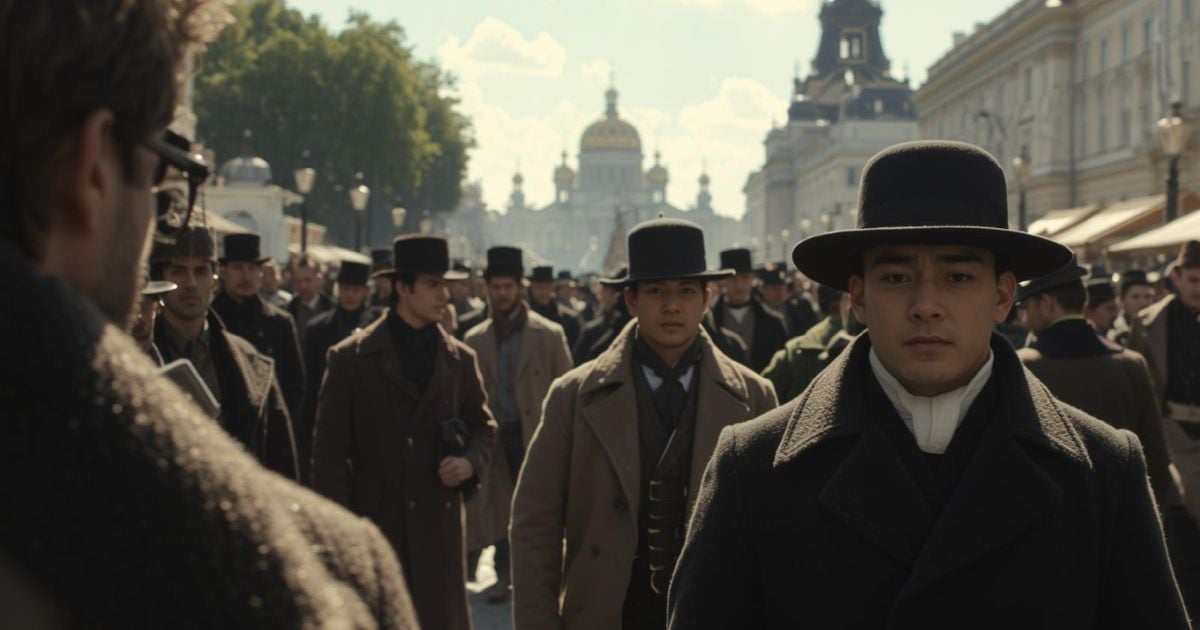
Raskolnikov rushes home expecting a search, but the room is untouched and the loot still bulges from the wall. He pockets eight articles and the purse, then tries to dispose of them in the canal, only to find rafts, washerwomen, and witnesses everywhere. Paranoia makes every passer-by seem to stare. He slips into a deserted courtyard, lifts a heavy stone, and empties his pocket into the hollow beneath. For an instant he feels the same joy he felt at the police office: I have buried my tracks.
Crossing the square he laughs a thin nervous laugh until memory stops him at the boulevard bench where he met the drunk girl. Fury and self-disgust follow. He suddenly asks why he never even glanced into the purse if the crime was deliberate, then decides he is too ill to think straight. Hatred of every face on the street drives him, almost against his will, to Razumihin's garret.
He accepts three roubles and two signatures for a translation job, walks out, then returns the money and papers without a word, telling his friend from the stairs that he is by himself, alone. Razumihin had offered a bookseller named Heruvimov, natural science manuals, two signatures worth more than five lessons. Raskolnikov wants none of it, no one's services, no one's sympathy. On Nikolaevsky Bridge a coachman lashes him for stumbling into traffic. Bystanders call him a pickpocket. An elderly woman presses twenty copecks into his hand in Christ's name. He stares at the Neva, finds the picture of his old student thoughts strangely cold, flings the coin into the water, and wanders for hours before collapsing at home.
At dusk a scream wakes him: he hears Ilya Petrovitch beating the landlady on the stairs. Terror grips him until Nastasya brings soup and says calmly that nobody has been beating anyone. That is the blood crying in your ears, she tells him. When there is no outlet and it gets clotted, you begin fancying things. He asks for something to drink. She brings a white jug of water. He swallows one sip, spills some on his neck, and forgetfulness follows.
Part II Chapter II is about the messy middle of guilt: not the act, not the trial, but the wretched day after. Raskolnikov's room is safe, which only makes his hiding more frantic. The canal fails because the city is too public; the stone succeeds just enough to give him one laugh of relief before shame returns. Dostoevsky is sharp on the purse question. If this were truly about money, Raskolnikov would know what he stole. The chapter strips away the utilitarian mask and leaves compulsion. Razumihin's entrance should be comic relief, but Raskolnikov experiences it as invasion. He takes the translation work and returns it, unable to tolerate ordinary friendship. By the bridge he has sunk so low that charity hurts. The ending is the chapter's masterpiece: a fully heard beating that Nastasya calmly denies. Whether you call it fever, hallucination, or conscience, the effect is the same. Guilt without confession turns inward and becomes sound. Nastasya's folk wisdom, blood crying in the ears, is more accurate than any police theory in the novel so far.
Explore this chapter with AI to uncover deeper meaning and practical takeaways.
AI Discussion