
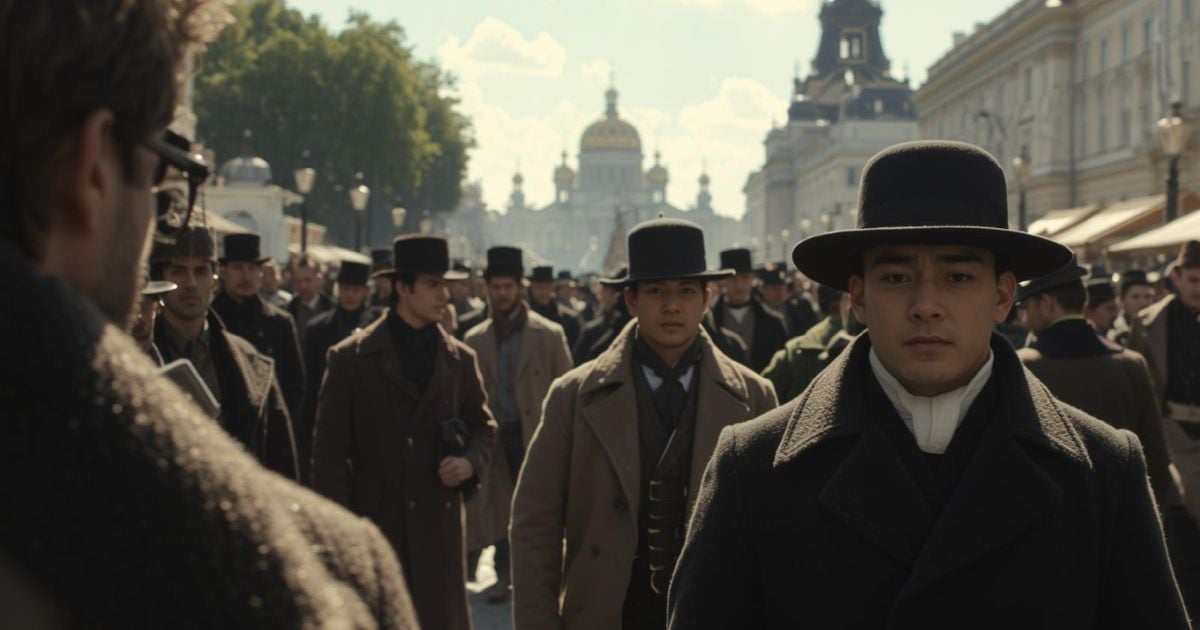
Raskolnikov enters Porfiry Petrovitch's flat still laughing from the staircase, Razumihin red and crashing a tea-glass while Porfiry quotes gaily about a loss to the Crown. The performance buys a moment: Rodya claims business about pawned pledges, a ring and his father's silver watch, feigning poverty and family feeling. Porfiry's eyes never leave him. I have been expecting you here for some time lands like ice. He knows the date on the pledge paper and that Rodya is the only holder who had not come forward. Zametov watches from the corner. Razumihin blurts delirium, the twenty-five roubles to the widow, and last night's wanderings. Rodya snaps, then plays insolent wit while his mind screams cat and mouse.
When Porfiry steps out for tea, Rodya's inner monologue lists every wink, every tone, and every glance as proof they hunt him in concert. Back in the room Razumihin battles socialist pamphlets on environment and crime while Porfiry toys with both sides, even defending environment for a crime against a child to bait him. Then the turn: Porfiry read Rodya's article in the Periodical Review, the piece on crime psychology and ordinary versus extraordinary men. He states the idea flatly: extraordinary men have a right to commit any crime and to transgress the law. Rodya, almost pleased, elaborates Newton, Napoleon, Lycurgus, blood waded through for a new word, masses who hang then worship. Razumihin is horrified at bloodshed in the name of conscience. Porfiry agrees it is more terrible than legal execution.
The duel sharpens. Pain and suffering are always inevitable for a large intelligence, Rodya says dreamily. Porfiry asks if he fancied himself an extraordinary man, then whether need could drive him to rob and murder, winking. If I did I certainly should not tell you. Perhaps it was one of these future Napoleons who did for Alyona Ivanovna last week, Zametov blurts; gloomy silence. Rodya denies he is Napoleon and turns to go. On the way out Porfiry feigns confusion about painters at the flat between seven and eight. Rodya answers slowly: no painters, but porters with a sofa on the fourth storey opposite Alyona's. Razumihin suddenly sees the trap on the murder day. Porfiry apologizes and sees them out with excessive politeness.
They leave gloomy and sullen. Rodya thinks he beat the painter question on the stairs; Razumihin suddenly saw that the workmen could not have been there on the murder day. Porfiry has apologised and seen them out with excessive politeness. There is still no arrest, only the article, the theory, and a timeline question saved for the door. Razumihin has already blurted last night's wanderings and the twenty-five roubles; the mother's arrival has given Porfiry a clock on Rodya's life.
Part III Chapter V is the novel's great interrogation without handcuffs. Rodya arrives performing laughter; Porfiry performs hospitality. The pawned watch is pretext. I have been expecting you shifts power instantly. Tea leaves Rodya alone with cat-and-mouse thoughts while Razumihin supplies delirium, money, and run-over man. The article debate is the core: extraordinary men, Newton, Lycurgus, Lazarus, bloodshed sanctified by conscience. Rodya talks himself deeper because pride loves an audience. Porfiry's playful could you rob and murder and Zametov's Alyona line probe the wound. The painter question is craftier: feigned confusion, Razumihin's late shout, Rodya's fourth-storey sofa answer. No arrest yet because conscience is the hoped informant. The chapter teaches that ideas published for pride can be evidence gathered for trial.
Explore this chapter with AI to uncover deeper meaning and practical takeaways.
AI Discussion