
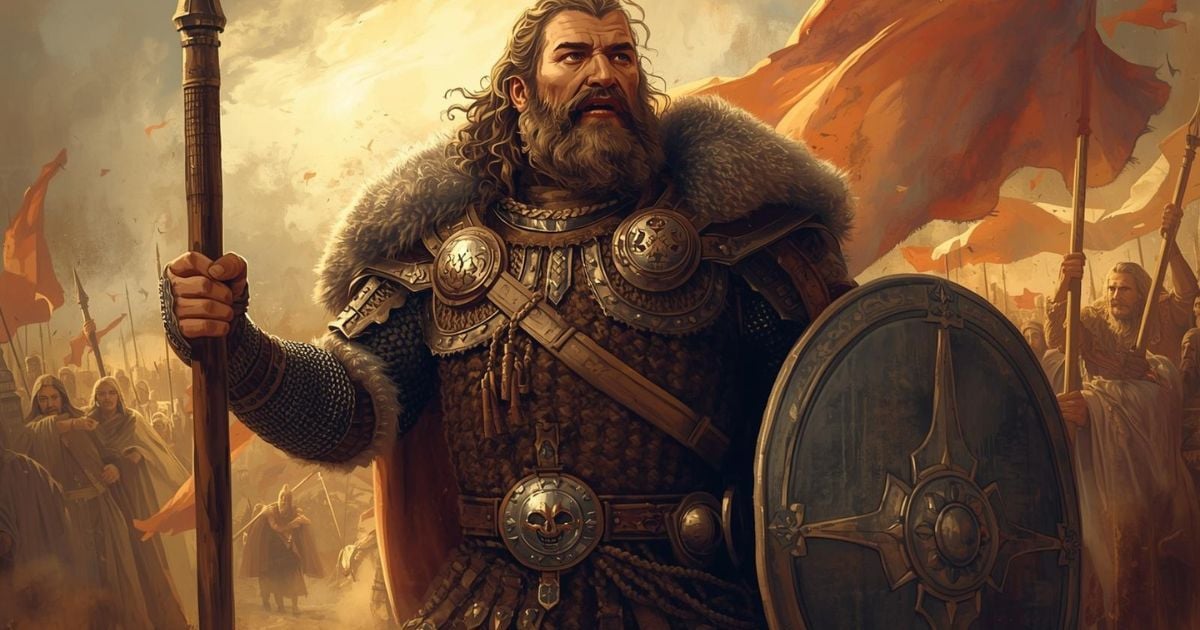
Chapter I carries the title "The Life and Death of Scyld" and opens not with the hero of the poem but with his ancestor, Scyld Scefing, the founding king of the Spear-Danes, and an account of his reign and burial that functions as a prologue to everything that follows.
The poem begins with "Lo!", a call to listen, a signal that what follows is meant to be heard aloud. The narrator announces that he has heard the glory of the Spear-Danes, their folk-kings, their feats in battle. This is a poem that knows it is a poem, and that it is performing memory.
Scyld himself arrived as a foundling: "friendless and wretched," without name or kin. From that beginning he rises to compel neighboring peoples across the sea to bow to his authority and bring tribute. The mechanism of his rise is not explained; it is simply declared, in the manner of legend.
His son is born and named Beowulf (not the poem's hero, but Scyld's son and Hrothgar's grandfather). The narrator pauses to offer a lesson on the obligations of a young prince: he must be generous to his father's friends, lavish with gifts, so that when age comes and war assaults him, those companions will serve him. Loyalty in the heroic world is not inherited; it is purchased with treasure and maintained by action.
Scyld dies at "the hour that was fated," fate here working exactly as it will throughout the poem, as an appointed time that cannot be avoided, only met well or badly. His people carry him to the sea. They lay him in a ring-prowed vessel at anchor, "icy in glimmer and eager for sailing." Around him they place swords, byrnies (coats of mail), jewels, fretted ornaments brought from distant lands, and a gold standard raised high above his head. The description of the funeral hoard is exact and lavish: this is a king honoured with everything a warrior world considers valuable.
The ship is released on the current. No one alive, the narrator says, can tell where it carried him. The chapter ends in acknowledged mystery, the same note of the unknowable on which it will close.
Scyld's funeral reveals something profound about leadership that modern workplaces often miss. His people didn't honour him because they had to, they honoured him because they wanted to. The treasure-laden ship wasn't mandated by law or tradition; it was their genuine expression of gratitude for a leader who had invested in them. This distinction between earned loyalty and demanded obedience shows up everywhere today. Think about the managers who get real results versus those who just push people around. The effective ones understand what Scyld knew: authority flows upward from those who choose to follow, not downward from those who demand compliance. They invest in their people's success, share credit generously, and build relationships that survive setbacks. In contrast, leaders who rely on titles, threats, or formal power find their authority evaporates the moment they face real challenges. Their people do the minimum required and leave at the first opportunity. This ancient story reveals why some leaders inspire fierce loyalty while others struggle with constant turnover. True authority isn't about having power over people, it's about having people choose to give you power because you've proven worthy of it. The question isn't whether you have the title, but whether your people would honour you even when they don't have to.
Explore this chapter with AI to uncover deeper meaning and practical takeaways.
AI Discussion