
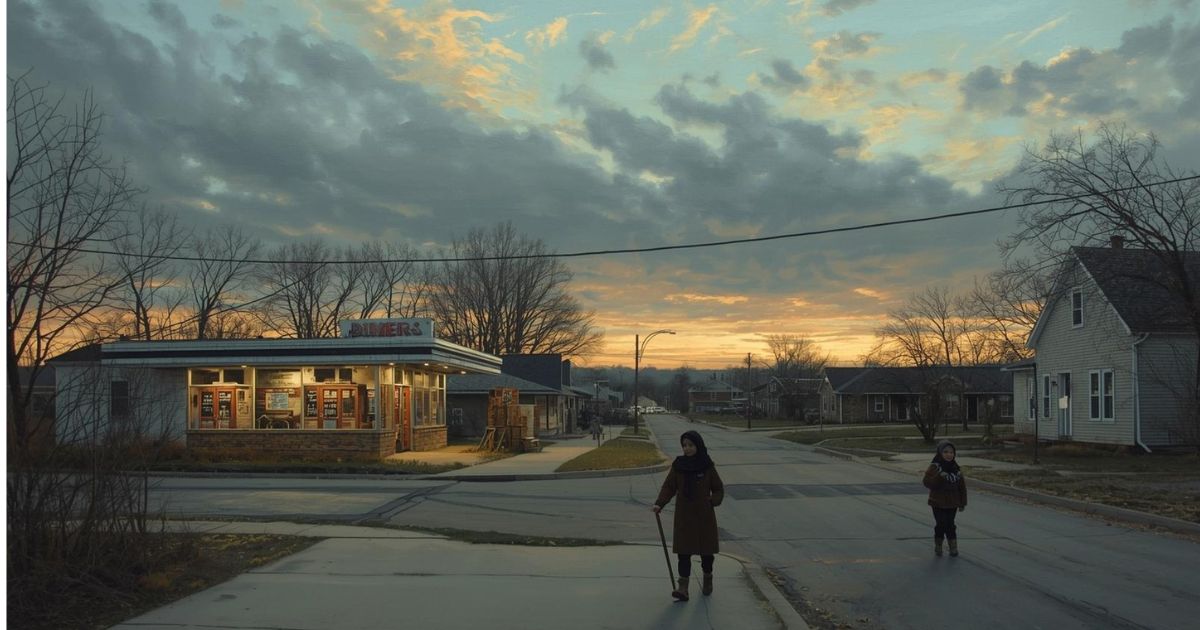
Years ago Alice replaced the family's brass dinner-bell with three little Chinese bowls on a string. They chime sweetly however hard they are struck, which leaves an angry cook no way to sound angry. Today the cook taps them, gives up, packs her bag and shouts goodbye from the front hall. Mrs. Adams takes it calmly. She believes, much as Alice believes in her unknown suitor, that somewhere in the world there is a perfect maid who will come and stay forever.
Alice washes the dishes so her mother can reline the organdie. Over the sink she dreams of the evening: an archway, a ballroom turning to look, a tall dark stranger. In every picture she carries flowers, first orchids, then roses, then camellias, and in none of them can she find anyone who might send them. She breaks a saucer and sweeps the pieces under the stove. Then she sees a violet in the sooty yard. She finds twenty-two, the number of her years, and not enough. So she takes a trolley to the new park at the edge of town and stoops for hours by an old grove, lifting each plant with its roots and wrapping the stems in a wet napkin. She comes home in the rain at five with an aching back and three hundred violets.
There is still the matter of an escort. Walter, told at dinner that he is taking Alice to Mildred Palmer's dance, refuses. He has a date downtown, and 'YOUR friends!' is all he will say about the Palmers. His mother catches him at the front door. Alice can't go alone, she pleads; the young men don't run after her because the family is poor and she has no 'background'. Walter says she tries hard enough. Then his mother mentions the hours of violet-picking, and he flings his hat at the wall. He will take her, but there is no money for a taxi and none left to ask his father for. For seventy-five cents he can get her something to ride in. It isn't a cab, he warns, and his mother needn't tell Alice what it is until she is inside.
Alice's violet-gathering marathon reveals something brutal about class mobility: the harder you try to perform your way into belonging, the more obvious it becomes that you don't belong. In 1921, Alice spent hours stooping in a park gathering flowers to appear naturally elegant. Today, working-class people max out credit cards buying the 'right' clothes for networking events, practice 'professional' speech patterns, and research conversation topics to seem naturally sophisticated. Both versions exhaust themselves maintaining an illusion. The cruel irony is that authentic belonging often comes from the very qualities performance tries to hide. The nurse who stops pretending to love wine tastings and starts hosting game nights discovers her real tribe. The mechanic who quits forcing business jargon and speaks plainly about problems finds colleagues who actually listen. The temp worker who admits she's learning instead of pretending expertise gets mentors who want to help. Performance requires constant energy to maintain and always feels precarious. Real belonging grows from genuine interests, skills, and character traits that naturally attract compatible people. The navigation question becomes: Are you building yourself up or building yourself a costume? One creates lasting change, the other creates lasting exhaustion.
Explore this chapter with AI to uncover deeper meaning and practical takeaways.
AI Discussion