
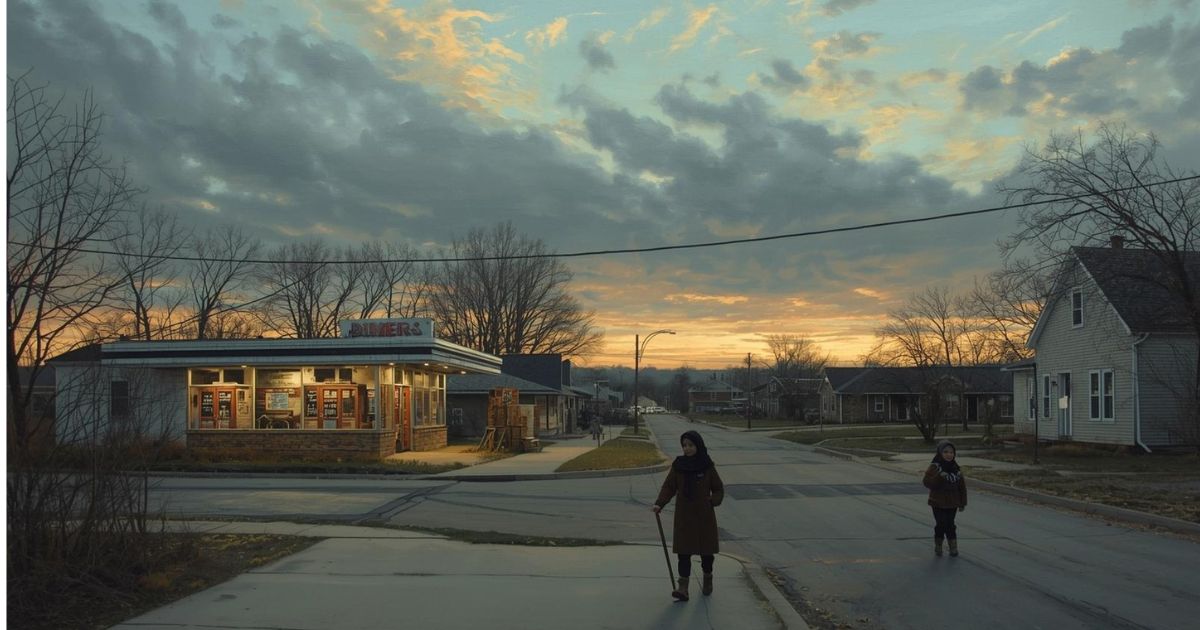
Before she goes out, Alice settles a small question of identity. She has two boxes of visiting cards, one plain 'Miss Adams', the other engraved in Gothic letters 'Miss Alys Tuttle Adams'. She lets the Alys cards fall like snow into the waste-basket. Downstairs, the house tells a less flattering story. It was built fifteen years ago in the new Colonial fashion and is already sagging: the painted pine columns are chipped, the plaster is giving way under the paper, and the soot of the soft-coal city has worked into every curtain. Alice once won a battle to hang a huge photograph of the Colosseum over the mantelpiece, banishing her father's engraving of Niagara, a gift from his colleagues at Lamb and Company, to the upstairs hall. It never occurred to her that the Colosseum might be the more dismaying of the two.
She sets out in a tight skirt, a touch of rouge and with an ivory-topped Malacca walking-stick she has seen in magazines. Mrs. Dowling, round as a frost-bitten peach, glares at the cane, then smiles like a Santa Claus mask and lets out a hard breath as Alice passes. A married man of forty straightens his tie and lifts his hat, and Alice answers with a smile copied from an actress, her hand drifting toward her heart. He means nothing to her. In her unspoken thought he is a messenger who will tell some unknown bachelor how mysterious she is. She is 'waiting. Just waiting.'
Then the walk turns. Small children at a muddy alley say, 'Lady got cane!', and women stop to stare. A closed black car glides by with three ladies in mourning who clutch each other, laughing. They are the Lamb women, of the family her father has served since before she was born, and she is sure they know his salary. Suddenly her whole life seems spoiled. A young stranger slows down to look at her, and she meets his eyes gravely. At Mildred Palmer's gate she stops to scrape a bit of mortar off the gatepost with the tip of her cane, as anyone who lived there might, and walks up the drive with a lighter step.
Alice's walking stick disaster reveals something universal about human social dynamics: the harder we perform to fit somewhere we don't belong, the more obvious our outsider status becomes. This wasn't just about 1921 fashion accessories - it's about the exhausting mathematics of social climbing that still governs workplaces, schools, and neighborhoods today. The cruel irony is that authentic confidence often comes from accepting your actual position, while performed confidence screams insecurity to everyone watching. Think about the coworker who constantly mentions their expensive purchases, or the parent who brags about their child's achievements to other parents. The performance creates the opposite of its intended effect because it highlights the very gap the person is trying to bridge. What makes this particularly painful is that the performer usually knows it's not working, but feels trapped in the act. Alice scraping mortar off her shoes before entering the wealthy neighborhood captures this perfectly - she's literally trying to clean off evidence of her real world before entering the space she wants to belong to. The question becomes: when does aspiration become self-defeating performance? And how do we distinguish between healthy growth and desperate signaling? The pattern suggests that genuine belonging comes through shared values and authentic connection, not through costume changes and vocabulary upgrades.
Explore this chapter with AI to uncover deeper meaning and practical takeaways.
AI Discussion