
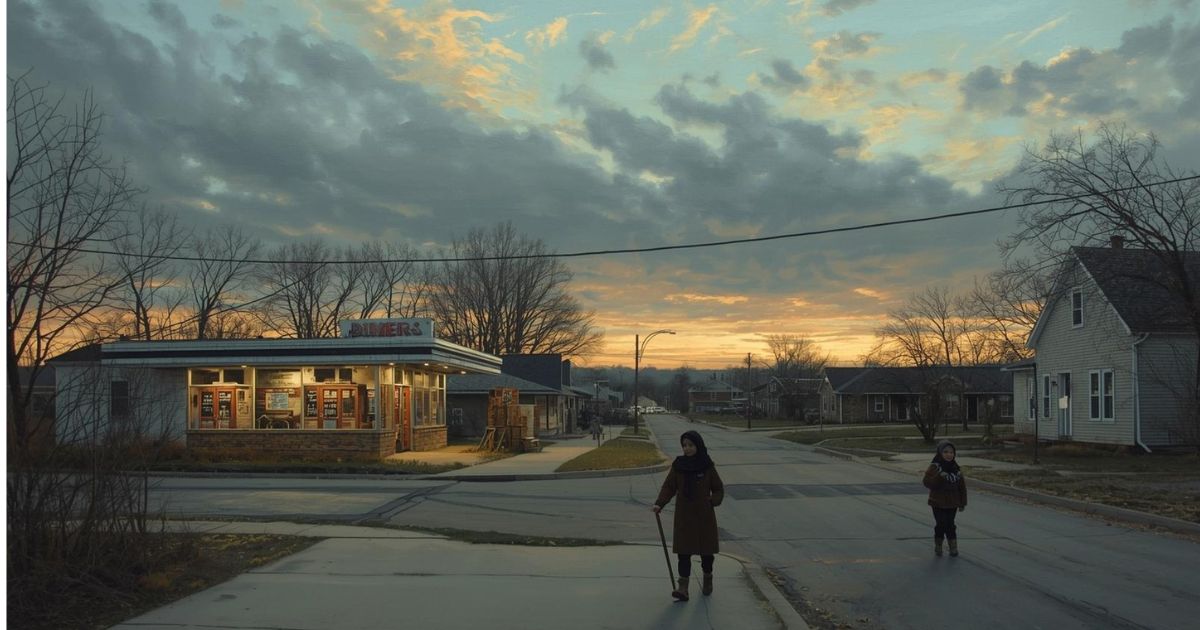
Two days later the sun shines, and Alice walks beside Russell at her prettiest and wittiest. Everything she says can mean as much or as little as he likes, and he has begun to find that the only interesting moments of his day are the ones in which she flirts with him. He raises the Lamb dance again: her father is better, so surely she can come. She finds a new way out. She and Henrietta do not get on, she says; Henrietta went to a dance less than a year after her own father's death. The narrator notes the trouble. Alice has already let him think she is the pampered daughter of an indulgent father, and now she must keep to the part. Truth is usually simple. Lies, to work, would need to be simple too, and Alice's never are.
She begs him not to let other girls talk to him about her. This town talks fearfully, she says, and invents things. A girl who is talked about is not there to show who she really is, and that is how they kill her. He laughs and promises. Meanwhile she has led him down a dingy street of boarding-houses toward a little park where nobody they know will see them together.
The truth behind her next story is that Adams has given in. Her mother has told her, nervous rather than triumphant, that he will leave Lamb and Company to start the glue factory, and that J. A. Lamb will be angry, because leaving Lamb's has always been treated as treachery. Alice turns this into a family quarrel. Her father becomes a near-partner who built up the firm and is tired of other men taking the profit. Then she laughs. What he is leaving it all for is glue, and her dowry is going to be sticky.
On a bench in the park she catches herself just before claiming she would prefer a country place to their foolish little house, and she blushes. Every sentence now seems to be needed to hold up another. Russell has no idea why she is blushing and simply finds it lovely. She asks once more, softly, that he never give Henrietta the chance to get even with her. He promises, warmly.
Alice's predicament reveals something mathematical about deception: lies don't exist in isolation. Each false claim creates what we might call 'vulnerability points', places where the truth might leak through. To defend these points, we need supporting lies, which create their own vulnerability points, which require more supporting lies. The cognitive load grows exponentially. In 1921, Alice Adams had to worry about being seen at the wrong social events or having her father's real job discovered. Today's Alice faces the same mathematical problem with different variables: LinkedIn profiles that don't match reality, social media posts suggesting a lifestyle she can't afford, professional networking events where her temp status might be exposed. The exhaustion is identical across centuries because the human brain wasn't designed to maintain multiple false narratives simultaneously. We see this pattern everywhere in working-class life: the parent who lies about their financial situation to maintain their children's social standing, the worker who inflates their experience to get hired, the family that keeps up appearances while drowning in debt. Each situation follows the same mathematical progression: one lie, three supporting lies, nine supporting those, twenty-seven supporting those. The question isn't moral, it's practical. At what point does the energy required to maintain the facade exceed the energy it would take to deal with the truth? Tarkington understood that this calculation is universal, crossing all class lines and historical periods.
Explore this chapter with AI to uncover deeper meaning and practical takeaways.
AI Discussion