
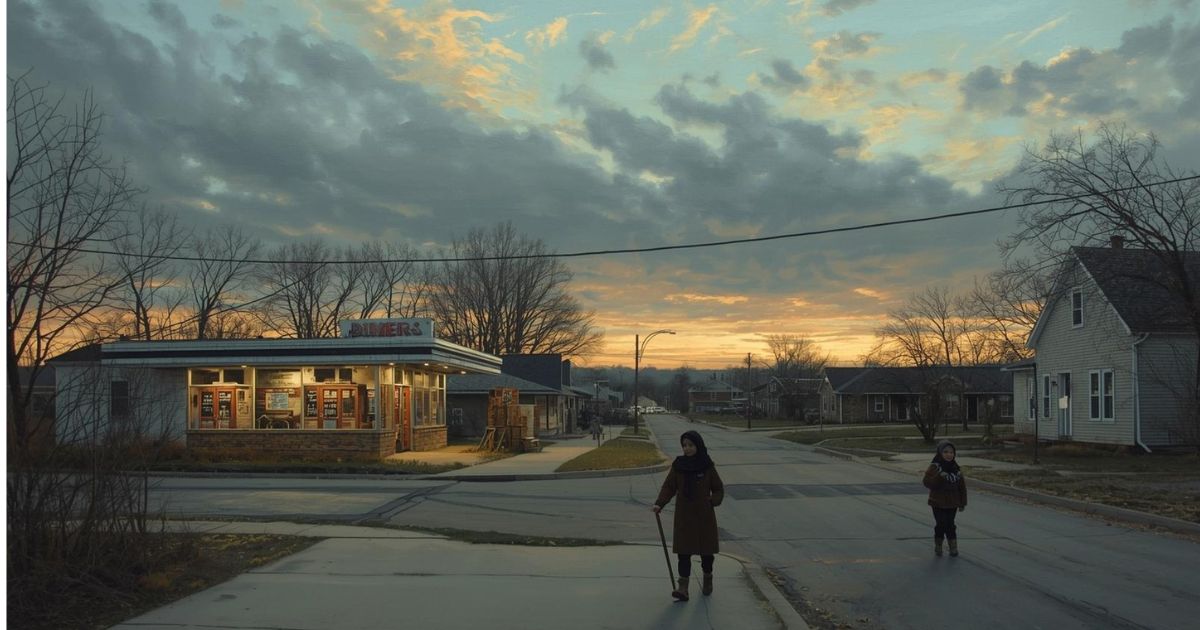
Virgil Adams is fifty-five, sick, and sure the night air will kill him. He argues with his nurse, Miss Perry, about the open windows, quoting his mother's old warning, and Miss Perry answers him as if he were a fretful boy before she goes to sleep on her cot. He believes he lies awake the whole night, though in fact he dozes and dreams. Outside, the smoky midland city never quite sleeps: owl cars howl on the curves, factories stir, and the milkman's horse clinks along the brick street. As a young man Adams might have been proud of that noise as proof he lived in a live town. Now it only presses on his nerves.
The detail that stays is the night-light. Propped behind a newspaper, it keeps up a thin glimmer against the coming sun, and it reminds him of something unpleasant he cannot name. The narrator names it for us: the feeble light straining against the dawn is a painful little sketch of his own life. He never quite works it out, and perhaps he is lucky not to.
His wife comes in before his daughter does. She is bright and brisk, moves his medicine glass an inch, turns a book over, and tells him he will soon be strong enough to 'fly around and find something really good to get into.' Her voice trembles on the last word, and he hears the real subject at once. She wants him to leave Lamb and Company, the place she calls an 'old hole', for the children's sake. He will not be told what he knows. She lets him see her tears and goes out. Alone, he laughs without any humour and says, 'And give us our daily bread!' The quarrel is plainly an old one, and nobody has won it yet.
Virgil Adams would rather stay sick than admit a working-class nurse knows more about health than his mother's old wisdom. This isn't just stubbornness, it's a survival mechanism gone wrong. In 1921, for a man like Adams, admitting error could mean losing face in a world where reputation was everything. But what served him in one context now traps him in another. Today, we face the same trap with different stakes. The mechanic who won't update their skills because 'cars used to be simpler.' The parent who won't adjust their approach because 'this is how I was raised.' The worker who stays in a toxic job because leaving would mean admitting they wasted years there. Social media amplifies this tendency, we perform certainty for audiences who judge us for changing our minds. But here's what Adams teaches us: the cost of being wrong about something is usually temporary embarrassment. The cost of staying wrong is often permanent damage. The strongest people aren't those who never make mistakes, but those who can say 'I was wrong about that' and pivot toward what actually works. When you can recognize the difference between protecting your interests and protecting your ego, you've learned something that transcends class, era, and circumstance.
Explore this chapter with AI to uncover deeper meaning and practical takeaways.
AI Discussion