
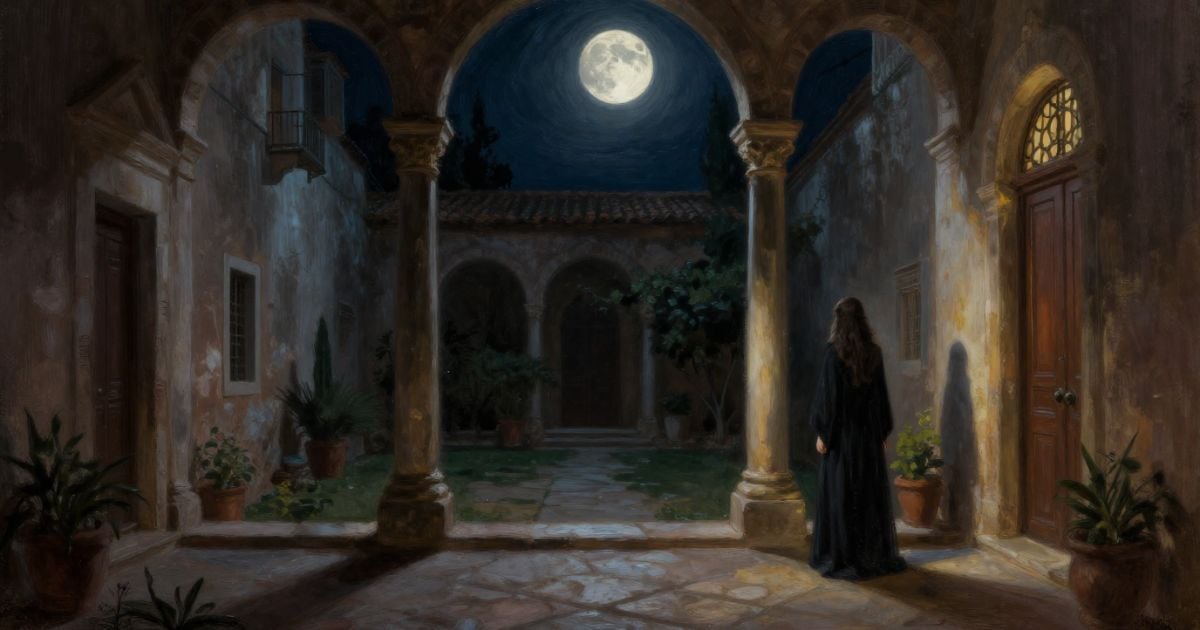
Julia goes on. A quarter of a league from the walls she put on the servant's dress Madame now sees. Caterina tied the old gown to stones and threw it into the stream by the almond grove. They walked most of the way to a cottage near Ferrini, where Caterina's parents took them in. The mother's look said she did not believe the disguise, so Julia stopped pretending a rank she could not keep. The plan was the Benedictine abbey of St Augustin, where a church might hold what a father would not.
On the road, horsemen come out from a grove. Julia drops from the saddle. They bind the women and turn into a dark dell toward a ruined house. Julia is sure the duke has her. Madame sees none of the marquis's people in the troop and reaches the same conclusion. The man who receives them is Marquis Murani. His riders took Julia for his own daughter, who had run from a marriage she refused. When he sees the face, he tells them they have misled him. He lets both women go.
Guides take them to a town, then leave to keep searching. At noon they reach Azulia. Madame writes to the Padre Abate, a relation, and the answer is kind. That evening the abbey receives Julia. She prays, and she sleeps. At Mazzini the duke and the marquis are still dividing the blame, and Emilia is still in the marchioness's house. The abbey door has closed behind Julia. It has not closed the search.
Radcliffe understood something profound about how life actually works: our worst fears often become the very mechanisms that save us. Julia's terror at being captured leads directly to her freedom, because the 'wrong' captors turn out to be exactly the right people to escort her to safety. This isn't just literary convenience—it's a pattern that runs through real life constantly. Think about it: the job interview that goes horribly wrong sometimes leads to a better position when word gets around about how professionally you handled the disaster. The relationship that ends painfully often clears the path for someone who actually fits your life. The medical emergency that terrifies you frequently catches a problem before it becomes life-threatening. Even getting lost in an unfamiliar neighborhood can introduce you to resources you never knew existed. The key insight here isn't that everything happens for a reason—that's too simple. It's that our assumptions about what constitutes disaster versus salvation are often completely wrong. We fear the unknown so intensely that we miss the information it's trying to give us. Julia assumes the armed men work for her enemies, but they're actually working for someone with the same problem she has. The collision of their separate crises becomes the solution to both. Modern life offers countless examples: the 'wrong' college acceptance, the missed flight, the broken-down car that forces you to walk through a neighborhood where you meet your future business partner. When we can recognize that apparent chaos often contains hidden order, we stop wasting energy fighting every unexpected development and start looking for the opportunities that confusion creates.
Explore this chapter with AI to uncover deeper meaning and practical takeaways.
AI Discussion